CBSE Class 12 Mathematics 2024 Previous Year Paper
CBSEMathematics2024 Previous Year Paper
Paper code: 65/3/2 · 2024Practise the full 2024 CBSE Class 12 Mathematics main examination, set 65/3/2, in its original three-hour format. Then use the question-linked worked solutions to review why a method applies, not just what answer it produces.
This set is one of the year's papers. See every set from 2024, grouped by series.
Know the format before you start
This English-language paper carries 80 marks and contains 38 questions across five sections. Section A contains 18 multiple-choice questions and two assertion–reason questions, all worth one mark each. Section B has five very short answer questions worth two marks each; Section C has six short answer questions worth three marks each. Section D has four long answer questions worth five marks each, and Section E has three case studies worth four marks each.
There is no overall choice: all question numbers are compulsory. Internal choices are available in two questions in Section B, three in Section C, two in Section D and two in Section E. Attempt only one alternative at each printed OR in a timed sitting. Keep the calculator away, as the paper instructions require.

Mathematics 2024 | Class 12 | Previous Year Paper | Code 65/3/2
In the StudentCurio app
Complete CBSE Class 12 Mathematics examination paper for 2024 with questions and worked solutions across topics including calculus, matrices, vectors, probability and three-dimensional geometry. Helps students practise the full paper and review solution methods.
Follow the reasoning across calculus questions
The calculus questions cover continuity, differentiability, implicit differentiation, increasing and decreasing functions, extrema, integration and differential equations. They ask for different kinds of evidence. At an interior join in a piecewise function, for instance, continuity requires both one-sided limits to agree with the function value. Differentiability also requires the one-sided derivatives to exist and agree. Checking only that the pieces meet does not establish that their slopes match.
For an absolute-extrema question on a closed interval, include the endpoints in your comparison rather than looking only for stationary points. In the area question, the distinction is between a signed definite integral and geometric area. If the boundary crosses the horizontal axis within the interval, split the calculation there so that a region below the axis does not cancel one above it.
Connect algebraic properties to what they establish
The matrix questions span determinants, inverses, transposes and the adjugate. When reviewing an inverse calculation, check the condition for the shortcut, not just the arithmetic: a diagonal matrix is inverted by taking the reciprocal of each diagonal entry only when every diagonal entry is nonzero. The identity matrix gives you a way to check the result by multiplication.
The functions and relations questions require a different kind of justification. To establish that a function is onto, check whether its actual range equals the stated codomain. To prove that a relation is an equivalence relation, establish reflexivity, symmetry and transitivity on the stated set before identifying an equivalence class. Checking a few pairs can help you see a pattern, but it cannot replace a proof on that set.
Common mistakes in geometry and linear programming
The vector and three-dimensional geometry questions move between quantities such as vector magnitudes and angles, and tasks such as finding a line or a distance. In the long answer question about a line through an intersection, separate the two requirements: the intersection supplies a point, while perpendicularity constrains the direction. Finding a suitable direction does not establish that the required line passes through the right point. Also, a zero dot product establishes perpendicularity only when both vectors are nonzero.
In linear programming, avoid confusing the constraints with the objective function. The constraints, including any nonnegativity conditions, determine the feasible region. The objective is what you minimise or maximise over that region. When reviewing the graphical question, check that the shaded region satisfies all the inequalities together, not just the one corresponding to a single boundary.
Read probability and case studies as models
The probability questions include both conditional probability and a discrete distribution. In the CEO question, distinguish the probability of increased profits given a particular appointment from the probability of that appointment given that profits increased. These reverse the roles of the events. In any conditional probability calculation, the event after the conditioning bar must have positive probability.
Section E uses three different models: an exponential-growth differential equation, a matrix system for scholarships and a probability distribution for hours spent on self-study. In the scholarship study, label the unknown counts before translating the total number and total expenditure into equations, and distinguish writing the system from checking its consistency. For the self-study distribution, list the possible values of the variable, check that the probabilities sum to one and read strict inequalities as excluding the endpoints.
Use the worked solutions to locate your first error
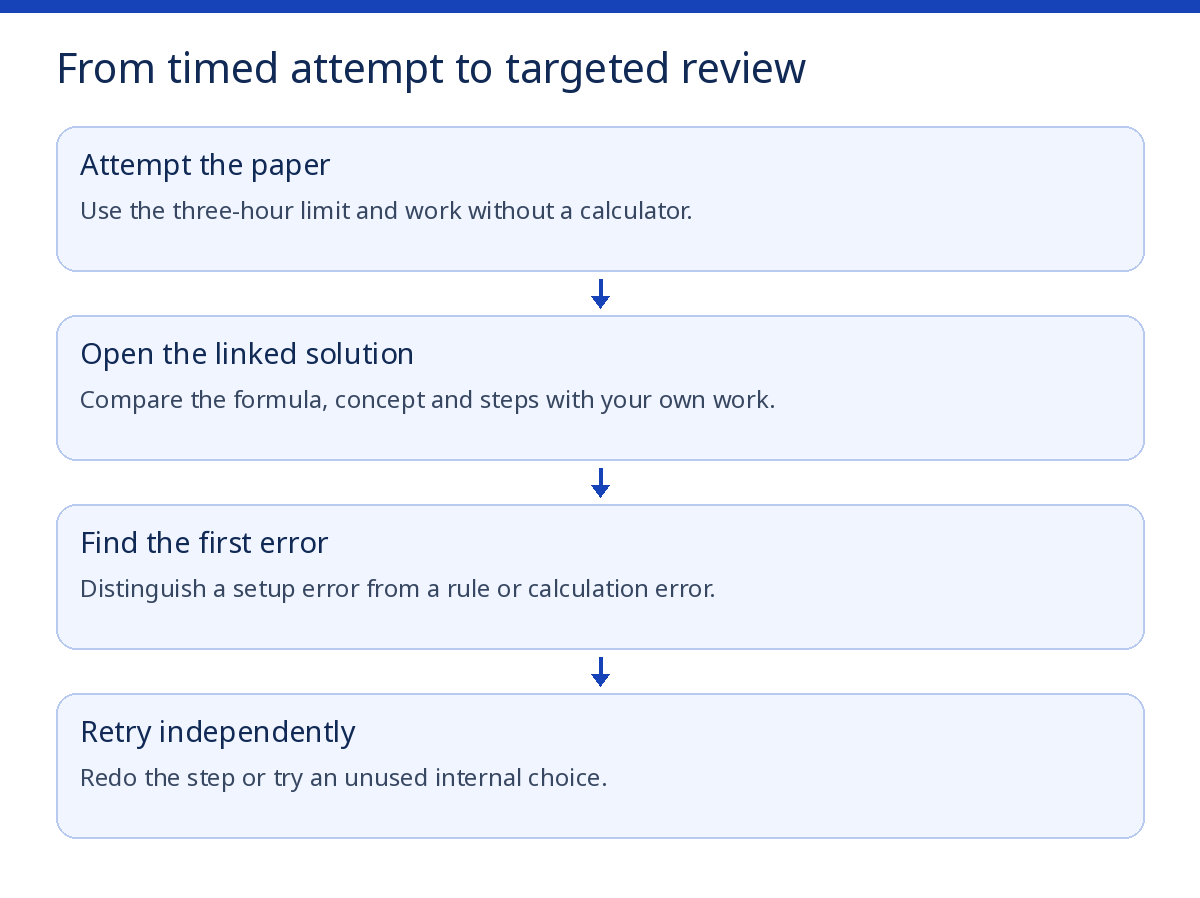
Attempt the question paper before opening the worked solutions. During review, use the question-number links to compare your work with the solution’s Formula used, Concept used and Explanation in steps. If your result differs, look for the first point where your reasoning diverged. A wrong model, an unjustified operation and an arithmetic slip call for different fixes. For assertion–reason questions, check the truth of each statement separately before deciding whether the reason explains the assertion.
Save the unattempted OR alternatives for a second pass. Try them without the explanation open to see whether you can recognise the method independently. This guide omits the final value and option from Q1, the answer equation and option from Q12, and the disputed option from Q11.
Quick self-check before you close the file
Pick one calculus response and one case-study response you have reviewed. Can you state the domain or interval on which your calculus argument applies, and point to the step where it matters? Can you explain what each unknown or random variable in your case-study response represents before doing any calculation? If either explanation is missing, return to the question and rewrite that part in your own words. Then retry the step without looking at the worked solution.
Spotted an error? Report a correction. Practise this in the app: notes, formula sheets and mind maps.





























































































































































Loading comments…