CBSE Class 12 Mathematics 2024 Paper: Set 65/4/3
CBSEMathematics2024 Previous Year Paper
Paper code: 65/4/3 · 2024Use this complete English-language CBSE Class 12 Mathematics paper from the 2024 main examination for a three-hour mock. Then use the linked worked solutions to review why a method applies, not just whether your final answer matches.
This set is one of the year's papers. See every set from 2024, grouped by series.
What to expect in the 2024 paper
Set 65/4/3 is a full previous year paper worth 80 marks, with 38 questions arranged in five sections. Section A has 18 multiple-choice questions and two assertion–reason questions, all worth one mark each. Sections B, C and D contain very short, short and long answers worth two, three and five marks per question, respectively. Section E has three case studies worth four marks each, on selection probabilities, sales revenue and three-dimensional vectors.
There is no overall choice. Attempt every required question, but choose only one branch where the paper prints an OR. For a mock, work from the question pages for three hours without a calculator. Save the unused OR branches for review: they give you extra practice without changing what counts as one attempt at the paper.

Mathematics 2024 | Class 12 | Previous Year Paper | Code 65/4/3
In the StudentCurio app
The complete 2024 CBSE Class 12 Mathematics paper (set 65/4/3) with worked solutions, including questions across the paper and final questions on revenue maximisation and three-dimensional vectors. It helps students practise the board-exam format and review solution methods.
Use the worked solutions to diagnose errors
The file preserves the question layout, options and diagrams and links question numbers to worked solutions, including both printed OR choices. The solution pages separate the formula, the concept and the steps. Read them in that order only after attempting the question: first check whether you chose the right method, then find the earliest step where your reasoning diverged. If you chose the wrong option despite sound reasoning, check the sign, arithmetic or interpretation rather than restarting the whole topic.
For assertion–reason questions, test each statement separately before asking whether the reason explains the assertion. This guide omits the opening vector-angle worked result because the question gives an absolute dot product, while the solution uses a definite sign.
Before differentiating or integrating: check the domain
The calculus questions cover continuity, differentiability, related rates, monotonicity, integration and differential equations. An absolute-value expression can be continuous at a join without being differentiable there. To test differentiability, compare the left- and right-hand derivatives rather than relying on the appearance of an unbroken graph. For inverse trigonometric expressions, check the principal-value range before simplifying: two angles can have the same trigonometric value without both being valid outputs of the inverse function.
If you differentiate one expression with respect to another by taking the ratio of their derivatives, the denominator derivative must be nonzero at the point. For a linear differential equation, identify the independent variable and an interval on which the coefficients are continuous before choosing an integrating factor. The paper’s parameter-based monotonicity item is best reviewed without its answer options: an everywhere positive derivative is sufficient for strict increase, but a strictly increasing function need not have a positive derivative at every point.
Matrices and functions: show what makes the method valid
Matrix questions range from recognising a scalar matrix to using an inverse to solve simultaneous equations. In the longer problem, make the link between the coefficient matrix and the original equations visible: write the variables and constants as column vectors in the same order as the equations. The inverse method requires an invertible coefficient matrix. When you use it, multiply the equation on the left by the inverse rather than treating the matrix as a number you can divide by.
For the function proof, keep one-one and onto separate. The first compares inputs that produce equal outputs; the second asks whether every element of the stated codomain has a preimage in the stated domain.
Two kinds of optimisation in the same paper
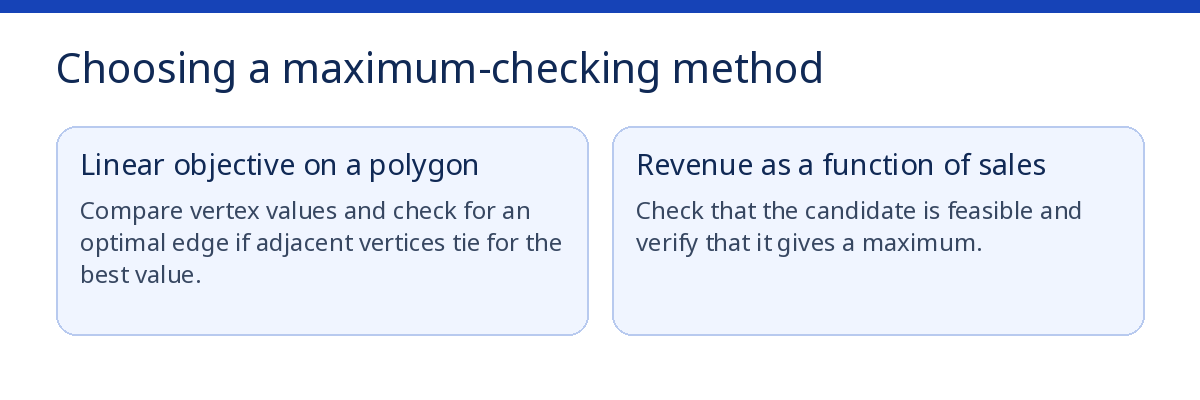
The linear programming questions ask you to read a feasible region and compare values of a linear objective. For a nonempty bounded polygonal feasible region, at least one vertex attains the optimum. That does not mean only vertices can be optimal. If two adjacent vertices attain the same optimal value, every point on the edge joining them has that value too. In review, distinguish finding the optimum value from identifying all the points that attain it.
The calculator-sales case study instead models revenue as quantity sold times the price per unit. A stationary point is a candidate for a maximum, not proof of one. Check that it belongs to the relevant domain and justify the maximum using the shape of the revenue function or the behaviour of its derivative. Keep the sales quantity, selling price and rebate distinct when reading the subparts.
Quick self-check: what event are you counting?
The probability questions include a distribution table, a conditional card problem and a case study with independent selection events. In a discrete distribution table, the probabilities must be nonnegative and sum to one. In a conditional problem, identify which event is already known before writing the probability: reversing the event of interest and the condition generally changes the question.
For the selection case study, ask whether your event means at least one or exactly one. The former includes every outcome except no selections; the latter includes only outcomes with a single selection. Use independence when multiplying probabilities for a joint outcome, and add the probabilities of mutually exclusive outcomes that meet the requested count.
Draw the direction before doing the vector algebra
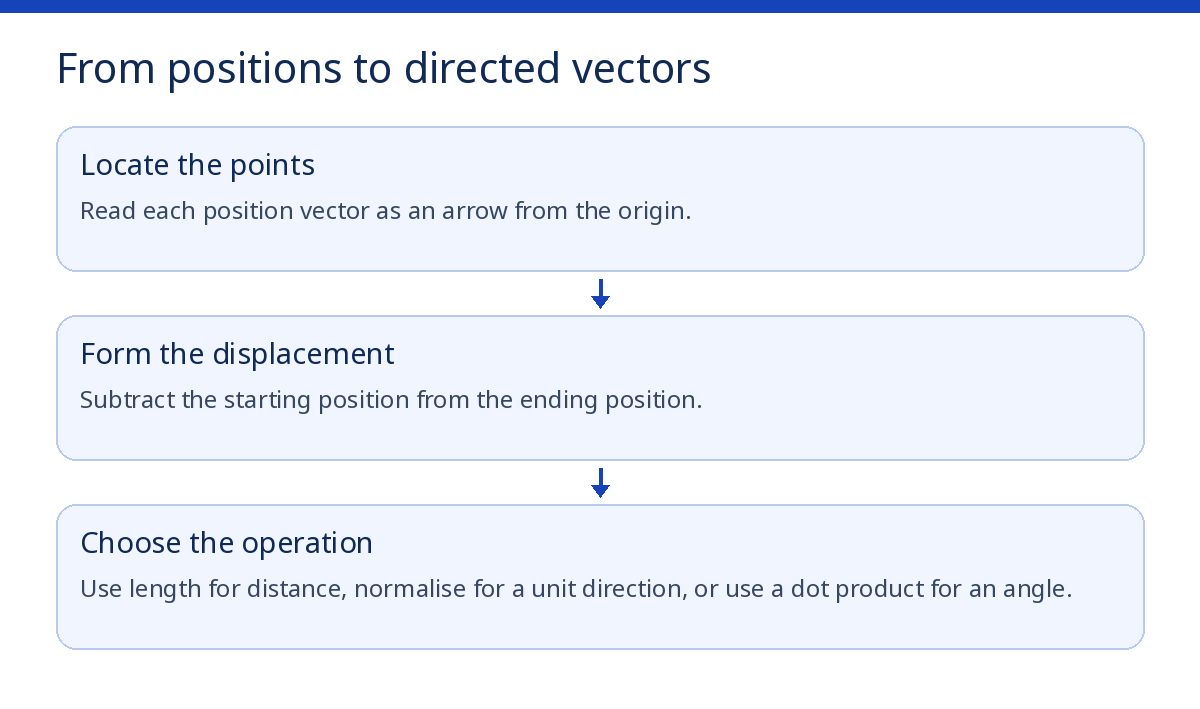
The paper moves from vector products and properties of lines to a final case study in which star locations are given as position vectors. A position vector runs from the origin to a point; a displacement between two points does not generally start at the origin. To form a displacement, subtract the starting position from the ending position. Its length gives a distance, and dividing a nonzero displacement by its length gives a unit vector in the same direction.
For an angle named by three letters, sketch the two directions from the middle point. Reversing one vector changes the sign of the dot product, so check the arrows before evaluating an angle or a projection. When reviewing equations of lines, a zero direction component means the corresponding coordinate stays constant; it is not a denominator.
Spotted an error? Report a correction. Practise this in the app: notes, formula sheets and mind maps.





























































































































































Loading comments…