CBSE Class 12 Mathematics 2024 Paper With Worked Solutions
CBSEMathematics2024 Previous Year Paper
Paper code: 65/4/1 · 2024Practise the full English-language CBSE Class 12 Mathematics 2024 main examination paper, set 65/4/1. Use the worked solutions to check why a method applies, not just whether your final answer matches.
This set is one of the year's papers. See every set from 2024, grouped by series.
What this 2024 paper contains
This file is organised by examination year rather than by chapter. It pairs the original question layout, options and diagrams with worked solutions for the questions, subparts and printed OR alternatives. The opening index links to individual questions, and the solution pages distinguish the formula, the concept and the explanation in steps. That structure lets you look up the reasoning behind one step without having to reread an entire topic.
The paper mixes matrices, relations and functions, calculus, vector algebra, three-dimensional geometry, linear programming and probability. Its value as a full paper is that the chapter is not announced before each problem. Part of the practice is recognising whether a prompt calls for a definition, a calculation, a graph or an argument.

Mathematics 2024 | Class 12 | Previous Year Paper | Code 65/4/1
In the StudentCurio app
Complete CBSE Class 12 Mathematics 2024 examination paper, set 65/4/1, with worked solutions. It covers questions across the syllabus, including vector geometry and probability.
Read the marks and choices before you start
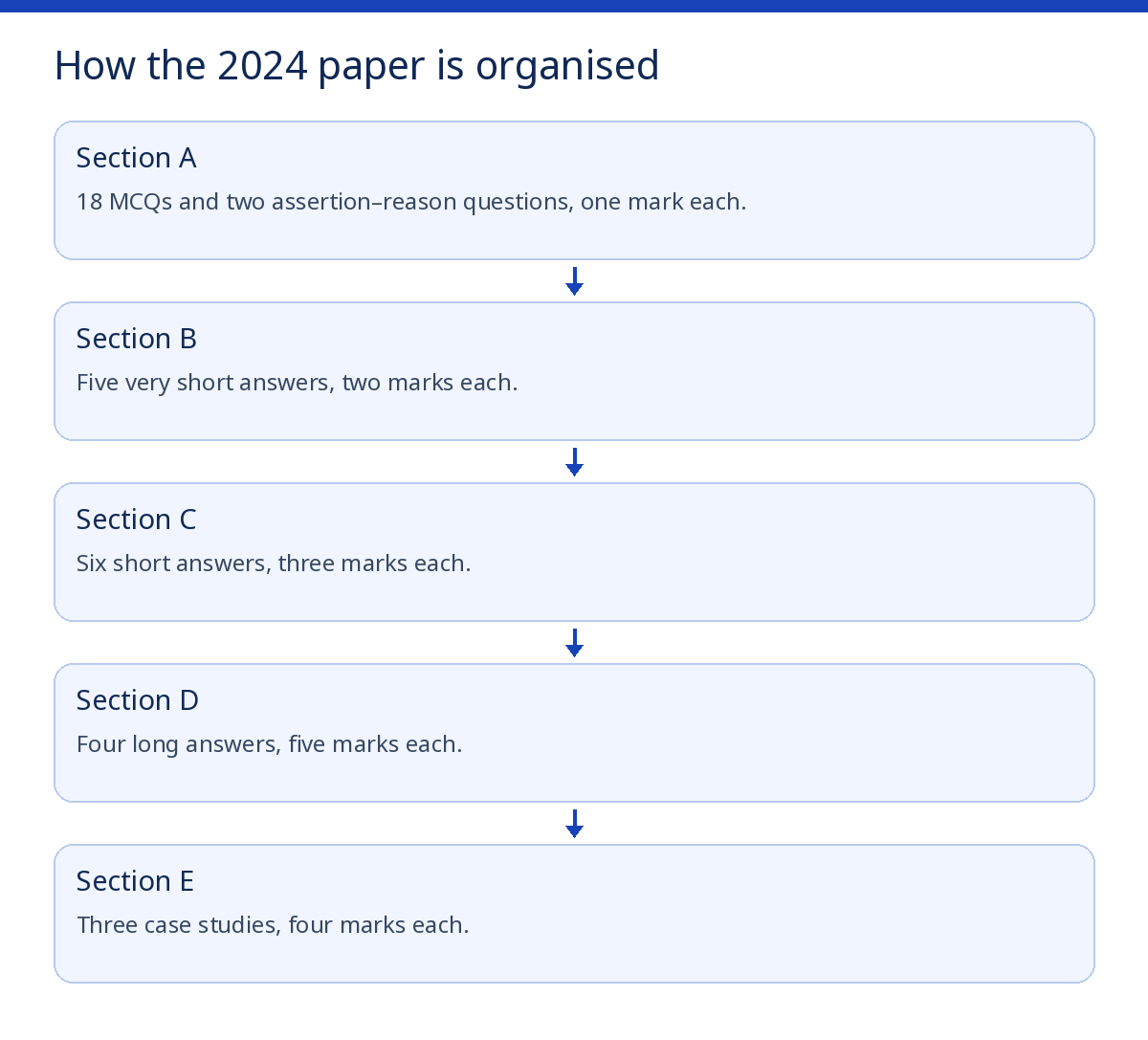
The paper has 38 questions, carries 80 marks and allows three hours. Calculators are not permitted. Section A starts with 18 multiple-choice questions and ends with two assertion–reason questions, all worth one mark each. Sections B, C and D contain very short, short and long answers worth two, three and five marks per question, respectively. Section E contains three case studies worth four marks each.
There is no overall choice. Where the paper prints an OR, choose one of the alternatives for that question or subpart in a timed attempt. The unchosen alternative is useful afterwards: try it separately to see whether your first choice reflected stronger understanding or simply a more familiar-looking prompt. In assertion–reason items, judge each statement first, then ask whether the reason actually explains the assertion.
Good to remember: Domains affect the method
The inverse trigonometry questions give you two different tasks: simplifying an expression under a stated restriction and finding principal values. An inverse trigonometric function returns a value in its prescribed principal range. An angle that gives the right sine, cosine or tangent is not necessarily the value the inverse function returns. Keep the restriction on the original variable in view when using a trigonometric identity.
The relations and functions questions make the role of sets explicit in another way. Reflexivity requires every element of the underlying set to be related to itself; checking a few examples cannot establish it. To prove a function is onto, you must show that every element of the stated codomain has a preimage in the stated domain. Any excluded inputs still matter when you rearrange the function rule.
Use the calculus questions to practise choosing a method
The calculus questions move between continuity, differentiation, integration, rates of change and differential equations. At a point where a function is defined separately, continuity requires the limit to exist and agree with the assigned function value. In a related-rates problem, quantities such as volume and surface area change through a shared variable. Differentiate with respect to time before substituting the dimensions at the specified instant, and check that the units describe the rate asked for.
For integration, distinguish a signed definite integral from geometric area. When a curve crosses the axis inside the interval, split the integral where the sign changes rather than allowing positive and negative contributions to cancel. In differential equations, distinguish the general family from a particular solution, which must also satisfy the given condition.
Common mix-up: Position, displacement and direction
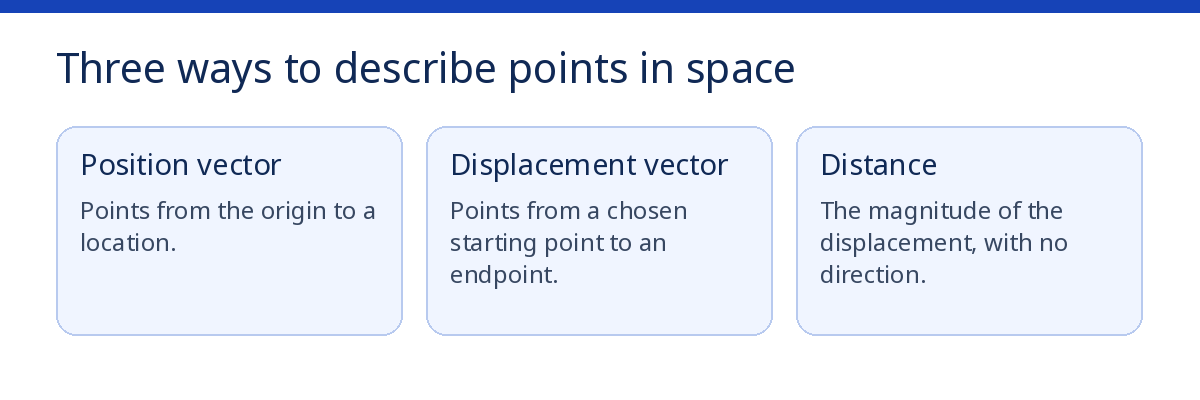
The astronomy case study gives positions relative to a common origin but asks about relationships between the points. A position vector locates a point from the origin. A displacement vector starts at one point and ends at another, so the order of subtraction matters. Reversing that order leaves the distance unchanged but reverses the direction. To form a unit vector, divide a nonzero displacement by its magnitude.
The three-dimensional line questions test a related distinction: a point fixes where a line passes, while a nonzero direction vector fixes its orientation. Before using a dot product to test perpendicular directions, identify the direction components correctly. If a coordinate numerator has a coefficient other than one, normalise that numerator and its denominator together before reading off the corresponding component.
Compare the different kinds of modelling
The paper gives you two distinct settings for optimisation. The revenue case starts from a demand rule and asks you to form and maximise a function of one variable. The graphical linear programming question instead starts with several inequalities. Draw or identify their common feasible region before comparing objective values: a point outside that region is not a candidate, even if its objective value is larger.
Probability likewise changes form across the paper. In a distribution table, check that the probabilities are nonnegative and sum to one. In a conditional probability question, identify which event is already known to have occurred; the conditioning event must have positive probability. In the interview case study, independence is given explicitly. Do not assume independence in another question just because several events are mentioned.
Review the reasoning after a timed attempt
After writing the paper, go back first to questions where you hesitated between methods. Compare your setup with the solution’s concept note before reading its calculations. For a matrix problem, for example, check whether the expression asks for a matrix or a scalar determinant. For a case study, check whether you translated the words into the right mathematical quantity before looking for an arithmetic slip. Then retry the question without the solution open.
This guide omits the answer discussion for the strict-increase MCQ because the listed sufficient condition does not express the full condition discussed in the solution. It also omits the biased-die alternative because the stated even-versus-odd likelihood does not determine the probability of a six without an additional assumption.
Spotted an error? Report a correction. Practise this in the app: notes, formula sheets and mind maps.





























































































































































Loading comments…