CBSE Class 12 Mathematics 2024 Paper with Worked Solutions
CBSEMathematics2024 Previous Year Paper
Paper code: 65/1/2 · 2024Practise with the complete 2024 CBSE Class 12 Mathematics main examination paper, set 65/1/2. Use the worked solutions to check not only your results but also whether your method fits the conditions in each question.
This set is one of the year's papers. See every set from 2024, grouped by series.
Read the paper format before you start
This is the English version of the 2024 main examination paper. It carries 80 marks, allows three hours, and does not permit calculators. The resource is organised by year, not by chapter, and preserves the original question layout, options and diagrams.
The paper has 38 questions across five sections. Section A contains 18 multiple-choice questions and two assertion–reason questions, all worth one mark each. Sections B, C and D contain very short, short and long answers worth two, three and five marks per question, respectively. Section E has three four-mark case studies. There is no overall choice: the printed OR alternatives apply only where offered. For a timed attempt, answer just one branch of each OR choice; save the other branch for review.

Mathematics 2024 | Class 12 | Previous Year Paper | Code 65/1/2
In the StudentCurio app
A worked-solution edition of the complete 2024 CBSE Class 12 Mathematics paper, covering questions across the syllabus. It helps students practise board-exam questions and review solution methods.
Use the worked solutions to locate the first wrong step
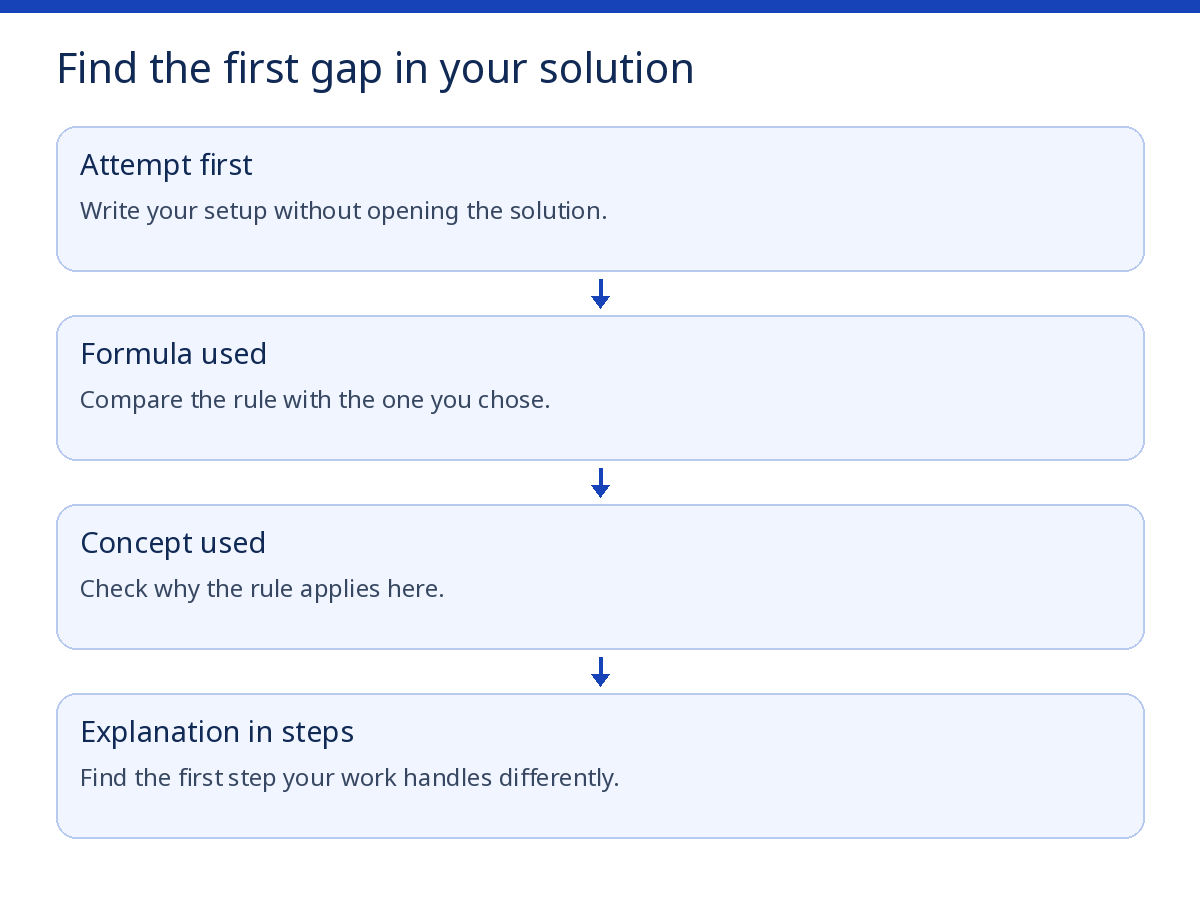
The file links question numbers to worked solutions and includes both branches of the printed OR choices. Attempt a question before opening its solution. Then use the three labelled parts—Formula used, Concept used and Explanation in steps—to find where your reasoning first diverged. A result can differ because you chose an unsuitable rule, missed a condition on that rule, or made an algebraic error after a sound setup. Those are different problems to fix.
For an assertion–reason question, decide whether each statement is true before asking whether the reason explains the assertion. Two true statements do not automatically form an explanation. This guide omits the final answer values and option letters for Questions 1, 6 and 18.
Common mistakes: matrix order and vector direction
The paper covers matrix entries and orders, determinants and cofactors, and the use of an inverse to solve simultaneous equations. In your written work, keep track of which factor is on the left: even when both products exist, matrix multiplication need not commute. In an inverse-matrix method, check that the coefficient matrix is invertible before using its inverse. Knowing how to carry out a multiplication is separate from knowing when the operation is justified.
Vector and three-dimensional geometry questions use coordinates, directed segments, direction cosines and equations of lines. When using a figure, label the initial and terminal points before subtracting coordinates. Reversing them reverses the vector, even though its magnitude is unchanged. In a parallelogram question, distinguish a side from a diagonal before choosing vectors for an area calculation.
When a calculus rule applies
The calculus questions ask you to differentiate composite and implicitly defined expressions, examine differentiability, find extrema, and use integrals for evaluation and area. For a composite function, account for the derivative of the inner expression before substituting a particular input. For absolute extrema of a continuous function on a closed interval, compare the endpoints with interior candidates, including points where the derivative is zero or does not exist. A search limited to stationary points can miss a candidate.
The differential-equation questions also test how you read an equation before operating on it. The order is set by the highest derivative present; the degree, when defined, is its power in the polynomial form in the derivatives. If you divide by an expression to put an equation in standard form, restrict that step to intervals where the divisor is nonzero.
Distinguish the feasible region from the objective
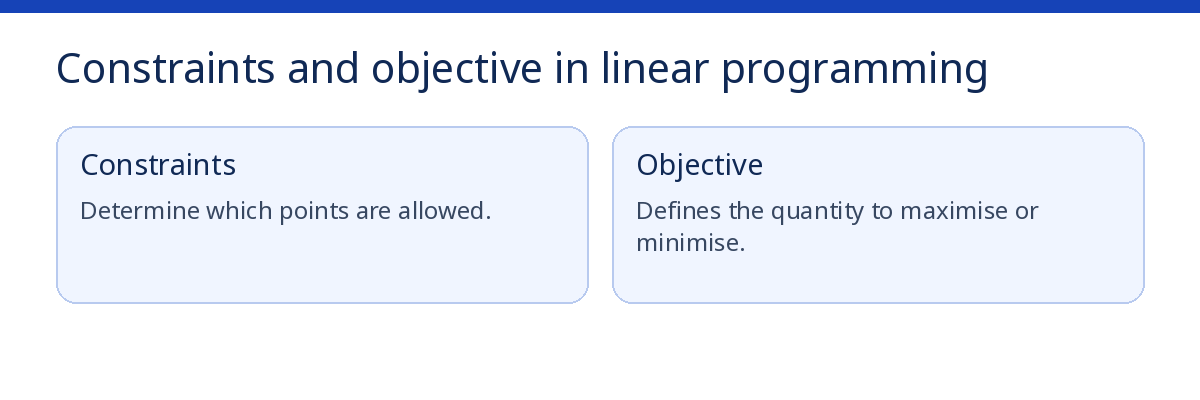
Linear programming appears both as a short conceptual test and as a graphical task. The constraints determine which points are feasible; the objective tells you what to maximise or minimise over those points. Sketching the boundary lines is therefore only part of the setup. Check which side of each line satisfies the corresponding inequality, and include any non-negativity restrictions before identifying the common region.
When reviewing your graph, verify that each proposed corner satisfies all the constraints, not just the two boundary equations that produced it. Also distinguish an unbounded region from a region with no vertices: unboundedness alone does not tell you whether corner points exist. These checks help separate errors in the graph from errors in evaluating the objective.
Quick self-check: what does each case study ask for?
The case studies move between probability, inverse trigonometric functions and related rates. In the flight-delay case, distinguish the overall probability of a delay from a probability conditioned on a delay. The first combines the possible turbulence categories and their conditional delay probabilities; the second takes the delay as given. For a conditional probability to be defined, its conditioning event must have positive probability.
In the sine case, ask why the input interval must be chosen so that sine is one-to-one and covers the stated output interval. In the camera case, ask whether the requested derivative is with respect to distance or time. The angle depends on distance, and distance changes with time, so a time rate needs the chain rule to connect those two changes.
Use the second attempt to test your reasoning
After checking the first attempt, return to an unused OR branch where one is available. This gives you another question from the same paper without asking you to repeat steps you have just read. Record the condition or distinction you missed, rather than simply the question number: for example, an endpoint omitted from an extrema check or an inequality shaded on the wrong side.
For longer questions, reread only your setup first. Check whether it identifies the interval, event, line or quantity the question actually asks about. If the setup is sound, audit the algebra separately. That way, the worked edition helps you decide what to practise next without replacing the experience of sitting the paper yourself.
Spotted an error? Report a correction. Practise this in the app: notes, formula sheets and mind maps.





























































































































































Loading comments…