CBSE Class 12 Mathematics 2024 Solved Paper: Set 65/3/3
CBSEMathematics2024 Previous Year Paper
Paper code: 65/3/3 · 2024Practise the full English version of the 2024 CBSE Class 12 Mathematics main examination, then use the worked solutions to review your reasoning. Set 65/3/3 lets you compare how you handle quick concept checks, longer written arguments and case studies within the same three-hour paper.
This set is one of the year's papers. See every set from 2024, grouped by series.
Know the format before starting the clock
This year-wise file contains one complete board paper, worth 80 marks, with 38 questions across five sections. Section A has 18 multiple-choice questions and two assertion–reason questions, all worth one mark each. Section B has five two-mark very short answers, Section C has six three-mark short answers, and Section D has four five-mark long answers. Section E contains three four-mark case studies. Calculators are not allowed.
No overall choice means you cannot drop an entire question in favour of another elsewhere in the paper. Internal choices are provided in two questions in Section B, three in Section C, two in Section D and two in Section E. In a timed attempt, answer only the required alternative where an OR is printed; save the other route for review.

Mathematics 2024 | Class 12 | Previous Year Paper | Code 65/3/3
In the StudentCurio app
Complete solved CBSE Class 12 Mathematics paper for 2024, set 65/3/3, with worked solutions across the exam. It helps students practise a full board paper and review solution methods.
Read the conditions before choosing a method
The paper tests functions in more than one setting. A short item specifies integer inputs and outputs, while a longer question uses real sets with an excluded value. For one-one, ask whether two distinct allowed inputs can give the same output. For onto, ask whether every member of the stated codomain is reached. The formula alone does not settle either question without the sets on which it is being used.
A similar distinction matters in the piecewise function questions. Continuity at a joining point requires the left and right limits to agree with the function value there. Differentiability requires the one-sided difference quotients to approach the same finite value. When reviewing, check whether your working establishes exactly the property asked for rather than stopping after a continuity check.
Common mistakes in calculus: losing the interval or the units
The calculus questions ask for different kinds of conclusions, including rates, intervals of increase or decrease, and extrema. A rate with respect to radius is not a rate with respect to time: when an area is measured in square centimetres and the radius in centimetres, the derivative has units of square centimetres per centimetre. In a monotonicity question involving a real logarithm, restrict the analysis to positive inputs before interpreting the sign of the derivative.
Distinguish a local extremum from an absolute extremum on a closed interval. For a continuous function on such an interval, compare the values at the endpoints and at any interior candidates. A stationary point alone does not establish an absolute maximum or minimum. The paper also asks for an enclosed area; there, identify the region and its boundaries before setting up the integral.
Connect vector calculations to diagrams and constraints
The vector and three-dimensional geometry questions move from angles and position vectors to equations of lines and distances. In a line problem, keep the point the line passes through separate from its direction. A perpendicularity condition constrains the direction, not the point. A zero dot product establishes perpendicularity when the two vectors being compared are nonzero, so identify which vectors represent the directions before using that test.
In linear programming, the paper asks you both to read a shaded region and to solve a graphical optimisation problem. The inequalities determine which points are feasible; the objective determines how those feasible points are compared. On review, check the boundary and the permitted side of each inequality separately. Correct arithmetic with an objective function does not repair a wrongly shaded region.
A useful connection across the three case studies
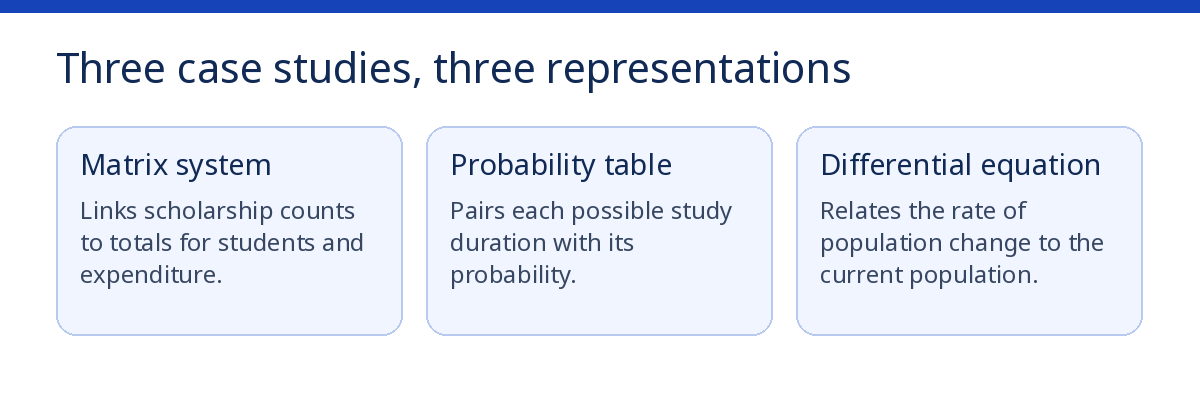
Each case study asks you to interpret a situation through a mathematical representation. In the scholarship case, a matrix system represents two kinds of totals. Give the unknowns clear meanings so that the student count and the expenditure do not end up in the wrong equations. Keep consistency, which concerns whether a solution exists, distinct from calculating the numbers in that solution.
In the self-study case, a probability table organises the possible values and their probabilities. The probabilities over all possible outcomes must sum to one, whereas an event uses only the outcomes that meet its conditions. The exponential growth case uses a differential equation instead of a table: its rate depends on the current population. When reviewing, distinguish the general relationship from the particular model constrained by the observations supplied in the question.
Use the worked solutions to find your first wrong step
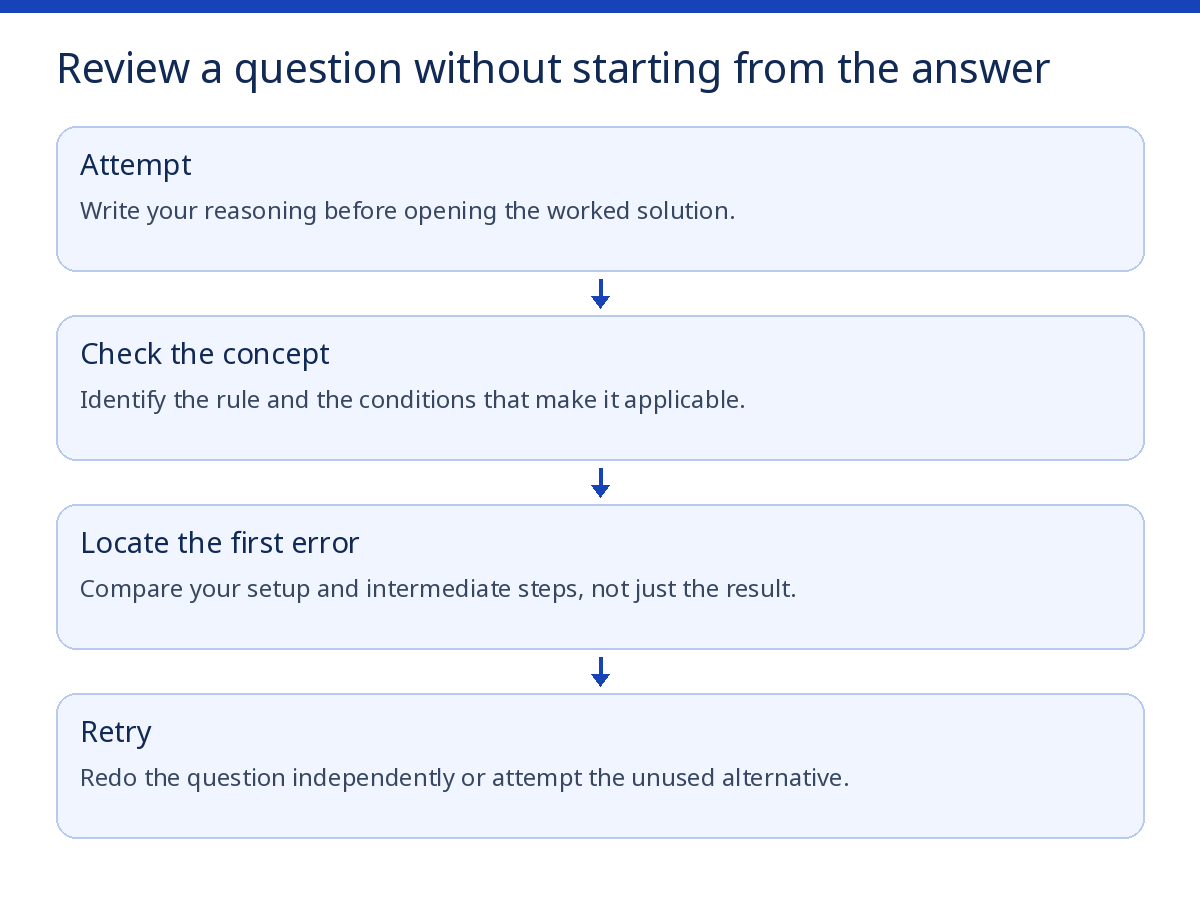
Start from the question pages rather than the linked solutions, and keep your first attempt intact. The file provides question-number navigation, and the solution pages distinguish Formula used, Concept used and Explanation in steps. Use those labels to diagnose the earliest difference between your approach and the worked method. For instance, if your feasible region differed from the one in the solution, compare the inequalities before checking any objective values.
For a missed multiple-choice item, write a brief reason for your revised choice before moving on. For an assertion–reason item, check each statement independently, then decide whether the reason explains the assertion if both are true. For a written response, revise the step where your reasoning first broke down. After marking the timed attempt, try an unused OR alternative to see whether you can choose and justify a method without relying on the first solution you read.
Spotted an error? Report a correction. Practise this in the app: notes, formula sheets and mind maps.





























































































































































Loading comments…