CBSE Class 12 Mathematics 2023 Paper: Set 65/5/1
CBSEMathematics2023 Previous Year Paper
Paper code: 65/5/1 · 2023Practise with the full English paper from the 2023 CBSE Class 12 Mathematics main examination. The worked solutions help you check not just your final answers, but also why a method applies.
This set is one of the year's papers. See every set from 2023, grouped by series.
What the 2023 paper includes
This year-wise resource contains the full 2023 CBSE Class 12 Mathematics paper for set 65/5/1. The paper allows 3 hours and carries 80 marks. The file preserves the original English question layout, options and diagrams. Its question-number index lets you go directly to a worked solution, including solutions for subparts and both alternatives wherever an OR choice is printed.
This is a board examination paper, not a chapter-wise worksheet. It brings together calculus, matrices, vectors, three-dimensional geometry, probability and linear programming. That mix lets you practise deciding which idea a question calls for without a chapter heading giving it away. Use the set code when matching a question to its solution, since the year alone does not identify the set.

Mathematics 2023 | Class 12 | Previous Year Paper | Code 65/5/1
In the StudentCurio app
The complete solved 2023 CBSE Class 12 Mathematics paper, set 65/5/1, covers questions across the syllabus, including calculus, matrices, vectors, three-dimensional geometry, probability and linear programming. It helps students practise the board exam and review step-by-step solution methods.
Attempt the paper before opening the solutions
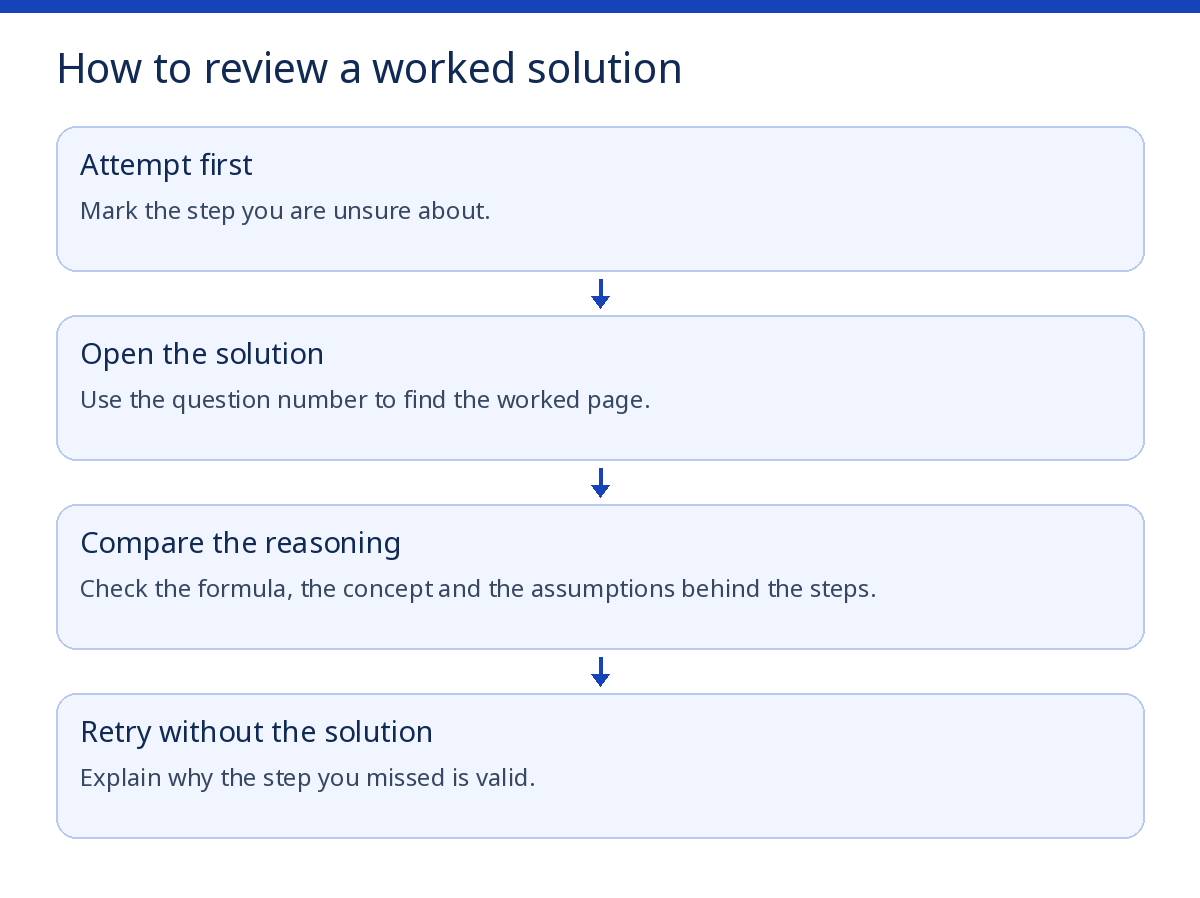
For a full rehearsal, use the printed three-hour limit and follow the question paper's directions on choices. Keep the worked pages closed during the attempt. If you are unsure about a step, mark the exact place where you got stuck rather than looking up the result immediately. A note such as “not sure which event to condition on” is more useful in review than simply marking the whole question as difficult.
Afterwards, open the relevant solution and read its Formula used, Concept used and Explanation in steps entries in that order. Find the first point where your reasoning differed. If you chose a different valid method, compare whether both routes use the same assumptions. Save the unattempted OR alternative for a separate retry, before reading its worked steps.
When a calculus rule applies
The calculus material gives you several ways to practise checking conditions before you calculate. In the logarithmic differentiation example, the method uses a real logarithm of the variable base, so the step requires . In the greatest-integer function example, the important distinction is between a point strictly between successive integers, where the function is locally constant, and an integer, where the function jumps. A rule for the constant part cannot be carried across the jump.
Integration calls for a different kind of check. Before removing an absolute value, determine whether the expression inside it keeps the same sign throughout the integration interval. If it changes sign, one replacement does not work across the whole interval. The worked answer for the differential-equation item with a missing right-hand side is omitted from this guide because the printed expression does not state a complete equation.
Matrix checks that go beyond arithmetic
The matrix solutions illustrate two distinct tasks: verifying that matrices are equal and recognising an inverse. For equality, matching one or two entries can give necessary conditions without settling the question. In particular, a diagonal condition on an unknown may leave several candidates. Check each candidate against the remaining entries, including the off-diagonal ones, before deciding whether the matrix equation holds.
When reviewing an inverse problem, look for an identity matrix produced by multiplication. A polynomial relation in a square matrix can sometimes be rearranged to exhibit that product directly, so an entry-by-entry calculation is not always needed. Determinant expansion is a separate technique: when a term contributes zero, note why it vanishes and continue to track the cofactor signs on the terms that remain.
Common mistakes with vectors and line directions
In the vector questions, distinguish magnitude from direction. The Euclidean norm uses squares of the components, so a negative component does not make a negative contribution to the sum. A direction cosine, by contrast, is the cosine of the angle with a coordinate axis and can be negative when that angle is obtuse. Preserving that sign is part of describing the direction correctly.
For collinearity, component ratios are usable only where their denominators are nonzero. Expressing one nonzero vector as a scalar multiple of the other avoids dividing by a zero component. For angles between lines, work with nonzero vectors in their directions, not with the coordinates of points on the lines. A zero dot product then establishes perpendicular directions without requiring you to calculate an angle by taking an inverse cosine.
Separate the probability model from the calculation
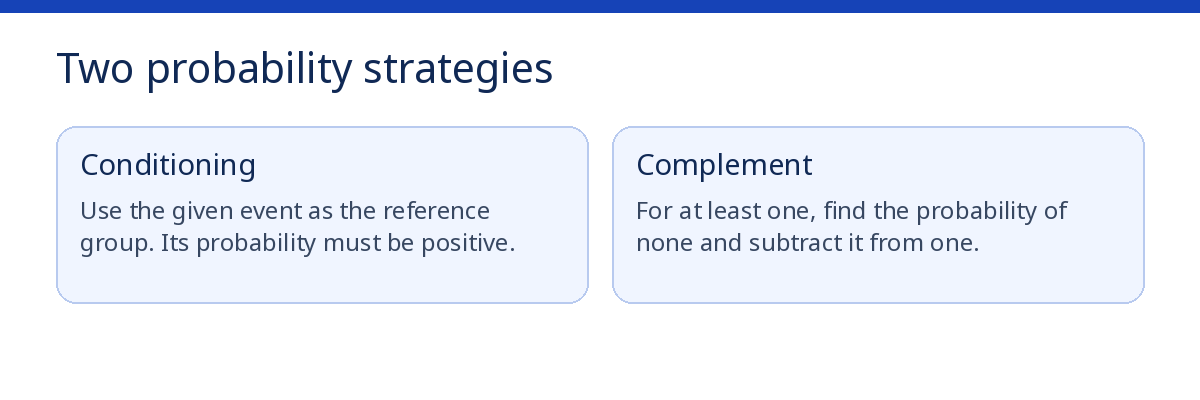
In conditional probability, the event after the conditioning bar determines the denominator: , provided . Before substituting, say in words which event is already known to have occurred. This distinguishes the intersection in the numerator from the event that restricts the sample space in the denominator.
An “at least one” question suggests another strategy: consider the complement, “none.” Taking a complement does not require independence; multiplying individual probabilities to find the probability of no successes does. The coin example uses both ideas, but they justify different steps. During review, ask whether you chose the wrong event or chose the right event and calculated its probability using an assumption the question did not give.
Quick self-check before a second attempt
Choose a question where you reached a result but could not fully explain the method. Hide the worked page and write one sentence justifying the step you were least sure about. In a calculus question, can you name the interval or domain on which the step is valid? In a matrix question, can you explain whether your entry checks establish equality or merely narrow the possibilities?
Try the same reasoning check when you move to a different topic. For linear programming, ask which expressions restrict the feasible choices and which expression is to be optimised. That distinction gives you a way to read the question before doing any calculation. Reattempt the question, then compare the justification as well as the result.
Spotted an error? Report a correction. Practise this in the app: notes, formula sheets and mind maps.





























































































































































Loading comments…