CBSE Class 12 Mathematics 2023 Solved Paper (65/5/2)
CBSEMathematics2023 Previous Year Paper
Paper code: 65/5/2 · 2023Practise the full English-language 2023 CBSE Class 12 Mathematics main examination, then use the worked solutions to check not just your results but also why each method applies.
This set is one of the year's papers. See every set from 2023, grouped by series.
What this year-wise paper contains
This resource is the 2023 CBSE Class 12 Mathematics main examination, paper code 65/5/2. The paper has a duration of 3 hours and carries a maximum of 80 marks. It is arranged as a full paper for one year, not as a chapter-wise question bank. The English question layout, options and diagrams are preserved, so you can work through the questions in their original context.
The file pairs the question paper with worked solutions for every question and subpart, including both printed OR alternatives. A question-number index lets you jump to a particular item during review. For a timed attempt, follow the choices as printed in the paper. Afterward, use the additional worked alternative for practice without treating both choices as part of the timed attempt.

Mathematics 2023 | Class 12 | Previous Year Paper | Code 65/5/2
In the StudentCurio app
Complete solved CBSE Class 12 Mathematics examination paper for 2023 (code 65/5/2), covering questions across multiple syllabus topics. Helps students practise board-exam questions and review step-by-step solutions.
Use the solution pages to diagnose errors
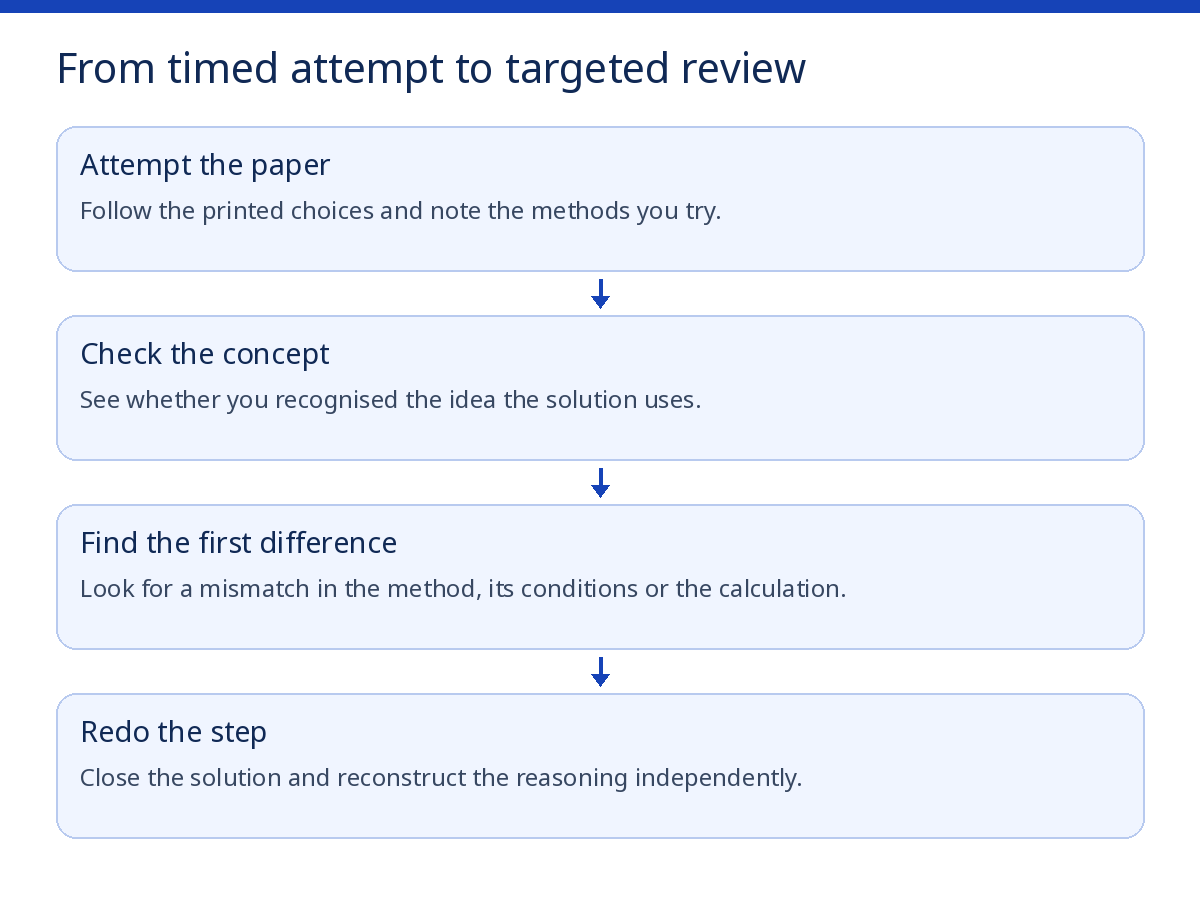
Attempt the paper before opening the worked solutions. For an exam-style sitting, use the stated three-hour limit. On a first attempt at a difficult item, write down the method you considered, even if you cannot finish. That gives you something specific to compare with the worked reasoning later.
The solutions distinguish the formula used, the concept used and the explanation in steps. Read the concept first to see whether you recognised the right mathematical structure. Then compare the formula and identify the earliest step where your work diverged. An unjustified identity, an overlooked condition and a sign slip require different fixes. For a multiple-choice item, check the reasoning that led to your choice rather than stopping when the option matches.
Relations, matrices and determinants: check the structure
In the relations material, distinguish the pairs that a definition requires from those it leaves optional. For a reflexive relation on a set, every element must be related to itself. The off-diagonal pairs are not required by reflexivity. This distinction explains the counting method more clearly than memorising the final formula: the mandatory pairs are already fixed, and the choices concern the remaining pairs.
For matrices, an equation between two matrices requires equality of every corresponding entry, not just the diagonal. If one entry gives possible values for an unknown, the remaining entries can rule some of them out. Determinant expansion is a different task: choosing a row with a zero can remove a term from the calculation, but it does not remove the need to track the cofactor signs of the terms that remain.
Calculus: when a familiar method applies
The calculus material includes principal inverse-trigonometric values, continuity and differentiability, logarithmic differentiation, derivative signs and trigonometric integration. Two questions that look similar in notation can ask for different checks. An inverse sine calls for the value in its principal range, not every angle with the given sine. For the greatest-integer function, behaviour between consecutive integers does not establish behaviour at the integers themselves, where the function jumps.
- At a join: Differentiating the separate pieces does not establish differentiability at their meeting point. Check the derivative there using the difference quotient from both sides.
- Before taking logarithms: For the real logarithmic differentiation used in the paper with a variable base and exponent, the base is positive. Keep that domain condition when rewriting the expression.
- Before deciding where a function decreases: Use the sign of the derivative on an interval. Finding the derivative's zeros can help divide the domain into intervals, but it does not by itself tell you the sign on any of them.
Vectors and 3D geometry: identify the role of each vector
The vector and three-dimensional geometry material uses proportional components, scalar projection, line directions and direction cosines. These ideas use components for different purposes. To compare directions for collinearity, work with proportional vectors rather than dividing by a component that may be zero. To test whether two lines are perpendicular, take the dot product of their nonzero direction vectors; a zero result is the perpendicularity criterion.
Scalar projection uses a dot product too, but the question of which vector is being projected onto matters: divide by the magnitude of that nonzero vector. Direction cosines, in contrast, are the cosines of the angles a direction makes with the positive coordinate axes. An obtuse axis angle gives a negative cosine, so the signs carry information about the direction.
Probability: check what you are conditioning on
The probability material distinguishes direct use of conditional probability from reasoning with independent events. In , the event after the bar is the condition. The numerator is , and the denominator is , which must be positive. Reversing the order of the events changes the condition and generally changes the calculation.
If two events are independent, complementing one of them preserves independence. This is not a shortcut to use whenever a complement appears: first establish that the original events are independent, and check that the conditioning event has positive probability before using a conditional expression.
Quick self-check: Can you explain in words why the denominator belongs to the event after the bar, and which assumption lets you replace a conditional probability with an unconditional one?
Return to the exact step you need to practise
After comparing your work with a solution, close it and redo the step that caused the difficulty. If you chose the right method but mishandled a sign, redo the calculation. If you picked the wrong method, start by writing the condition that makes the correct one valid. Where the paper gives an OR choice, you can then attempt the alternative independently before checking its explanation.
This guide omits the answers and option letters for Q9 and Q11. It also leaves out the worked result for Q12 because the printed expression does not show a complete equation.
Spotted an error? Report a correction. Practise this in the app: notes, formula sheets and mind maps.





























































































































































Loading comments…