CBSE Class 12 Mathematics 2023 Paper With Worked Solutions
CBSEMathematics2023 Previous Year Paper
Paper code: 65/2/3 · 2023Practise the full 2023 CBSE Class 12 Mathematics main examination paper (65/2/3) in its original English layout. Use the worked solutions to check not just which method you chose, but whether its conditions were met.
This set is one of the year's papers. See every set from 2023, grouped by series.
What this year-wise paper contains
This file contains a complete CBSE Class 12 Mathematics main examination paper, not a chapter-wise question bank. The cover identifies the English version of the 2023 paper, with a duration of 3 hours and a maximum of 80 marks. The original question layout, options and diagrams are preserved, so you can practise reading the paper as it appeared rather than working through questions regrouped by topic.
The cover’s question-number index lets you jump to an item for targeted review. The worked solutions cover subparts and both printed OR alternatives. In a timed attempt, follow the paper’s instructions for internal choices; afterwards, use the unattempted alternative as a fresh problem rather than reading its solution immediately.

Mathematics 2023 | Class 12 | Previous Year Paper | Code 65/2/3
In the StudentCurio app
The complete 2023 CBSE Class 12 Mathematics examination paper (code 65/2/3) covers questions across the syllabus, with worked solutions including applications of derivatives. It helps students practise the board-exam format and review solution methods.
How to read the worked solutions
The solutions distinguish the formula used, the concept used and the explanation in steps. These labels answer different questions: what rule is being applied, why it fits, and how the reasoning proceeds. When your approach differs, compare the setups before comparing the calculations. You may have chosen another valid method, or you may have missed a condition that changes whether your next step is allowed.
A useful way to review is to read only the concept label first and try to restart the problem. If you still cannot proceed, read the formula and identify the quantities it relates before looking at the steps. This helps you locate whether the difficulty was recognising the method or carrying it out.
Calculus: distinguish a limit, an integral and an initial value
The visible solutions include continuity and differentiability at a point, implicit differentiation, and definite integration. At a point where a function’s behaviour needs special attention, check continuity by comparing the limit with the function value. Test differentiability separately by checking whether the difference quotient has a finite limit. Continuity is necessary for differentiability, but it does not establish it on its own.
The integration questions illustrate two different jobs. For a definite integral, an identity can simplify the integrand, but the limits still determine the value: similar integrands on different intervals do not automatically produce the same result. When you recover a function from its derivative by indefinite integration, keep the constant of integration until you have applied the given initial value. That value selects a particular function from the family of antiderivatives.
Before using an integrating factor, name the variable
The differential-equation solutions show why the choice of independent variable matters. If the equation is linear in as a function of , put it into the form . The integrating factor is then : the coefficient is integrated with respect to , even though is the dependent variable. Work on an interval where the standard form is defined, and check whether any division used to obtain it excludes particular values.
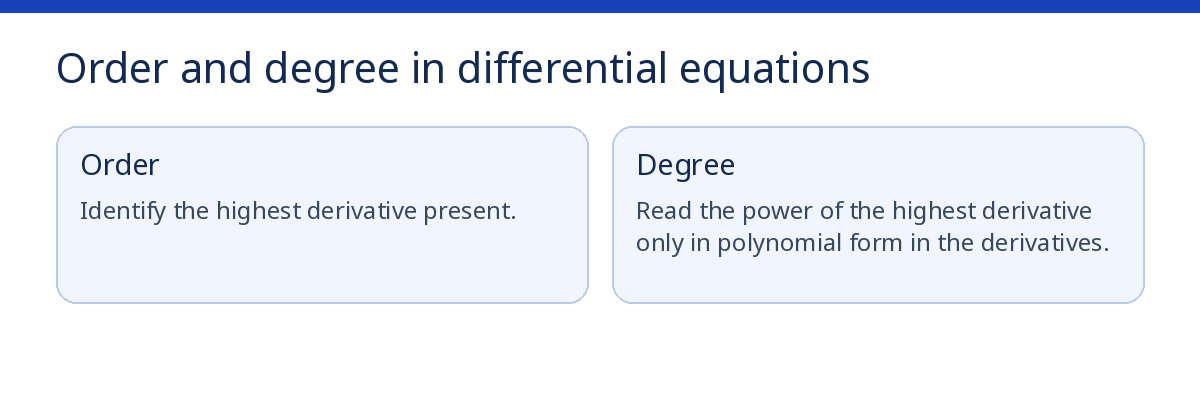
Keep order and degree separate. Order identifies the highest derivative present. Degree requires a polynomial equation in the derivatives; a derivative inside a cosine is not a polynomial power. The presence of a first derivative therefore does not, by itself, make the equation first degree.
Matrices and determinants: check what symmetry and signs imply
The matrix solutions use transpose relationships to discuss symmetric and skew-symmetric parts. In a symmetric matrix, each off-diagonal entry must match the corresponding entry across the main diagonal. When counting independent choices, count each mirrored pair once. For a skew-symmetric matrix, the corresponding entries have opposite signs, and the diagonal entries are zero.
The determinant questions connect algebra with geometry and invertibility. A square matrix is nonsingular exactly when its determinant is nonzero. That condition matters in symbolic work: cancelling a determinant assumes it is not zero. In the triangle-area calculation, the determinant can carry an orientation sign, whereas geometric area is nonnegative. Its absolute value gives twice the triangle’s area for the coordinate determinant used for that purpose.
A useful connection: direction, conditioning and constraints
Several shorter questions reward identifying the reference quantity before doing any arithmetic. In vector geometry, a direction from one point to another is obtained by subtracting the starting position vector from the ending one. Normalising divides that displacement by its magnitude, which requires a nonzero displacement and preserves its direction.
In conditional probability, the event after the conditioning bar sets the reference group. For , the numerator is the probability of the intersection, while the denominator is , which must be positive. In linear programming, the constraints determine which points are feasible, while the objective determines which feasible values to compare. When the feasible region is a nonempty bounded polygon, evaluating the linear objective at its vertices is enough to find its maximum and minimum.
Turn one timed attempt into a focused review
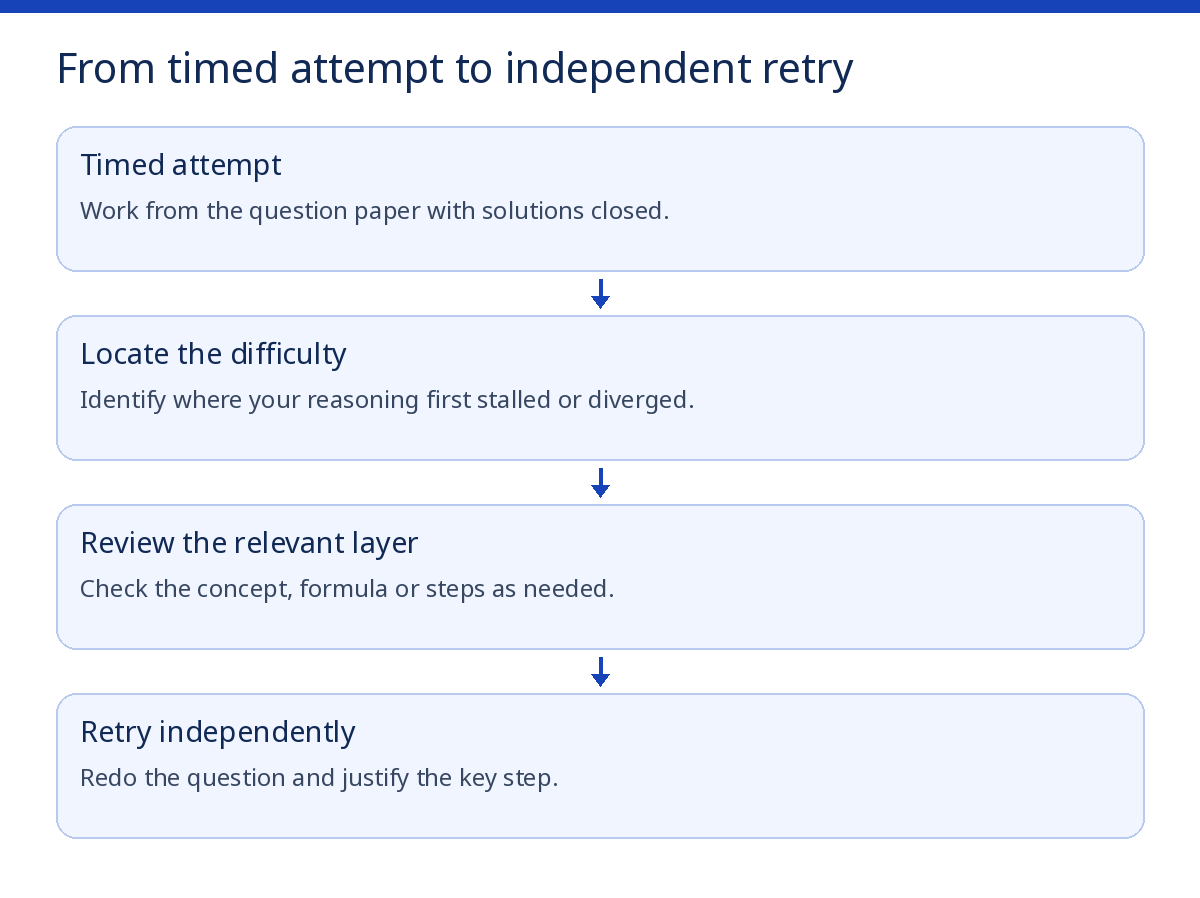
Use the three-hour limit for a board-style attempt and keep the worked solutions closed until you finish. During review, mark the first step where your reasoning went off track. A wrong result might come from misreading a diagram, selecting an unsuitable method, overlooking an excluded value or making an arithmetic slip. Each calls for a different correction.
Return to the question index and redo selected items without the explanation in view. On the second attempt, write a short reason for your key step, such as why a denominator is nonzero or why a particular variable is the one to integrate over. This guide omits final assessment answers, option letters and individual worked examples involving disputed choices or unstated assumptions.
Spotted an error? Report a correction. Practise this in the app: notes, formula sheets and mind maps.





























































































































































Loading comments…