CBSE Class 12 Mathematics 2023 Paper 65/4/1 With Solutions
CBSEMathematics2023 Previous Year Paper
Paper code: 65/4/1 · 2023Use the full English-language 2023 CBSE Class 12 Mathematics main examination paper (65/4/1) for a three-hour, calculator-free practice attempt. Then use the worked solutions to check not just your answers, but also why each method applies.
This set is one of the year's papers. See every set from 2023, grouped by series.
How the 80-mark paper is organised
This year-wise resource contains the complete paper rather than a set of questions grouped by chapter. Its 38 questions are divided into five sections. Section A has 18 multiple-choice questions and two assertion–reason questions, all worth one mark each. Sections B, C and D contain very short, short and long answers worth two, three and five marks per question, respectively. Section E contains three case studies worth four marks each.
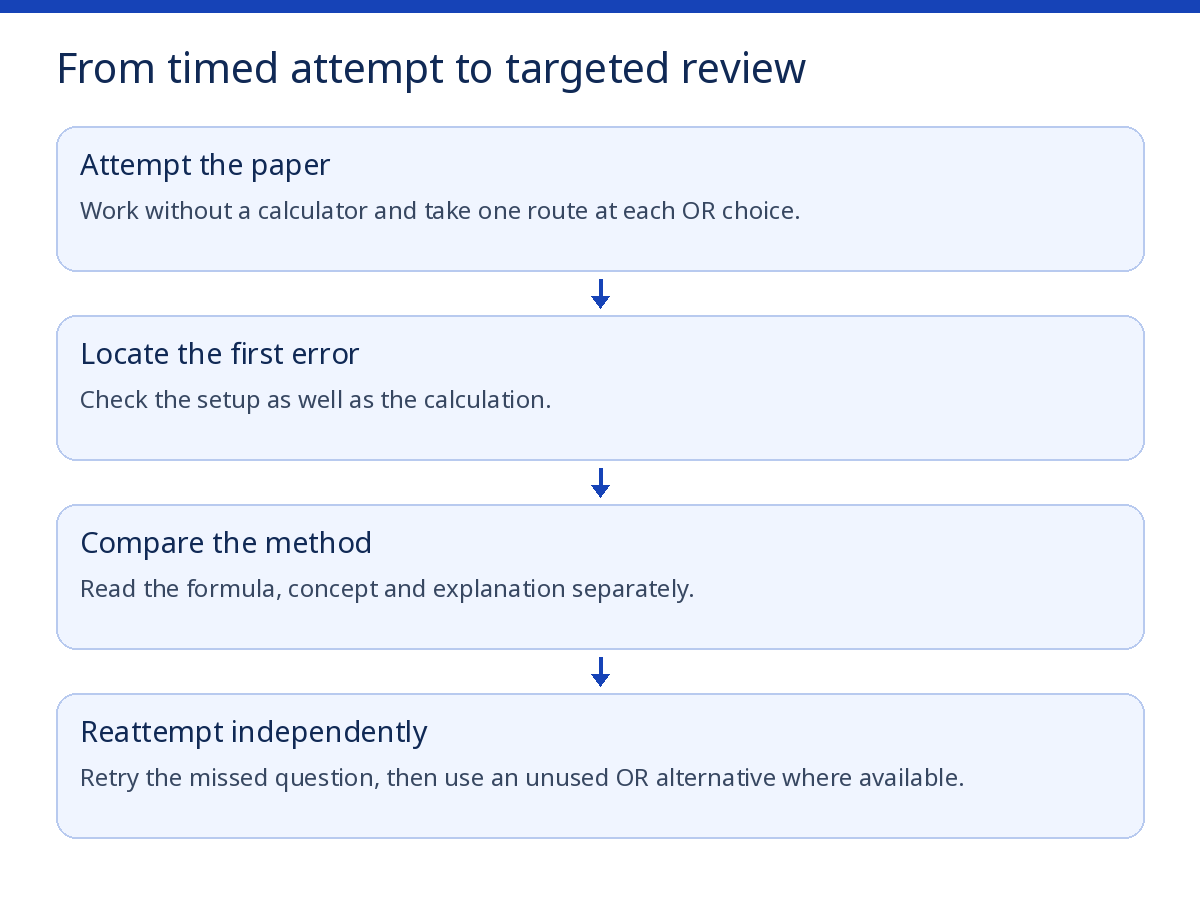
There is no overall choice: the printed OR alternatives apply only where offered. For a timed attempt, take one route at each internal choice and leave the other for review. In assertion–reason questions, decide whether each statement is true before judging whether the reason explains the assertion. Two true statements do not necessarily form a valid explanation.

Mathematics 2023 | Class 12 | Previous Year Paper | Code 65/4/1
In the StudentCurio app
Complete 2023 CBSE Class 12 Mathematics paper (65/4/1) with worked solutions across the syllabus. Helps students practise previous-year questions and review solution methods.
Matrices and functions: check the objects first
The matrix questions move from reading entries and checking products to using a matrix inverse to solve simultaneous linear equations. Before multiplying, check that the inner dimensions match and use the outer dimensions to predict the shape of the product. This is especially useful when a transpose is involved: reversing the order can change the shape, not just the entries. In a system written as , the inverse method applies only when the square coefficient matrix is invertible.
The relations and functions questions call for a different kind of checking. An equivalence relation must be reflexive, symmetric and transitive; verifying just one or two properties is not enough. For a function, distinguish being one-one from being onto. Being one-one concerns whether distinct inputs can share an output, while being onto depends on whether every element of the stated codomain is reached.
Calculus: identify the task before choosing a technique
The paper ranges from differentiating composite or implicitly defined expressions to evaluating integrals and solving differential equations. These tasks may all involve derivatives or integrals, but they ask for different outcomes. A composite expression calls for tracing its layers, while implicit differentiation treats as a function of . In differential equations, a general solution can contain arbitrary constants; a given initial condition can be used to determine a particular solution.
The applications also differ in what must be set up before calculating. For an area problem, identify the enclosed region and the bounds that describe it. For the fencing case study, first use the length constraint to express the area in one variable. Then consider which dimensions are possible before deciding where the maximum occurs. This separates the modelling step from the differentiation step.
Common mistakes: ignoring a boundary or a domain
- Inverse trigonometric functions: Check the input to the inverse function, not just whether the inner expression can be evaluated. A real-valued inverse sine requires its argument to lie in , including the endpoints.
- Piecewise differentiability: At the joining point, use the definition of the function on the appropriate side and the actual value at the point. Differentiability requires both one-sided derivatives to exist and agree; continuity alone does not settle the question.
- Linear inequalities: A strict inequality excludes its boundary line, while a non-strict inequality includes it. In graphical linear programming, the feasible region consists of points satisfying all the constraints together. Check that region before comparing objective values.
Vectors and probability: distinguish the quantities
The vector and three-dimensional geometry questions use direction, projection, distance and relationships between lines. A direction vector describes how a line runs, but does not locate it. When testing whether two lines meet, use both their directions and the points through which they pass: a common point must satisfy both line equations. For a projection or an angle calculation, identify the relevant vectors before substituting their components.
In probability, the sampling question asks for a distribution and then its mean. With replacement, the first draw does not change the composition of the lot for the second draw. Keep the number of defective bulbs, which is the random variable, separate from the probabilities attached to its possible values. For the conditional-probability case study, label the conditioning event before substituting numbers. A joint probability concerns both events occurring; a conditional probability uses the given event to define the group under consideration.
After the timed attempt: find the first step to fix
Keep the worked solutions closed until you finish the practice attempt. In review, use the separate Formula used, Concept used and Explanation in steps labels to find where your reasoning first diverged. For example, if an integration method was appropriate but the bounds were wrong, revisit how you represented the interval or region rather than redoing only the algebra. If an objective answer was correct but your reasoning was uncertain, check the method anyway before treating it as secure.
Reattempt a missed question without looking, then try an unused OR alternative where available. That gives you a way to check whether you can recognise the relevant method in another problem, rather than remembering a sequence of steps. This guide omits the final answers and selected option letters for Questions 9, 12 and 14.
Spotted an error? Report a correction. Practise this in the app: notes, formula sheets and mind maps.





























































































































































Loading comments…