CBSE Class 12 Mathematics 2023 Paper: Set 65/1/2
CBSEMathematics2023 Previous Year Paper
Paper code: 65/1/2 · 2023Practise the full English-language CBSE Class 12 Mathematics main examination paper from 2023, set 65/1/2. Use the worked solutions after your attempt to distinguish a wrong method from an error in carrying out the right one.
This set is one of the year's papers. See every set from 2023, grouped by series.
Read the paper pattern before you start
This year-wise PDF brings together the full question paper and its worked solutions. The main examination allowed 3 hours for 80 marks, with no calculator. There are 38 questions across five sections. Section A has 18 multiple-choice questions and two assertion–reason questions, each worth one mark. Sections B, C and D contain very short, short and long answers worth two, three and five marks per question, respectively. Section E has three case studies worth four marks each.
There is no overall choice. Internal choices appear in two questions in Section B, three in Section C, two in Section D and two in Section E. In a timed attempt, follow each printed OR rather than answering both branches. Save the unused branches for revision.

Mathematics 2023 | Class 12 | Previous Year Paper | Code 65/1/2
In the StudentCurio app
The complete 2023 CBSE Class 12 Mathematics paper, set 65/1/2, covers questions across the syllabus with worked solutions, including probability and differentiation. It helps students practise a full previous-year paper and review solution methods.
Calculus: decide what the question is asking for
This set tests calculus in several forms: continuity of a piecewise function, increasing and decreasing intervals, indefinite and definite integration, differential equations, area by integration and related rates. These are not interchangeable tasks. A continuity check compares a limit with the function value; a monotonicity question asks how the function behaves over an interval. For a general solution of a differential equation, retain the arbitrary constant where the method introduces one. For a particular solution, use the supplied condition to determine it.
Before you differentiate or integrate: Identify the domain or interval first. Dividing by an expression requires it to be nonzero on the interval where that step is used. For a definite integral containing an absolute value, check where the expression inside changes sign before deciding how to split the interval.
Algebra and graphs: check the conditions on the method
The paper moves between matrix arithmetic, determinants, inverse matrices and solving a system of equations by a matrix method. Keep matrix operations separate from determinant operations. Multiplying a matrix by a scalar multiplies each entry by that scalar, but the factor by which the determinant changes depends on the order of the square matrix. If you plan to use an inverse, check that the matrix is invertible.
Linear programming calls for a different kind of check. The inequalities determine which points are feasible; the objective function tells you how to compare feasible points. In a graphical problem, establish the feasible side of each boundary before looking for corners. If the region is unbounded, a comparison of its corner values alone does not establish that a finite optimum exists.
Vectors, lines and relations: work from definitions
The vector and three-dimensional geometry questions move between components, direction and equations of lines. Distinguish a point on a line from a vector giving its direction. For two nonzero direction vectors, a zero dot product establishes that their directions are perpendicular. If a direction component is zero, use a parametric form or state the corresponding coordinate as constant rather than writing a symmetric-form fraction with a zero denominator.
Questions on functions and relations also reward starting with the definition. An onto function must reach every element of its codomain; being one-to-one is a separate condition. When testing reflexivity, symmetry or transitivity, ask exactly which elements or pairs the definition requires you to check. A few confirming examples cannot establish a universal property, but a valid counterexample can disprove it.
Case studies: translate the context into mathematics
Section E uses a draining tank, a Venn diagram of yoga participation and a polynomial model of a roller-coaster path. The useful first step differs in each case. For the tank, identify which geometric quantities change with time and distinguish a signed rate of change from the positive magnitude of a rate of decrease. For the polynomial, distinguish what a point on the graph tells you about the function value from what a derivative tells you about the slope.
Probability self-check: Before using a Venn diagram or a conditional probability formula, can you name the event being measured and, if there is a condition, the event that restricts the sample space? The conditioning event must have positive probability. In a discrete distribution, check that the probabilities sum to one before using them as weights for the mean.
Use the worked solutions to find your first wrong step
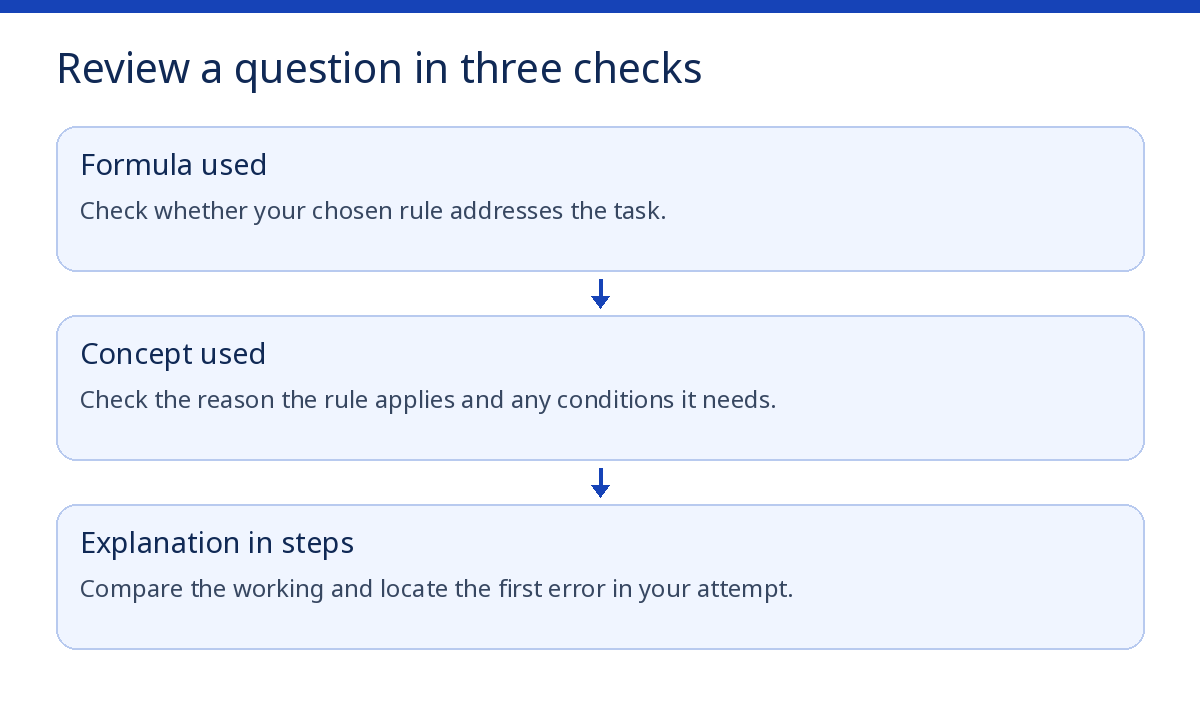
Attempt the paper without opening the solutions if you want a timed run under the printed conditions. When reviewing, use the question-number navigation to find the relevant explanation. The solution layout separates the formula used, the concept used and the steps. Compare those in order: did you select an appropriate rule, did its conditions hold, and did the algebra preserve signs and restrictions? For assertion–reason items, check the truth of each statement before deciding whether the reason explains the assertion.
The file describes worked solutions for each subpart and both printed OR choices, so an unattempted branch gives you a second practice task. This guide omits individual answers and does not reconstruct unclear symbols or options from the text extract. When a sign, bound or diagram matters, read it on the PDF page itself.
Spotted an error? Report a correction. Practise this in the app: notes, formula sheets and mind maps.





























































































































































Loading comments…