CBSE Class 12 Mathematics 2023 Paper: Set 65(B)
CBSEMathematics2023 Previous Year Paper
Paper code: 65(B) · 2023Use this full, year-wise CBSE Class 12 Mathematics paper as a three-hour mock, then review your reasoning with the worked solutions. Set 65(B) spans the board-paper format, from one-mark checks to case studies on rates of change, optimisation and conditional probability.
This set is one of the year's papers. See every set from 2023, grouped by series.
Read the 2023 paper pattern before starting
This English-language file is labelled an adapted main-examination paper for 2023. It carries 80 marks, allows three hours and does not permit calculators. Its 38 questions are arranged in five sections:
- Section A: 18 multiple-choice questions and two assertion–reason questions, each worth one mark.
- Section B: five very short answer questions worth two marks each.
- Section C: six short answer questions worth three marks each.
- Section D: four long answer questions worth five marks each.
- Section E: three case studies worth four marks each.
There is no overall choice: attempt every question number, choosing one alternative where an internal OR is printed. For a mock, follow that rule on your first attempt. Save the unattempted alternatives for revision so you can compare the skills tested by the two routes without changing the conditions of your timed attempt.

Mathematics 2023 | Class 12 | Previous Year Paper | Code 65(B)
In the StudentCurio app
Complete CBSE Class 12 Mathematics 2023 paper, set 65(B), with worked solutions across the syllabus. It includes questions on optimization and conditional probability, helping students practise the board-exam format and review solution methods.
Check the mathematical object before choosing a rule
The paper moves between inverse trigonometry, relations and functions, and matrix methods. For functions, distinguish the domain from the codomain and the range. Injectivity asks whether distinct inputs can share an output; surjectivity asks whether every element of the stated codomain is reached. A formula alone does not settle both questions: the sets in the function definition are part of the problem.
In matrices, the question may ask you to locate an entry, find a minor, compute an inverse or use matrices to solve a system. These are different operations. In particular, a minor is the determinant left after deleting the indicated row and column; the alternating sign factor belongs to the corresponding cofactor. If you use the inverse-matrix method for a system, first check that the square coefficient matrix has a nonzero determinant.
Follow the calculus setup, not just the calculation
The calculus coverage includes continuity, differentiation, integration and differential equations. For a piecewise continuity question, the limit at the joining point must exist and agree with the assigned function value. In an integration question, symmetry is useful only after you check both the interval and the integrand: an odd, integrable function has integral zero over a symmetric interval. The symmetry of the limits alone is not enough.
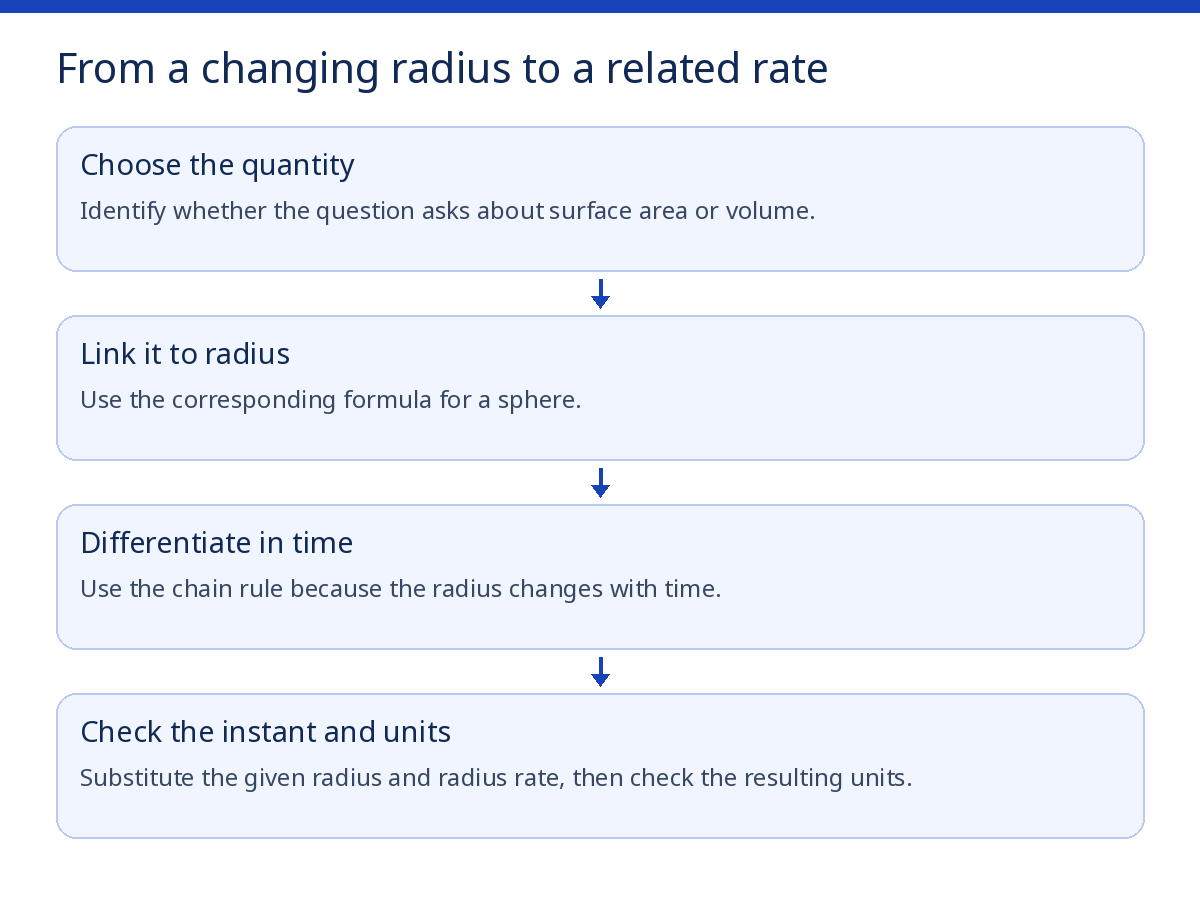
The paper also distinguishes general solutions of differential equations from particular solutions. A general solution can contain arbitrary constants; when an initial value is supplied, use it to select a solution on an interval where the equation is defined. In the related-rates questions, the air bubble and spherical balloon connect geometry to differentiation. Write the quantity of interest as a function of the radius, regard the radius as changing with time, and use the chain rule before substituting the values at the specified instant. Keep the rate units tied to the quantity being measured.
When a direction or a boundary changes the method
The vector and three-dimensional geometry questions require you to distinguish a point's position vector from a line's direction vector. For a directed displacement, subtract the position vector of the starting point from that of the endpoint. Reversing the order reverses the direction. For nonzero direction vectors, a zero dot product tests perpendicularity; the coordinates of points on the lines are not a substitute for their direction vectors.
In linear programming, the constraints determine the feasible region, while the objective function determines the value to compare. One question supplies the corner points directly, so the task is to compare objective values rather than reconstruct the region. For a nonempty bounded feasible polygon, a linear objective attains each extremum at a corner, though an entire edge can tie. When interpreting a constraint graphically, distinguish strict inequalities, which exclude the boundary line, from non-strict inequalities, which include it.
Quick self-check: what changes the probability?
The probability questions give you three different setups to recognise: a card draw with information about the result, a report about a coin toss, and a sample of bulbs drawn without replacement. In the card case study, ask which outcomes are still possible once the stated information is known. For the report question, distinguish the event that occurred from the event that someone reported it. These are not interchangeable when deciding which event you are conditioning on.
For the bulbs, ask how the first draw changes what remains for the second. To build the requested probability distribution, identify the possible counts of defective bulbs and check that their probabilities sum to one before using the distribution to find the mean. This checks your model without relying on a selected option or a numerical answer.
Use worked solutions to locate your first wrong step
After the mock, use the question-number index to find the corresponding worked solutions. The file separates the formula, the concept and the explanation in steps. Compare your approach at each level: did you choose an applicable rule, translate the question into the right mathematical form, and carry out the algebra consistently? For assertion–reason items, check the two statements separately before deciding whether the reason explains the assertion. For a case study, check whether the expressions you set up in earlier parts can support the later parts.
This guide omits the worked derivative, evaluated result and selected option for Q6, and does not reproduce or endorse the inconsistent answer option in the half-plane question.
Spotted an error? Report a correction. Practise this in the app: notes, formula sheets and mind maps.





























































































































































Loading comments…