CBSE Class 12 Mathematics 2023 Paper With Worked Solutions
CBSEMathematics2023 Previous Year Paper
Paper code: 65/1/3 · 2023Practise the complete English-language CBSE Class 12 Mathematics main examination paper from 2023, set 65/1/3. Use the original paper for a three-hour attempt, then review the worked solutions to see where your choice of method, use of conditions or written reasoning needs attention.
This set is one of the year's papers. See every set from 2023, grouped by series.
What this 2023 paper contains
This year-wise resource contains one full CBSE Class 12 board paper, not a chapter-wise question bank. The PDF preserves the English question layout, options and diagrams, and links questions to worked solutions. The solution pages separate the formula, the underlying concept and the steps. The file also includes solutions for both printed OR alternatives, which lets you review the route you did not take during a timed attempt.
The paper spans relations and functions, inverse trigonometry, matrices and determinants, calculus, vectors and three-dimensional geometry, probability, and linear programming. Its value is seeing those topics together: you have to recognise the method a question calls for without a chapter heading to cue you.

Mathematics 2023 | Class 12 | Previous Year Paper | Code 65/1/3
In the StudentCurio app
Complete CBSE Class 12 Mathematics 2023 paper, set 65/1/3, with worked solutions covering topics including matrices, calculus, probability, vectors and linear programming. It helps students practise the board-exam format and review solution methods.
How the five sections work
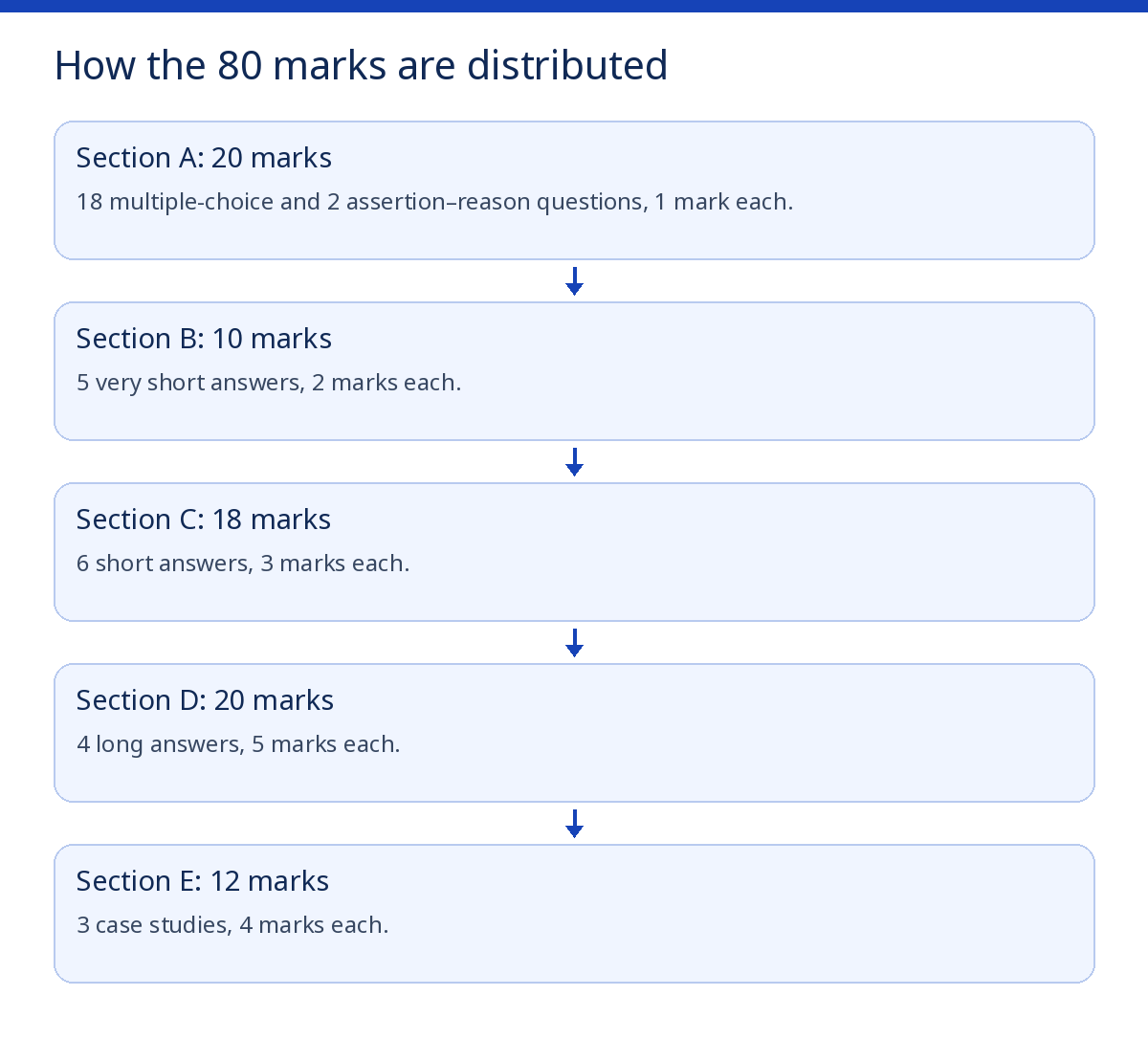
The paper allows three hours for 80 marks, contains 38 questions and does not permit calculators. Section A starts with 18 multiple-choice questions and ends with two assertion–reason questions, all worth one mark each. Section B has five two-mark very short answers, Section C has six three-mark short answers, and Section D has four five-mark long answers. Section E has three four-mark case studies divided into subparts.
No overall choice means you cannot skip an entire numbered question in favour of another. Internal choices appear in two questions in Section B, three in Section C, two in Section D and two in Section E. Where an OR is printed, attempt only the required alternative during your mock; save the other for later practice.
Matrices, functions and geometry: identify the object first
The matrix questions move from recognising properties of square matrices to using matrix methods in longer tasks. Keep the determinant and the matrix itself distinct: a determinant is a scalar, and a square matrix is invertible exactly when that scalar is nonzero. In a system of equations, identify the coefficient matrix before deciding whether an inverse-based method is available.
The functions questions ask for different kinds of reasoning. One-to-one and onto concern how inputs map to the stated codomain; a question about an inverse trigonometric value instead depends on the function’s principal range. In vectors and three-dimensional geometry, distinguish a point on a line from a direction vector. The point fixes where the line passes, while a nonzero direction vector specifies its orientation.
Calculus: choose the method before calculating
The calculus tasks include continuity and differentiability, optimisation, integration, differential equations and related rates. In a continuity question, compare the limit with the function value; in a differentiability question at a join, compare the left and right derivatives. These are separate tests. For an area bounded by lines, Sketch the region first so you can identify the limits and decide whether the upper or lower boundary changes between intersections.
Check the domain before dividing. If a differential-equation method divides by a variable, the rearranged equation applies only where that variable is nonzero. Carry that restriction into the integration. Also distinguish a general solution, which includes an arbitrary constant, from a particular solution selected by a given condition.
Probability and linear programming: translate before using a rule
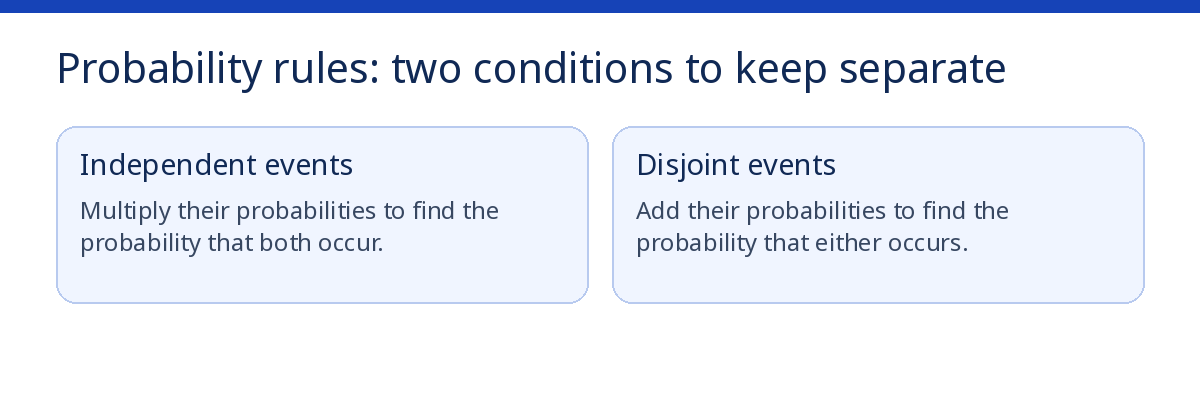
The probability questions use repeated trials, a discrete distribution, independent events and a Venn diagram. Treat independence as a condition of the model, not a consequence of having two trials. Independence allows you to multiply the relevant probabilities for a joint outcome; adding probabilities for alternative outcomes without an overlap correction requires those outcomes to be disjoint. In a distribution question, the probabilities must sum to one before you use them to find the mean.
In graphical linear programming, the constraints determine which points are feasible; the objective function tells you what to maximise or minimise over those points. A bounded feasible polygon allows you to find extrema by comparing objective values at its corners. For an unbounded region, a list of corners alone does not establish that a finite optimum exists.
Case studies: carry the context into the mathematics
The case studies use a draining tank, a Venn diagram about yoga participation and a polynomial model of a roller-coaster path. The contexts call for different translations: relate geometric quantities before differentiating in the tank problem, read event regions carefully in the Venn diagram, and express an intercept as a condition on the polynomial. Read the shared setup before starting the subparts, since a later calculation may rely on a relationship established earlier.
Quick self-check: Can you explain the sign you expect for a quantity that is decreasing, or point to the part of a Venn diagram that an event excludes? These checks can catch a misreading before you compare any calculations with the worked solution.
Turn the worked solutions into a second practice round
For a realistic attempt, work from the question-paper pages without opening the solution links. Afterward, pick a question where your reasoning stalled and compare your first step with the solution’s concept and formula. If you chose the right method but got a different result, look for the first line where the two approaches diverge. That will tell you more than checking the final answer alone.
Then attempt an unused OR alternative without looking at its solution. This tests whether you can choose a method again rather than repeat a calculation you have just read. Individual options and worked examples with unclear notation in the text extract are omitted here; refer to the original PDF layout when signs, brackets or diagram labels matter.
Spotted an error? Report a correction. Practise this in the app: notes, formula sheets and mind maps.





























































































































































Loading comments…