CBSE Class 12 Mathematics 2023 Paper: Set 65/2/2
CBSEMathematics2023 Previous Year Paper
Paper code: 65/2/2 · 2023Practise the full English-language 2023 CBSE Class 12 Mathematics main examination under its original three-hour, 80-mark format. Then use the worked solutions to check not just your calculations, but also why a method applies.
This set is one of the year's papers. See every set from 2023, grouped by series.
Know the five sections before you start
This year-wise resource presents set 65/2/2 as a complete question paper rather than a chapter-wise worksheet. Its 38 questions are spread across five sections. Section A contains 18 multiple-choice questions and two assertion–reason questions, each worth one mark. Sections B, C and D contain very short, short and long answers worth two, three and five marks per question respectively. Section E has three case- or source-based units worth four marks each.
There is no overall choice, but some questions in Sections B–E offer a printed OR. For a timed attempt, choose one alternative where offered and keep the other for revision. Work without a calculator, as the original instructions require. In assertion–reason items, judge the two statements separately before deciding whether the reason explains the assertion.

Mathematics 2023 | Class 12 | Previous Year Paper | Code 65/2/2
In the StudentCurio app
Complete CBSE Class 12 Mathematics paper set 65/2/2 from 2023, with worked solutions covering topics across the syllabus, including calculus, matrices, vectors, probability and differential equations. Helps students practise a full board examination paper and review solution methods.
Calculus: identify what the question asks you to find
The paper moves between differentiation, rates of change, integration and differential equations. A rate-of-change question links quantities that vary together; it is not the same task as finding the value of either quantity. The cylinder case in Section E tests another distinction: the sheet area constrains the dimensions, while the volume is the quantity to maximise. Keep those roles separate when turning the description into equations.
Integration appears both as a calculation and as a way to find geometric area. A definite integral measures signed accumulation; if the integrand represents the difference between two boundary curves, nonnegative area requires using the upper curve minus the lower curve on each relevant interval. That distinction helps you see why choosing the limits and identifying the boundaries matter before you look for an antiderivative.
When a differential-equation method applies
First identify the dependent variable. This paper includes a differential equation written with , so the coefficient and integrating factor must be read with as the independent variable. For a first-order linear equation written as , the integrating factor is . Use that form on an interval where the normalised equation is defined; if you divide by the coefficient of the derivative to obtain it, check where that coefficient is nonzero.
Also distinguish order from degree. Order identifies the highest derivative present. Degree concerns its power when the equation is expressed as a polynomial in its derivatives. Finding a first derivative in an expression does not, by itself, establish a degree.
Matrices, vectors and linear programming
The matrix questions connect symbolic operations with checks you can make before calculating. In a product, the number of columns of the first matrix must equal the number of rows of the second. Check those dimensions again if a factor is transposed. A determinant serves a different purpose: for a square matrix, a nonzero determinant establishes nonsingularity. The paper also uses matrix multiplication in a longer question on simultaneous equations.
In vectors and three-dimensional geometry, distinguish a point on a line from a vector giving its direction. A direction vector need not have unit length; normalising a nonzero vector changes its length, not its direction. In graphical linear programming, distinguish the constraints, which determine feasibility, from the objective function, which you evaluate to compare feasible points. A point that gives a favourable objective value is not a candidate if it violates a constraint.
Common mix-up: reversing a probability condition
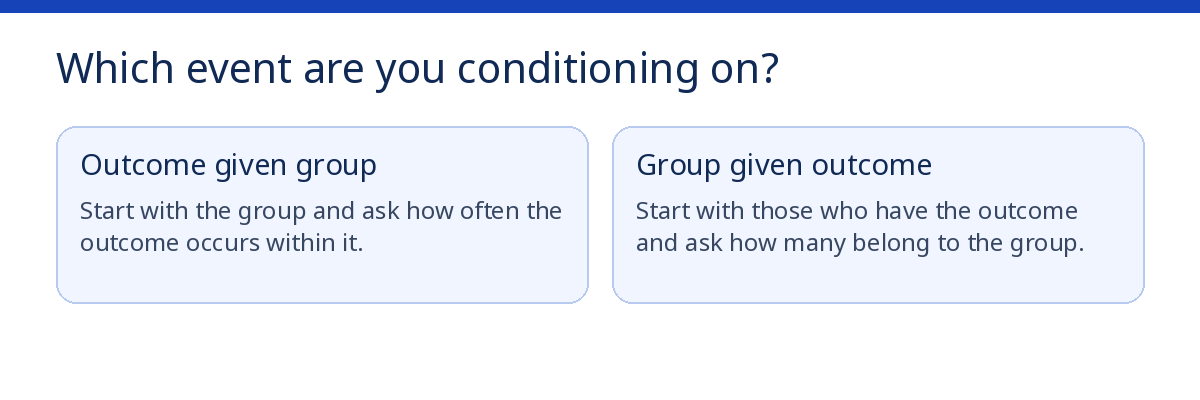
Probability appears in short questions, longer problems and a case-based unit. The handedness case is useful for practising how to read conditional information: the probability of an outcome given a group is a different quantity from the probability of belonging to that group given the outcome. In , the event after the bar determines the reference group, and its probability must be positive for this conditional probability to be defined.
The paper also asks for a probability distribution and its mean. A distribution assigns a probability to each possible value of the random variable; its mean weights each value by that probability. When reviewing your setup, check that you have identified the possible values of the count, rather than merely listed the individual draw sequences.
Before you move on: name the first step you would change
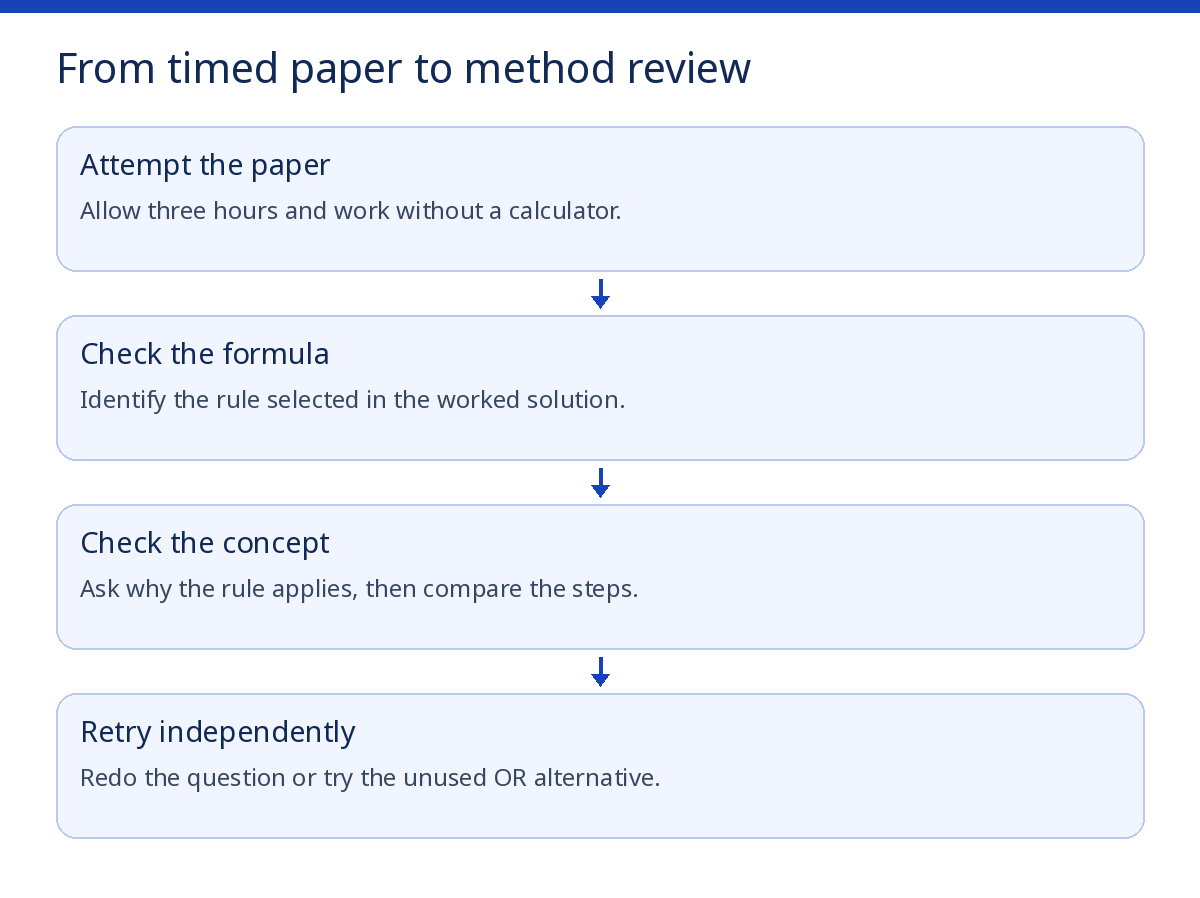
Keep the solutions closed during your first attempt. When you review, use the resource’s Formula used, Concept used and Explanation in steps labels to locate the first place your reasoning diverged. If you recognised the correct formula but used it outside its domain, that calls for a different correction from an arithmetic slip. Once you can explain the missing condition or step, retry the question without looking. Then use any unattempted OR alternative to check whether you can choose a method independently.
This guide leaves out individual answers and options, including the disputed line notation, a linear-programming option mismatch and a function item with a domain–codomain issue. It also omits assumption-dependent numerical conclusions and does not treat a printed assertion–reason statement as a standalone rule. Use the independently supported questions for timed practice and keep any source issue separate from your own errors.
Spotted an error? Report a correction. Practise this in the app: notes, formula sheets and mind maps.





























































































































































Loading comments…