2022 CBSE Class 12 Mathematics Term 2 Paper With Solutions
CBSEMathematics2022 Previous Year Paper
Paper code: 65/4/1 · 2022Practise the full 2022 CBSE Class 12 Mathematics Term 2 paper, set 65/4/1, and use its worked solutions to check how you set up each problem. The guide explains what to look for in probability, vectors, three-dimensional geometry, differential equations and integration.
This set is one of the year's papers. See every set from 2022, grouped by series.
What this 40-mark paper contains
This year-wise resource contains the English version of the main examination paper from the 2021–22 session. It was a two-hour, 40-mark Term 2 paper. Use those limits if you want to recreate this particular sitting, rather than treating its format as a template for every CBSE Mathematics paper.
All three sections are compulsory. Section A has six short-answer questions worth two marks each, Section B has four short-answer questions worth three marks each, and Section C has four long-answer questions worth four marks each. Some questions offer an internal choice. The last question is a case study with two subparts worth two marks each, so its marks are split even though it sits in Section C. The file preserves the question layout and provides worked solutions for both branches of the printed choices.

Mathematics 2022 | Class 12 | Previous Year Paper | Code 65/4/1
In the StudentCurio app
The 2022 CBSE Class 12 Mathematics Term 2 paper, set 65/4/1, with worked solutions for its questions and alternatives. It covers probability, vectors, three-dimensional geometry, differential equations and integration, helping students practise the exam format and review solution methods.
Probability: separate conditioning from independence
The paper gives you three different probability setups: successive draws without replacement, a distribution for the number of tails, and a case study involving two archers. They call for different starting points. In a draw without replacement, update the pool after each known draw. For a discrete probability distribution, check that the probabilities of all possible values sum to one before using the table to reason about the underlying experiment.
The case study asks about joint outcomes, but the question does not explicitly state that the archers’ scoring events are independent. Multiplying the two individual event probabilities to obtain their joint probability requires independence. Likewise, “exactly one” combines two mutually exclusive cases: the first event occurs without the second, or the second occurs without the first. The guide omits numerical answers to the case study because the supplied probabilities alone do not determine them; the worked solution labels its independence assumption.
Vectors and 3D geometry: choose the right representation
The vector questions connect dot and cross products with magnitude and angle. In an angle calculation, the dot product gives the cosine only after division by the product of the two nonzero magnitudes. When vectors are mutually perpendicular, their pairwise dot products vanish. This can simplify both the squared magnitude of a vector sum and comparisons between its angles with different vectors.
The geometry questions ask you to read geometric information before applying a formula. A point and its distinct perpendicular foot on a plane give a normal direction, and the foot gives a point on the plane. For a question about skew lines, check whether the directions are parallel before using a coplanarity test to distinguish intersection from skewness. A separate plane question combines two constraints: the plane must contain a given intersection line and meet a distance condition. Satisfying just one constraint is not enough.
Integration: decide what the integrand needs
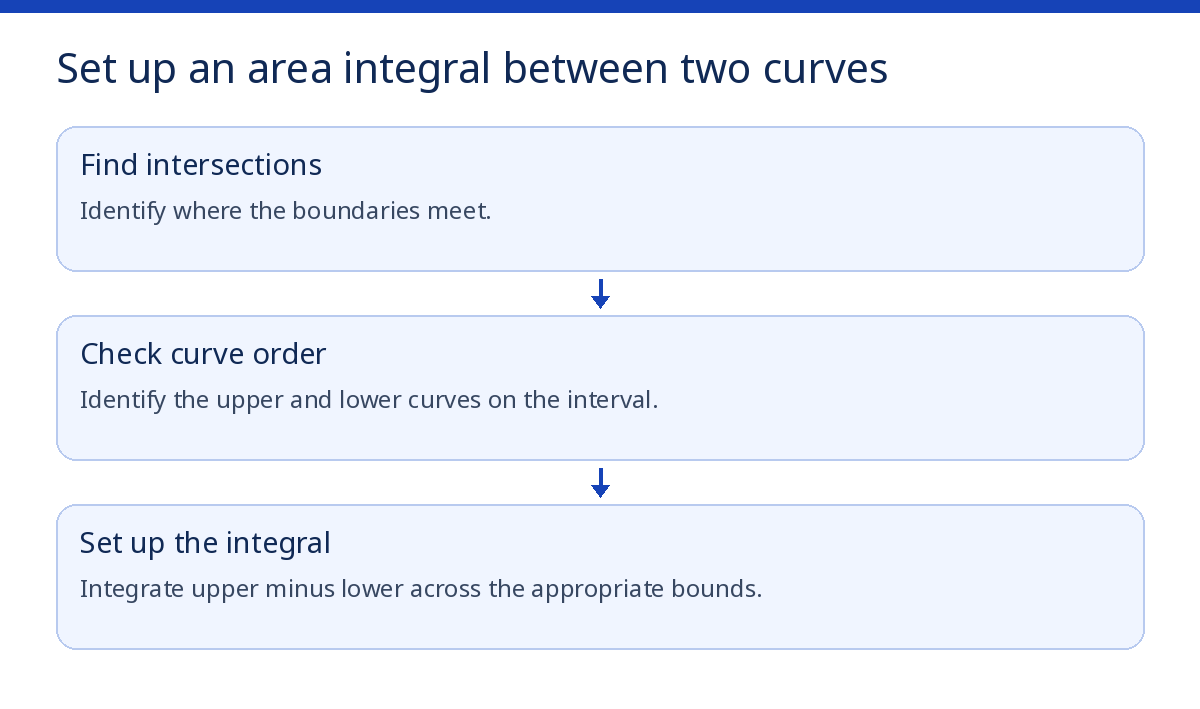
The integration questions are useful for comparing methods rather than practising one rule repeatedly. The worked solutions illustrate repeated integration by parts for a polynomial–exponential product, rewriting an integrand to recognise a logarithmic derivative, and splitting an absolute-value integral where the expression inside the modulus changes sign. For the area question, the bounds come from the curves’ intersections, but the integrand depends on which curve is above the other over the interval being used.
The logarithmic definite integral adds a different check. A trigonometric identity can help rewrite the integrand in the interior, and reflection can relate integrals involving sine and cosine. That does not make a logarithm defined at an endpoint where its argument vanishes. When reviewing the solution, distinguish the identity valid inside the interval from the limiting interpretation that allows the integral to be evaluated at its bounds.
Differential equations: track constants and domains
The paper includes both general and particular solutions. A general solution retains an arbitrary constant; a particular solution here uses a given value of the function to determine that constant. In the product-rule examples, look for terms that together form the derivative or differential of a single product. Recognising that structure can avoid rearranging each term separately.
The homogeneous alternative shows why substitution and separation need domain checks. Writing to introduce the ratio requires . If you then divide by an expression that can vanish, test the excluded cases in the original equation rather than assuming the separated work covers them. For the particular solution, check the interval containing the point specified by the initial condition, not just whether the final expression has the right value at that point.
Common mistake: losing signs in direction cosines
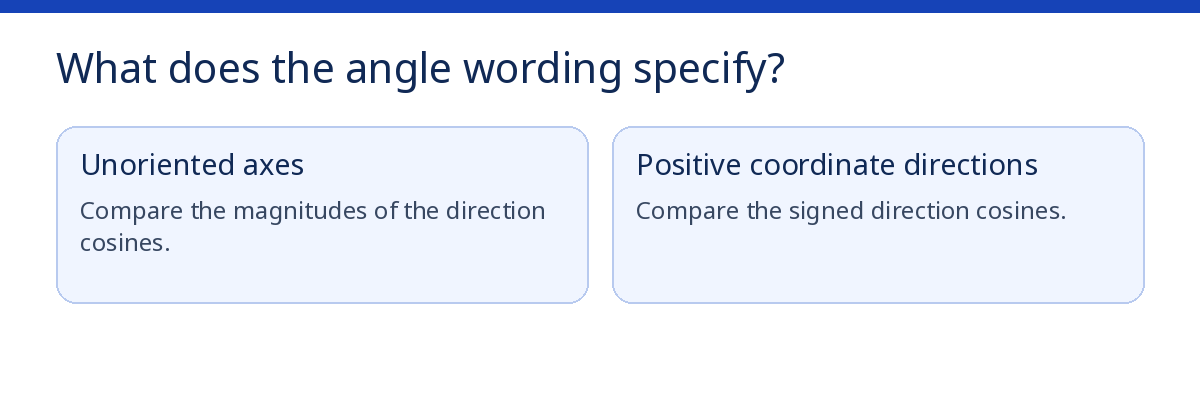
For a nonzero direction, the direction cosines satisfy . Finding the square of an unknown cosine fixes its magnitude, not necessarily its sign. Check the wording for a restriction that rules out an obtuse or acute angle. The paper also distinguishes equal inclinations to unoriented axes from equal angles with the positive coordinate directions. The former compares absolute direction cosines; the latter compares signed cosines. Read that distinction before deciding which sign combinations are admissible.
Use the worked solutions to find your first wrong step
On a first pass, work from the question pages and choose one branch of each internal choice you attempt, as you would in the exam. Afterwards, use the question-number links to compare your work with the solution’s Formula used, Concept used and Explanation in steps blocks. Look for the first point where your reasoning diverges: for example, did you choose the wrong bounds, omit a sign check, or apply a rule without its required assumption?
Then try the unused alternatives without looking at their solutions. This makes them a second opportunity to choose a method independently, rather than a second set of answers to read.
Spotted an error? Report a correction. Practise this in the app: notes, formula sheets and mind maps.





























































































































































Loading comments…