CBSE Class 12 Mathematics 2022 Term 2 Paper with Solutions
CBSEMathematics2022 Previous Year Paper
Paper code: 65/1/3 · 2022Practise the full 2022 CBSE Class 12 Mathematics Term 2 paper, code 65/1/3, under its original two-hour, 40-mark format. Then use the worked solutions to review why a method applies, from identifying the conditioning event in probability to choosing the right test in three-dimensional geometry.
This set is one of the year's papers. See every set from 2022, grouped by series.
What this year-wise paper includes
This is the English version of the main examination paper from the 2021–22 session, organised as a complete year-wise resource rather than a chapter worksheet. The file preserves the original question layout, choices and diagrams. Its separate solution section covers the questions, subparts and both sides of the printed OR choices. The explanations distinguish the formula used, the concept behind it and the steps that connect the two.
For a timed attempt, work from the question pages and follow the printed choices. Afterwards, use the question-number links to review the solutions. The alternative you skipped can then serve as a fresh problem. That is especially useful when two alternatives are drawn from the same topic but call for different methods, as they do in integration.

Mathematics 2022 | Class 12 | Previous Year Paper | Code 65/1/3
In the StudentCurio app
Complete CBSE Class 12 Mathematics Term 2 question paper 65/1/3 from 2022, with worked solutions and explanations for all questions and OR choices. It covers probability, differential equations, integration, vectors, three-dimensional geometry and applications of integrals.
Probability: identify what is already known
The probability questions distinguish three tasks: reversing a conditional probability, finding the distribution of a count, and updating a probability after an observation. In the first, and share the intersection , but they divide by different event probabilities. The event after the bar tells you which probability goes in the denominator, and that probability must be positive.
For the distribution question, the draws are without replacement. The solution counts unordered pairs because the count being studied does not depend on draw order and the pairs are equally likely. Check that the probabilities cover every possible count and sum to one. In the Bayes question, the observed draw can occur under either of two prior cases. The denominator must account for both ways the observation can arise, not just the case whose probability you want.
Differential equations: simplify before classifying
One question is about reading the structure of a differential equation, not solving it. Order is determined by the highest derivative that remains. Degree is the power of that derivative when the equation is expressed as a polynomial in its derivatives. A squared derivative visible in the original expression need not determine the degree: terms of that kind can cancel on simplification.
The paper also uses the substitution for a homogeneous first-order equation. The key step is treating as a function of , so the product rule gives . In this problem the substitution turns the equation into a separable one. When reviewing the working, track where division takes place: the solution is stated on intervals where both and are nonzero.
Integration: match the method to the expression
The integration questions reward recognising a useful form before starting to integrate. A trigonometric identity can create a term suited to substitution, while recognising a product derivative can avoid a longer calculation. Where an antiderivative is required to have a specified value at a point, apply that condition after integrating to fix the constant. For the logarithmic alternative, the relevant intervals lie in and exclude .
The paper also uses a common-root substitution to turn fractional powers into integer powers of a new variable. In a definite integral, rewrite the limits in the new variable if you plan to evaluate in that variable. A separate symmetry question shows why checking the interval matters: on , the reflection preserves an integrable factor only if . Check that factor before using the symmetry shortcut.
Before integrating for area, check the boundary
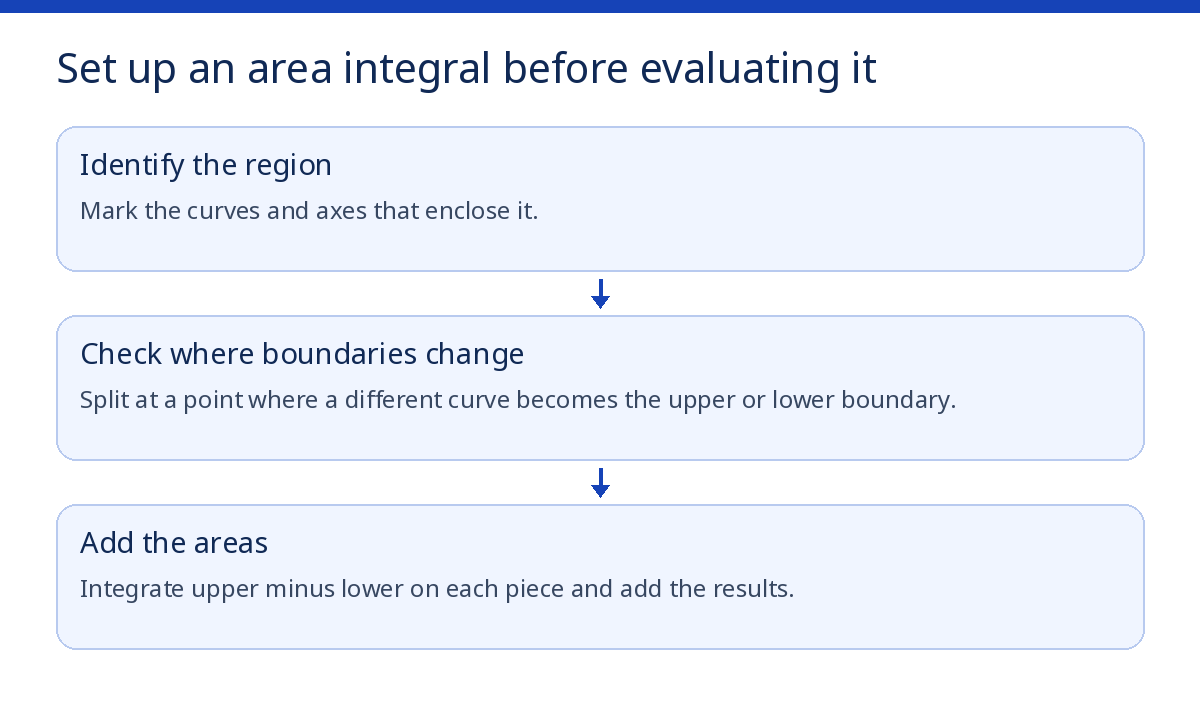
The applications-of-integrals alternatives distinguish a region with one continuous upper boundary from a region whose upper boundary changes. When a curve stays above the horizontal axis on the stated interval, its definite integral over that interval gives the area between it and the axis. For a region enclosed by several curves, however, the same curve may not bound the region across its entire width.
Use the diagram or a sketch to identify the upper and lower boundaries on each interval. A point where the upper boundary switches supplies a place to split the integral. For each piece, integrate upper minus lower; then add the pieces and report the result in square units. Comparing the two alternatives makes the difference between setting up an area and merely evaluating an integral clear.
Vectors and 3D geometry: choose the test by its purpose
A zero dot product tests perpendicularity for two nonzero vectors. A zero cross product tests parallelism when both vectors are nonzero, while a cross-product magnitude can be used to find area. The solutions also use the sum and difference of adjacent side vectors to represent the diagonals of a parallelogram. Finding a unit vector along a diagonal requires dividing by its length; reversing the sign reverses the direction without changing the line of the diagonal.
In coordinate geometry, keep three tasks separate. The point-to-plane distance uses an absolute value and divides by the length of the plane’s normal. Finding where a line meets a plane instead calls for substituting the line’s parametric coordinates into the plane equation. For two nonparallel lines, a zero scalar triple product involving their directions and the displacement between points on them establishes coplanarity. Locating the intersection is a separate step: the parameters must satisfy all three coordinate equations.
Quick self-check after reading a solution
Close the worked solution and explain the first decision in your own words. Which event determines the denominator? Which restriction survives the differential-equation substitution? What tells you that an area integral needs to be split? If you can reproduce the algebra but cannot explain the decision that led to it, return to the Concept Used note before reading the calculation again.
Spotted an error? Report a correction. Practise this in the app: notes, formula sheets and mind maps.





























































































































































Loading comments…