CBSE Class 12 Mathematics 2022 Term 2 Paper with Solutions
CBSEMathematics2022 Previous Year Paper
Paper code: 65/3/2 · 2022Practise with the full English-language CBSE Class 12 Mathematics main examination paper from 2022, then use the worked solutions to check how you chose and applied each method.
This set is one of the year's papers. See every set from 2022, grouped by series.
What this 2022 paper contains
This year-wise resource contains the full CBSE Class 12 Mathematics Term 2 main examination paper for the 2021–22 session. The file identifies the paper as 65/3/2 and gives the original time limit of two hours and maximum of 40 marks. Use those figures when practising this particular paper, rather than treating them as a guide to the format of a later CBSE examination.
The file keeps the original English question layout, choices and diagrams. You can move from a question number to its worked solution, where the formula, underlying concept and explanation are presented separately. The solutions cover subparts and both sides of printed OR choices, so you can revisit the alternative even if you did not attempt it in your timed sitting.

Mathematics 2022 | Class 12 | Previous Year Paper | Code 65/3/2
In the StudentCurio app
A worked CBSE Class 12 Mathematics Term 2 main examination paper from 2022, with questions spanning the syllabus and step-by-step solutions. It helps students practise the exam format and review problem-solving methods.
Integration: let the expression guide the method
The integration questions show why recognising the form of an expression matters before you choose a formula. Completing the square can turn a quadratic denominator into a sum of squares that matches an inverse-tangent antiderivative. With a rational expression whose denominator is already factored, partial fractions can instead break it into simpler terms. Another alternative uses completing the square under a square root to recognise part of a circle. That geometric interpretation depends on both the shape of the integrand and the interval of integration.
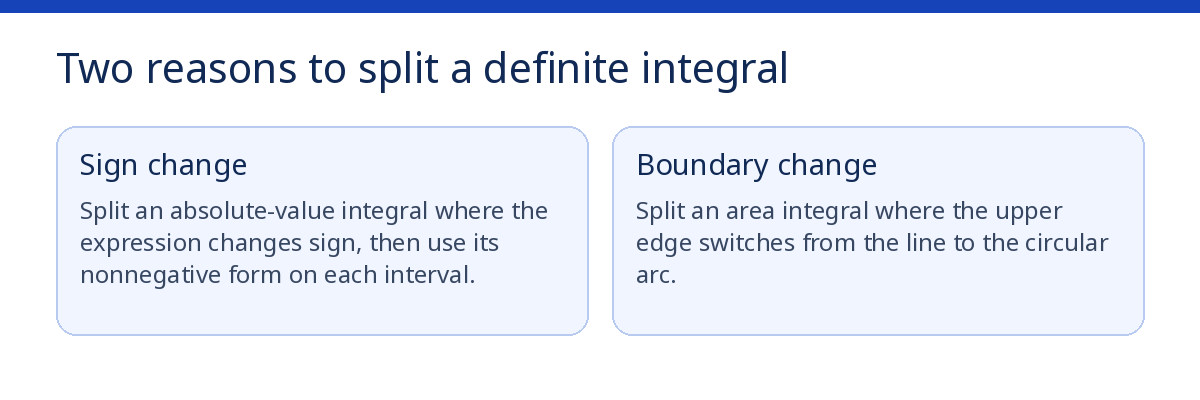
For a definite integral with an absolute value, first locate the zeros in the interval and check the sign between them. Keep the original expression where it is nonnegative and negate it where it is negative. Integrating the original expression across a sign change would allow contributions to cancel, which is not what the absolute-value integral measures.
Area between curves: check which boundary applies
The area material adds a different reason to split an integral. In the region involving a line and a circle, a vertical slice does not meet the same upper boundary throughout. The point where the line meets the arc determines where one boundary gives way to the other. The split is therefore a decision about the region, not a shortcut for evaluating an antiderivative.
Use the diagram alongside your algebra: identify the lower and upper boundaries on each interval before looking at the solution's integral setup. This makes it easier to distinguish two errors that can look alike in a final result: choosing the wrong limits and using the wrong function as the height of a slice.
Differential equations: check the domain before dividing
The differential equations illustrate several ways to recognise a useful transformation: exponentiating a logarithmic equation before separating variables, spotting a quotient derivative, and using a ratio substitution. The condition that makes a transformation valid belongs in the reasoning, not just at the end. In real-valued work, requires , while a ratio such as requires wherever that substitution is used. Logarithms of the variables themselves impose their own positivity conditions.
The worked solutions also distinguish nonzero-parameter cases from cases in which a parameter vanishes. When reviewing your attempt, note exactly where a constant first appears in a denominator. A formula derived by dividing by that constant cannot be applied unchanged when the constant is zero.
Vectors and 3D geometry: identify the object you need
A scalar projection gives a signed component along a direction; a vector projection gives a vector parallel to that direction. The projection solution distinguishes the two, and both require a nonzero vector to specify the direction. This is a useful check on notation: a number and a vector do not answer the same question.
The three-dimensional geometry questions also reward getting the representation right before calculating. Read a line's point and direction carefully from its symmetric form, including any coefficient attached to a coordinate. For coplanarity, the scalar triple product uses the two direction vectors and the displacement between points on the lines. A different task, finding the distance from a given point to a line–plane intersection, requires locating the intersection first. In a point-to-plane distance equation, retain the absolute value until you have considered both possible signs.
Probability: distinguish independence from conditioning
The paper gives several reasons to choose one probability model over another. In the card-draw question, replacement keeps the success probability fixed and makes the draws independent, supporting a binomial model for the number of successes. In the dice question, an observed sum restricts the sample space. If you calculate the conditional probability by counting, count favourable outcomes within that restricted space and make sure the outcomes counted are equally likely.
The mixture question distinguishes total probability from Bayes' theorem. To find the overall probability of an outcome, weight its conditional probability in each group by the group's share. To infer the group after observing the outcome, use the joint probability of that group and outcome as the numerator and the overall probability of the observed outcome as the denominator, provided it is positive.
After the timed attempt: find the first decision to revisit
Attempt the original paper before opening the worked pages, following the printed choices during your timed sitting. Afterwards, compare your chosen method with the Concept Used note before reading the calculation. If you chose the right method but reached a different result, look for the first step where your setup changes: a missing sign, an unsuitable boundary, or a condition that did not carry through the algebra.
Save unused OR alternatives for a separate attempt. They are useful for checking whether you can recognise a different method without the worked steps in view. For example, before calculating an integral, ask yourself whether the expression calls for algebraic rewriting, a change of variable, or a geometric interpretation, and what feature of the question supports that choice.
Spotted an error? Report a correction. Practise this in the app: notes, formula sheets and mind maps.





























































































































































Loading comments…