CBSE Class 12 Mathematics 2022 Term 2 Paper With Solutions
CBSEMathematics2022 Previous Year Paper
Paper code: 65/3/1 · 2022Practise the full 2022 CBSE Class 12 Mathematics Term 2 paper, then use the worked solutions to check why each method applies. The guide focuses on choosing an integration method, keeping track of domains, and distinguishing similar-looking tasks in probability, vectors and three-dimensional geometry.
This set is one of the year's papers. See every set from 2022, grouped by series.
Which 2022 paper this file contains
This year-wise resource contains the English version of the CBSE Class 12 Mathematics main examination paper for Term 2 of the 2021–22 session. The paper code is 65/3/1, the printed duration is two hours, and the maximum is 40 marks. These details describe this particular sitting, not the format of every CBSE Class 12 Mathematics examination.
The file presents the full question paper with its original layout, options and diagrams, followed by worked solutions for each question, subpart and both sides of the printed OR choices. You can navigate by question number. The solutions separate the formula used, concept used and explanation in steps, so you can check your choice of method before comparing the rest of your working.

Mathematics 2022 | Class 12 | Previous Year Paper | Code 65/3/1
In the StudentCurio app
Worked solutions for the 2022 CBSE Class 12 Mathematics paper, covering questions from topics including probability, integral calculus, vectors and three-dimensional geometry. Helps students practise past-paper questions and review solution methods.
Integral calculus: choose the method from the form
Several solutions show why the first step in integration is often to rewrite the expression. Completing the square can turn a quadratic denominator into a shifted square plus a positive constant, revealing the standard inverse-tangent form. In a different rational expression, partial fractions separate a product of quadratic factors into simpler terms. When reviewing these methods, compare what the algebra achieves: one exposes a standard form within a denominator, while the other splits the fraction into terms that can be integrated separately.
The definite integrals call for different decisions. One exploits symmetry by pairing two parts of an interval so their integrands simplify when added. Another uses a shift to recognise a quarter-circle area; the limits after the shift are what identify the relevant portion of the circle. For the area between a line and a parabola, the intersections set the bounds, and the integrand is the upper curve minus the lower one on the interval in question. That ordering matters because the geometric area is not a signed difference.
Domain checks before taking logs or dividing
In the differential-equation solutions, check which transformations are allowed before following the integration. When an exponential equals a square, the square cannot be zero because the exponential is strictly positive. Taking a natural logarithm then gives the identity for . Replacing with would discard the negative part of the allowed domain.
A quotient-derivative approach likewise requires a nonzero denominator on the interval where it is used. The printed logarithmic alternative has more restrictive conditions: the original logarithms require both variables to be positive. The worked method also retains the zero solution of the transformed equation. When comparing approaches, check whether dividing by an expression that could vanish would lose a valid case.
Probability: when to restrict, multiply or reverse
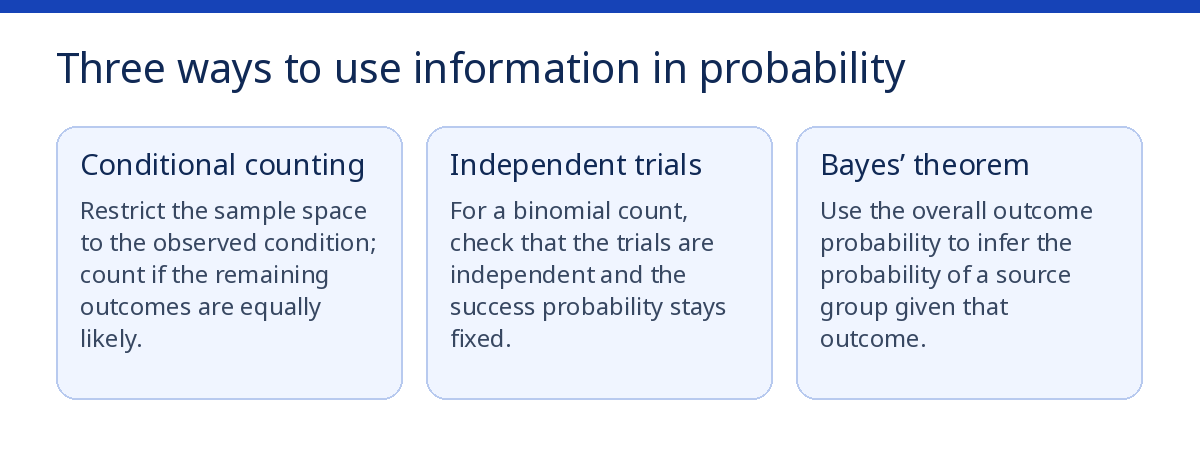
The probability questions distinguish a repeated-trial model from conditioning on information. Drawing with replacement in the card setting keeps the success probability unchanged and makes the draws independent. Those are the reasons a binomial model applies to the number of successes. The fact that there are two draws is not, by itself, enough to justify that model.
In the dice setting, the observed sum restricts the sample space. Counting favourable outcomes over all outcomes consistent with the observation works here because the ordered outcomes in that restricted space are equally likely. In the alternative involving independent attempts, the complement is useful: find the probability that both attempts fail, then subtract from one. Independence justifies multiplying the two failure probabilities, not the use of the complement itself.
The mixture question adds a distinction between total probability and Bayes’ theorem. Total probability combines the contributions from the different source groups, weighted by their proportions. Bayes’ theorem then uses that overall probability to work backwards from the observed outcome to the probability of a particular source group. Keeping track of what is given helps prevent reversing the conditioning.
Vectors and 3D geometry: match the operation to the result
The projection solution distinguishes a signed scalar component from a vector parallel to the direction of projection. Both use a dot product and require a nonzero direction vector, but they return different kinds of results. The paper also uses a zero dot product to express perpendicularity, while the magnitude of a cross product gives the area of the parallelogram formed by two side vectors.
In three-dimensional geometry, first identify what the given equation represents. For a line in symmetric form, extract a point and a direction carefully before using a scalar triple product to test coplanarity. For a line–plane intersection, substitute the parametric coordinates of the line into the plane equation. The paper also separates finding an intersection from finding a distance: in one setting you take the length of a displacement between points, while in the point-to-plane setting an absolute value makes the distance nonnegative. When solving a distance equation, keep both sign possibilities rather than simply dropping the absolute value.
Quick self-check after a timed attempt
Attempt the paper before opening the solutions. If you want to practise under the original time limit, set aside two hours and save the unused OR choices for a separate review. When you mark up your working, note the first line where your reasoning differs from the worked method rather than comparing only final expressions.
For each question you revisit, ask: What feature of the question justified my first step? Was there a domain restriction, a change in the sample space, or a distinction between a scalar and a vector? Try to explain that decision without the solution open, then redo the step that depended on it.
Spotted an error? Report a correction. Practise this in the app: notes, formula sheets and mind maps.





























































































































































Loading comments…