CBSE Class 12 Mathematics 2022 Term 2 Previous Year Paper
CBSEMathematics2022 Previous Year Paper
Paper code: 65(B)/5 · 2022The 2022 CBSE Class 12 Mathematics Term 2 paper pairs a full 40-mark question paper with worked solutions. Use it to practise under the original time limit, then check how you chose methods, handled conditions and set up each problem.
This set is one of the year's papers. See every set from 2022, grouped by series.
Paper format: two hours, three compulsory sections
This year-wise resource contains the English version of the 2021–22 Term 2 paper, code 65/B/5, presented as an adapted main examination paper. Section A has six 2-mark short-answer questions, Section B has four 3-mark short-answer questions, and Section C has four 4-mark long-answer questions. The final question is a case study with two 2-mark subparts.
All three sections are compulsory. An internal OR gives you a choice within a question, not permission to skip that question. For a timed attempt, follow the printed choices and stop at two hours. During review, try the alternatives you left out: the file includes worked solutions for both branches of the printed choices.

Mathematics 2022 | Class 12 | Previous Year Paper | Code 65(B)/5
In the StudentCurio app
CBSE Class 12 Mathematics Term 2 paper for the 2021–22 session, with worked solutions and a case-study question. It covers integrals, differential equations, vectors, three-dimensional geometry and probability.
Integrals: choose a method before calculating
The integration questions ask for more than finding an antiderivative. The paper includes recognising a standard form after completing a square, spotting an integrand as a derivative, and decomposing a rational expression into partial fractions. When a proper rational function has a linear factor and an irreducible quadratic factor in the denominator, the partial-fraction terms for those factors use a constant numerator and a numerator of degree at most one, respectively. Check that the decomposition recombines to the original expression before integrating.
When to split an integral: For an integrand inside absolute-value bars, split where the expression changes sign and remove the bars separately on each interval. If you substitute in a definite integral, express the limits in the new variable as well. For geometric area, identify the upper and lower boundaries first. In the ellipse question, the ordinates bound the region horizontally; integrating only the upper branch would omit the portion below the horizontal axis.
Differential equations: general and particular solutions
The paper includes separation of variables and a substitution based on the ratio . These are different decisions: separation rearranges an equation so each variable and its differential occur on the same side, while the ratio substitution introduces a new variable and requires . The exact equation in Question 2 is not reproduced here because its supplied text extraction is unclear; consult the rendered question when attempting it.
A general solution retains an arbitrary constant. A particular solution uses a given condition to select a member of that family. When reviewing the alternative with an initial condition, check both the differential equation and the condition. Satisfying the condition alone does not verify the solution.
Vectors and 3D geometry: direction, area and distance
The vector questions use the dot and cross products in different ways. The dot product and the two vector lengths can determine the magnitude of a cross product. When two vectors represent sides from the same triangle vertex, that magnitude gives the corresponding parallelogram area, so the triangle takes half of it. In three-dimensional geometry, direction ratios need only be proportional to a direction vector; direction cosines are the components after normalising that vector to unit length.
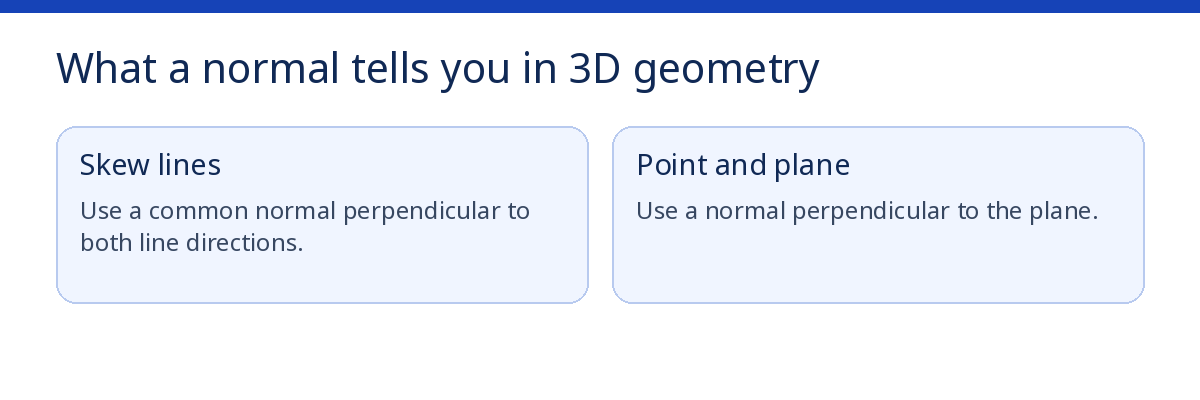
Check what the normal is perpendicular to: The shortest-distance formula for skew lines uses a common normal obtained from their nonparallel direction vectors. A point-to-plane distance instead uses a normal to the plane, which can be constructed from two nonparallel vectors in it. In both distance calculations, normalisation matters. For a line–plane intersection, the goal changes: look for a point on the line whose coordinates also satisfy the plane equation.
Probability: conditioning is not the same as counting draws
The coin question illustrates how given information restricts a sample space. Counting favourable outcomes over the remaining outcomes is valid when those outcomes are equally likely; the worked solution uses the standard assumption of independent fair coins. Write down the condition before deciding which outcomes belong in the denominator.
The apple question asks for a probability distribution, not the probability of just one event. Define the random variable as the number of rotten apples drawn and account for every possible value. Because the draws are without replacement, the first draw changes the composition available for the second. As a check, the probabilities assigned to all possible counts should sum to one.
The case study: read the direction of each conditional
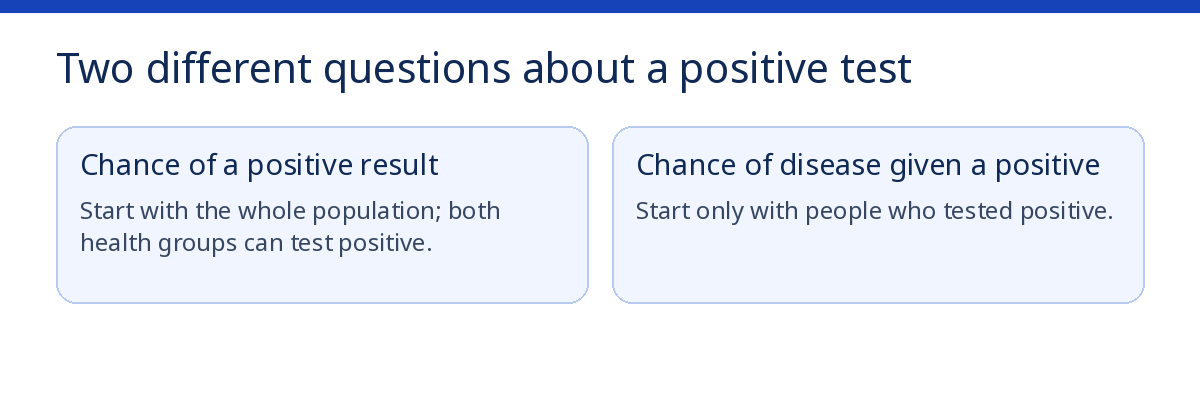
Question 14 distinguishes the probability of receiving a positive test result from the probability of having the disease given a positive result. The first includes positive results from both groups: people with the disease and people without it. Total probability combines those contributions, weighting each group's positive rate by its share of the population.
The second subpart takes a positive result as already given. Bayes’ theorem relates the probability of disease within that group to the rate of positive results among people with the disease, but the two probabilities are not interchangeable. When reading the case, label who is being considered in each rate. A false-positive rate applies to healthy people tested, not to everyone who receives a positive result.
Use the worked solutions to find your first wrong step
The solution pages separate the formula used, the concept used and the explanation in steps. Use those labels to diagnose an attempt rather than checking only the final line. If you stalled, read the concept first and return to your own work. If you reached a different result, find the first step where your reasoning diverged. A missed boundary, an incorrectly chosen normal or a reversed conditioning event calls for a different correction from an arithmetic slip. For an internal choice, try the unused branch before opening its solution so that it remains a fresh check of method selection.
Spotted an error? Report a correction. Practise this in the app: notes, formula sheets and mind maps.





























































































































































Loading comments…