CBSE Class 12 Mathematics 2022 Term 2 Paper with Solutions
CBSEMathematics2022 Previous Year Paper
Paper code: 65/5/3 · 2022Practise with the full English-language CBSE Class 12 Mathematics Term 2 paper from 2022, code 65/5/3. Use the worked solutions to review how you chose a method, handled its conditions and explained your reasoning.
This set is one of the year's papers. See every set from 2022, grouped by series.
What this year-wise paper contains
This is the 2022 main examination paper for Term 2 of the 2021–22 CBSE session. The printed time is two hours and the maximum is 40 marks. The file preserves the original English question layout, printed choices and diagrams, and includes a case-study question. These details describe this particular paper; use them to recreate its conditions rather than assuming they apply to another CBSE paper.
The question paper and worked solutions are presented separately, with links by question number. The solutions cover the questions, subparts and both alternatives where an OR is printed. Each solution distinguishes the formula used, the concept behind the method and the steps that connect them. That structure makes it possible to review a choice of method without going straight to the final answer.

Mathematics 2022 | Class 12 | Previous Year Paper | Code 65/5/3
In the StudentCurio app
The complete CBSE Class 12 Mathematics Term 2 paper for 2022 (code 65/5/3), with worked, step-by-step solutions for its questions. It covers a range of syllabus topics and includes a case-study question, helping students practise the exam format and review solution methods.
Integration: let the expression guide the method
The paper gives you several reasons to look at the form of an integrand before calculating. Completing the square can reveal the inverse-sine standard form in a square-root denominator. For a real integrand, the expression under that square root must be strictly positive: an endpoint where the root is zero also makes the denominator zero. In another question, a substitution makes a rational expression suitable for partial fractions. The point is to see what the substitution simplifies, not just which letter it introduces.
An exponential multiplied by a trigonometric function illustrates a different pattern: two rounds of integration by parts can bring back the original integral, which you then treat as an algebraic unknown. A definite integral instead uses reflection. On an interval , the substitution exchanges the endpoints. The useful check is what happens to the integrand under that reflection, not merely whether the interval maps onto itself.
Good to remember: track what an algebraic step excludes
The differential equations illustrate two reasons to rewrite an equation. One rewrite makes a chain-rule derivative visible; another puts the equation in linear form so an integrating factor can turn its left-hand side into a product derivative. An alternative also shows why it can help to change which variable is treated as independent and introduce a new dependent expression.
While reviewing these methods, mark any step that divides by a variable or a trigonometric expression. The rewritten equation is valid only where that divisor is defined and nonzero. If a candidate solution was excluded by division, test it in the original equation rather than discarding it automatically. Likewise, when an implicit relation is rewritten using a real logarithm, its argument must be positive.
Read the geometry before choosing a formula
Direction ratios describe a line's direction, while direction cosines are the components of a unit vector in that direction. When the coordinate terms in a symmetric equation have different coefficients, read the direction from the parametric form rather than taking the denominators as direction ratios without checking. Normalising a nonzero direction vector gives direction cosines; reversing the orientation changes all three signs together.
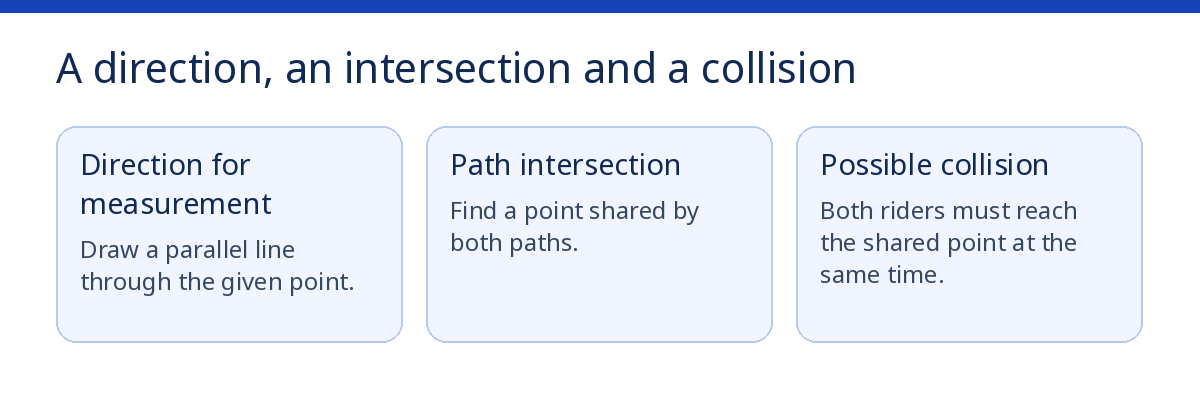
For a distance measured along a stated line direction, the reference line can supply the direction even if the given point is not on that line. This is different from measuring perpendicular distance to a plane. In the paper's rider scenario, there is another distinction: an intersection shows where the paths meet, but a collision also requires both riders to reach that point at the same time.
Probability: separate totals, joint events and conditions
The probability questions call for different checks. For a discrete distribution, express each probability in terms of the same unknown before applying the requirement that all the probabilities sum to one. For an experiment with independent draws, multiplication gives the probability of a specified joint outcome; probabilities for mutually exclusive ways of meeting the same condition can then be added.
A box-selection problem reverses the viewpoint. Once the colour is known, the question concerns the probability of a box given that observation, not the chance of the colour given the box. When reviewing the setup, check that the total probability of the observed colour includes every possible box. This guide omits the printed probability alternative flagged in the file for inconsistent data; the other probability questions can be studied independently.
Quick self-check: can you justify the setup?
After a timed attempt, use the question links to revisit the places where you hesitated. Read the concept note before the steps, then see if you can explain why your method applies. For the area question, for example, can you tell from the graph where an absolute-value boundary changes its expression? If the upper curve stays the same but the lower one changes, explain why the integral needs separate pieces even though the enclosed region is continuous.
For a printed OR, try the other alternative after the timed attempt. Compare the two by naming the clue that led to each method. If you chose a sound method but lost track of a sign or a restriction, revisit that line rather than treating the entire approach as wrong.
Spotted an error? Report a correction. Practise this in the app: notes, formula sheets and mind maps.





























































































































































Loading comments…