Linear Programming: CBSE Class 12 PYQs and Solutions Guide
CBSEMathematicsLinear Programming
Linear Programming in CBSE Class 12 Mathematics asks you to optimise a linear objective function over a feasible region formed by linear inequalities. This guide covers shading constraints, the corner point method, unbounded regions, reading constraints from a graph and multiple optima, using the patterns in a 99-question PYQ collection labelled 2023-2026.
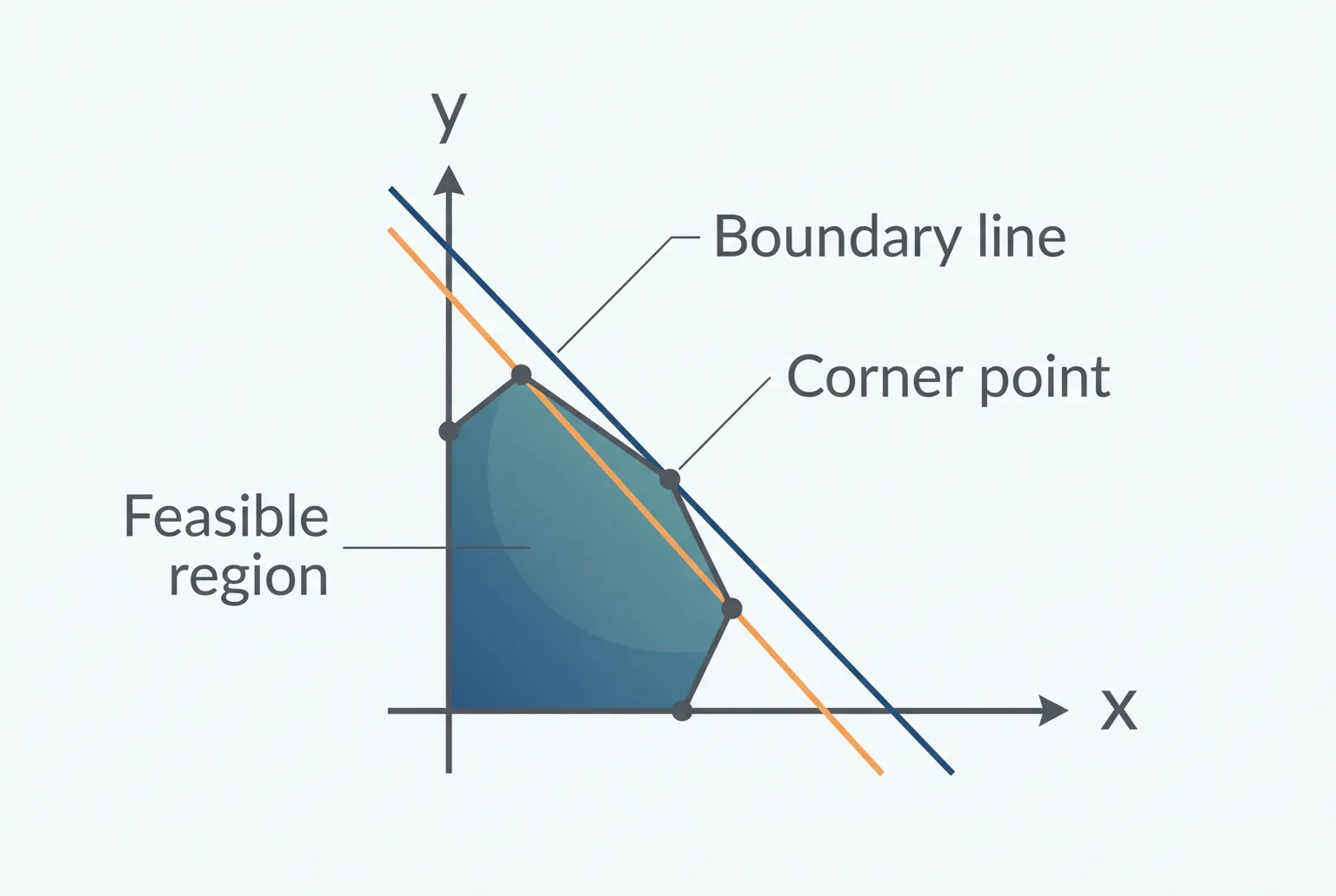
Six sub-topics across 99 board questions
The collection has 99 CBSE Class 12 previous-year questions on Chapter 12. They carry exam labels from 2023 to 2026 and include main sets, Delhi and Outside Delhi papers, and compartment sets. Each question links to a numbered worked solution.
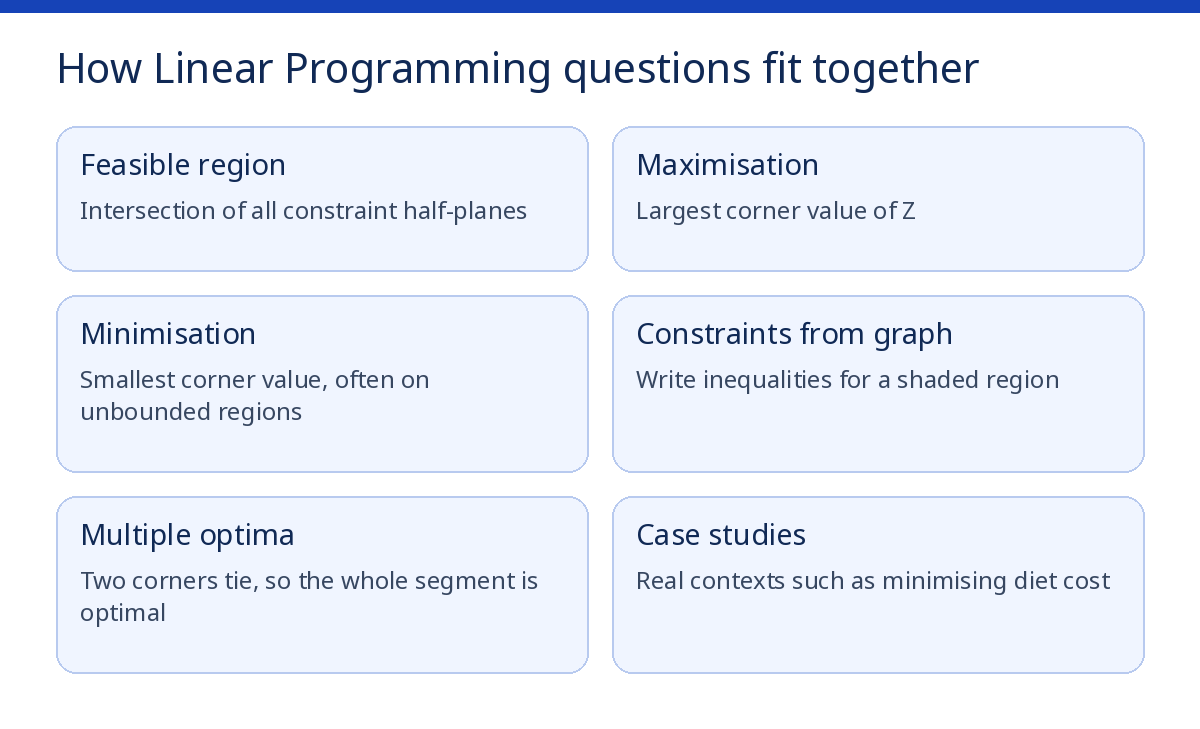
The topic index sorts the questions into six groups:
- graphical maximisation (33)
- graphical minimisation (22)
- feasible regions and constraints (18)
- corner points and multiple optima (16)
- objective functions and LPP concepts (8)
- applications and case studies (2)
The questions come in four formats: subjective, case-based, MCQ (single correct answer) and assertion and reason. In the original serial order, Q1–Q62 are subjective and the MCQs begin at Q63. More than half the collection asks for a complete graphical solution, so the method below is where most of the marks lie.

Linear Programming | Class 12 | Previous Year Paper
In the StudentCurio app
A collection of 99 solved CBSE Class 12 Linear Programming previous-year questions covering feasible regions, constraints, graphical maximisation and minimisation, and optimal solutions. Helps students practise exam-style problems and review solution methods.
Turning each constraint into a half-plane
Every problem has three parts:
- an objective function of the form , which you maximise or minimise
- linear constraints
- the non-negativity conditions , which keep the work in the first quadrant
To graph a constraint, first replace the inequality sign with to get the boundary line. Plot it using its intercepts. For example, meets the axes at and .
Next, decide which side of the line to keep by testing a point. The origin is the easiest test point, but it fails when the line passes through it. Constraints such as , and , which appear in these papers, all pass through . For these, test a point like instead.
Constraints such as , or are vertical or horizontal lines. The feasible region is the overlap of every half-plane. Its corner points are the vertices, which you find by solving pairs of boundary equations simultaneously.
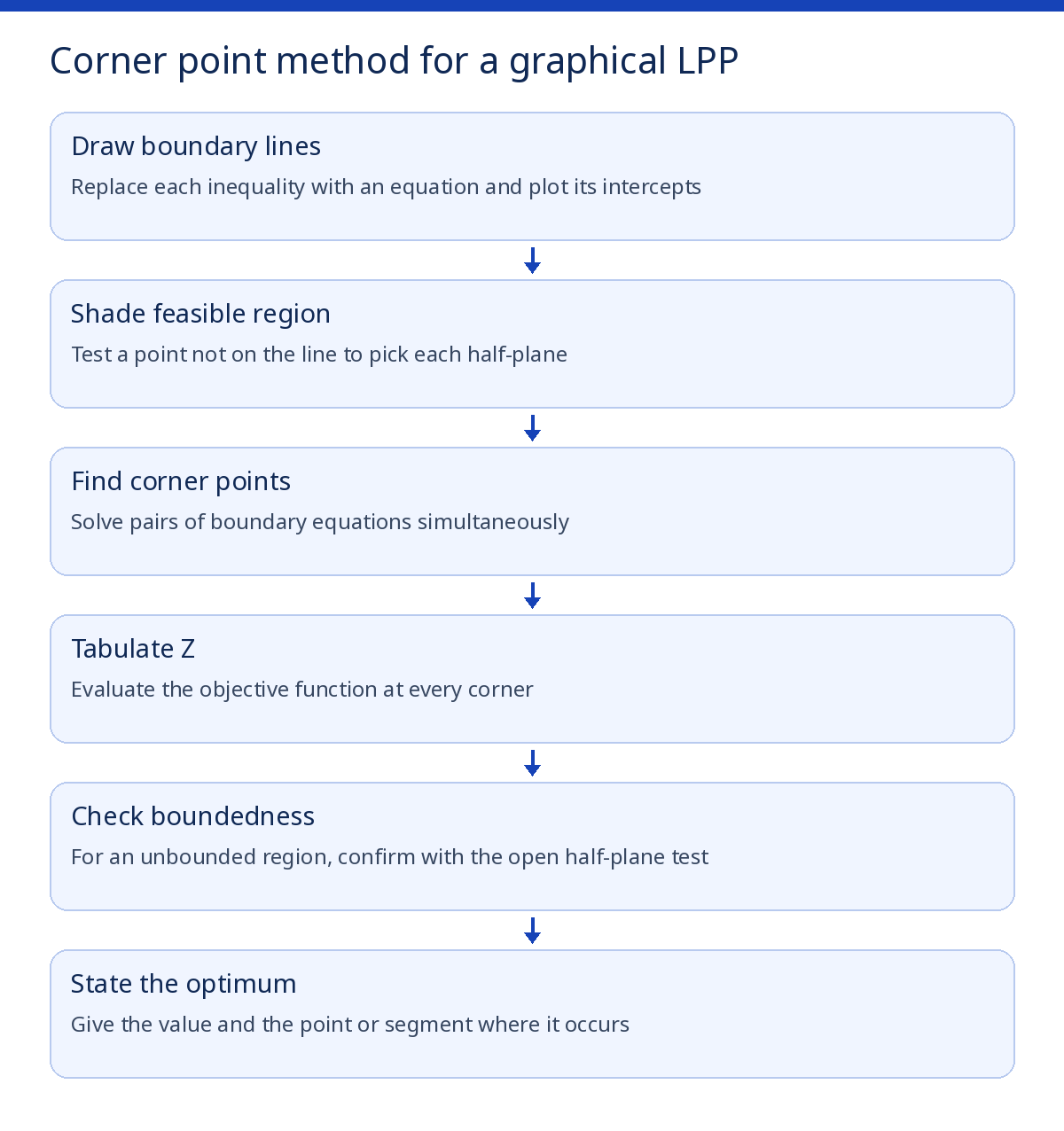
The corner point method for maximum and minimum
Most subjective questions say "solve graphically" and expect a visible sequence of steps:
- Draw every boundary line.
- Shade the feasible region.
- Label all corner points with their coordinates.
- Make a table of at each corner.
- State the optimal value and the point where it occurs.
The method rests on one result. When the feasible region is bounded, the maximum and the minimum of both exist and occur at corner points. You therefore never need to test interior points.
Several questions use cost or profit coefficients such as , so careful arithmetic in the table matters as much as the graph. Others use negative coefficients, such as minimising or maximising . The method does not change. Do not assume the origin or the largest corner gives the answer. Evaluate every corner.
When the feasible region is unbounded
Minimisation problems built from "" constraints, such as with , often produce a region that extends without limit. On such a region an optimum may not exist. The smallest corner value is only a candidate.
The standard NCERT check works like this. Suppose is the candidate minimum. Draw the open half-plane . If it shares no point with the feasible region, is the minimum. For a maximum, use in the same way.
Read question wording closely. The case-based diet question, set during Rashtriya Poshan Maah, asks for the minimum cost "assuming that minimum cost is possible for the given unbounded region". There, the assumption is given to you.
One MCQ tests whether a system of inequations describes a bounded or unbounded region, and in which quadrant. So recognising boundedness is a skill in its own right.
Reading constraints back from a given graph
Some questions reverse the usual task. You are shown a shaded region and must write the constraints that produce it. A typical stem gives a region with corners , , , and and asks for every constraint. The diet case study opens the same way, and one MCQ asks you to choose the correct pair of "non-trivial" constraints.
Work in this order:
- Identify each boundary line from two labelled points on it.
- Write its equation.
- Pick a point inside the shaded region and substitute it to fix the inequality direction.
- Add wherever the region sits in the first quadrant.
The skill is the same as shading, run backwards.
Multiple optima and conditions on p and q
Two adjacent corner points of a bounded region can give the same optimal value of . When that happens, every point on the segment joining them is also optimal. The topic index groups 16 questions under this idea.
A typical stem gives with and asks for the condition under which the maximum occurs at two named corners. Another variant names a whole segment of optimal points.
The reasoning is direct. Write at both corners in terms of and , then set the two expressions equal. The relation you get is the required condition. Compare it with the options before choosing.
Common mistakes in shading and corner work
- Testing the origin on a line through the origin. For or , the point lies on the line, so it cannot show which side to keep.
- Missing a corner. Every intersection of two boundaries that lies inside all the other constraints is a corner. Leaving one out can change the optimum.
- Reporting an unbounded optimum without checking. The smallest corner value is a candidate until the half-plane test confirms it, unless the question states the assumption.
- Stopping at a single point when two corners tie. If two corners give the same optimal value, the whole segment between them is optimal.
A practice route through the collection
Follow the topic index rather than the serial order:
- Feasible regions and constraints. Start here, because each later question depends on a correct region.
- Graphical maximisation, then graphical minimisation. Minimisation is where unbounded regions appear most often.
- Corner points and multiple optima.
- MCQs, case-based and assertion-reason items. Use these to test definitions and quick judgements.
Attempt each question on graph paper before opening its worked solution. Then compare your corner list and -table line by line with the solution.
Quick self-check: can you explain why a bounded region guarantees both a maximum and a minimum, while an unbounded one does not?
Frequently asked questions
Which question formats appear in this Linear Programming collection?
The collection has subjective, case-based, MCQ (single correct answer) and assertion and reason questions, all with worked solutions.
Which sub-topic has the most questions?
Graphical maximisation, with 33 of the 99 questions, followed by graphical minimisation with 22.
Spotted an error? Report a correction. Practise this in the app: notes, formula sheets and mind maps.





























































































































































Loading comments…