Continuity and Differentiability: Class 12 NCERT Notes
CBSEMathematicsLimit, Continuity and Differentiability
These CBSE Class 12 Mathematics notes use limits to explain continuity before moving on to differentiability and derivative techniques. The worked examples and chapter index let you revisit a specific skill, from checking a piecewise join to finding a second derivative.
A limit describes the approach, not the value
The notes begin by revisiting left- and right-hand limits from Class 11. A left-hand limit describes what happens to the output as the input approaches a point from smaller values. A right-hand limit does the same from larger values. The finite two-sided limit exists only when both one-sided limits exist as finite numbers and agree. Neither calculation uses the value assigned at the point itself.
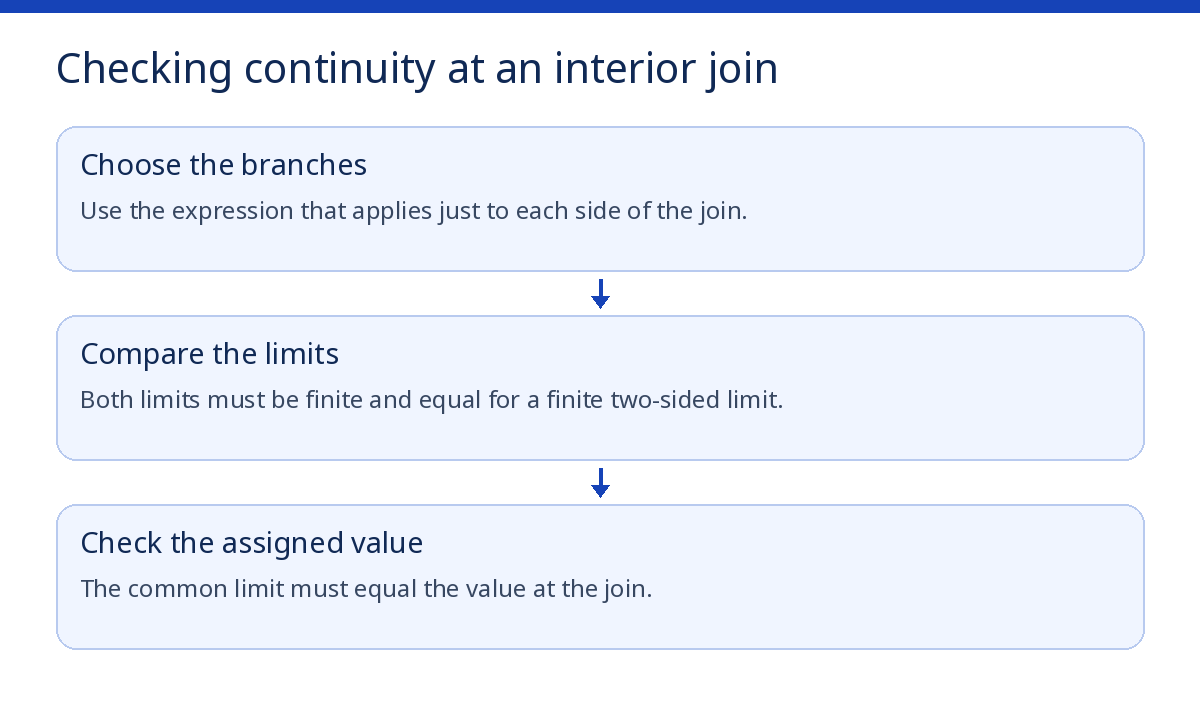
This distinction matters most when a function is defined by different expressions on different parts of its domain. For a piecewise join, first identify the expression that applies just to the left and the one that applies just to the right. The branch that includes the equality sign tells you which expression supplies the function value, not which expression to use for both limits.

Continuity and Differentiability | Class 12 | NCERT Notes
In the StudentCurio app
These revision notes cover continuity, differentiability and derivative techniques including the chain rule, implicit and parametric differentiation, logarithmic differentiation, and higher-order derivatives. They help Class 12 students review concepts and practise worked examples.
Common mistake: stopping when the limits agree
At an interior point , continuity requires . The notes use two graphical illustrations to separate the ways this check can fail. In one, the two sides approach different heights, so assigning a different value at the join cannot make the function continuous. In the other, both sides approach the same height, but the assigned point sits at a different height. Here the limit exists; the failure is that it does not match the function value.
The notes also distinguish continuity at a point from continuity on an interval. On a closed interval, check continuity at every interior point, use the right-hand limit at the left endpoint, and use the left-hand limit at the right endpoint. Each endpoint limit must equal the function value there.
Use continuity rules before testing every point
The properties section gives shortcuts when you can recognise familiar functions. Polynomials are continuous for every real input. Rational and trigonometric functions are continuous on their respective domains, so the domain still matters. If two functions are continuous at a point, their sum, difference and product are continuous there. The quotient rule for continuity has an extra condition: the denominator must be nonzero at that point.
For a composition , check the inner and outer functions at different inputs. The inner function must be continuous at , and the outer function must be defined and continuous at . These rules explain why the piecewise examples can focus on joins: once a rule establishes continuity within each piece, the joins are the places where the separate expressions still need to be compared.
A useful connection: a corner can be continuous
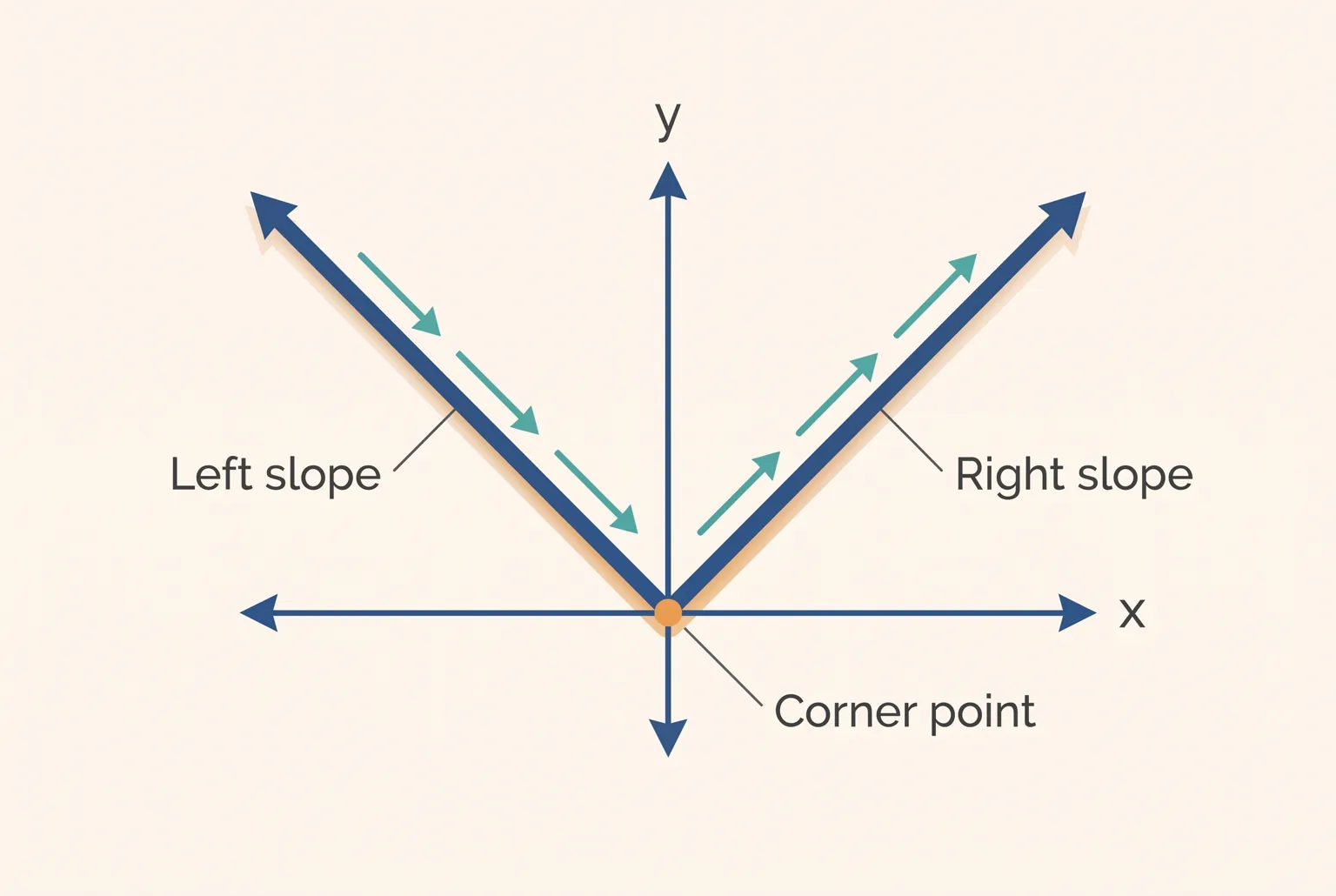
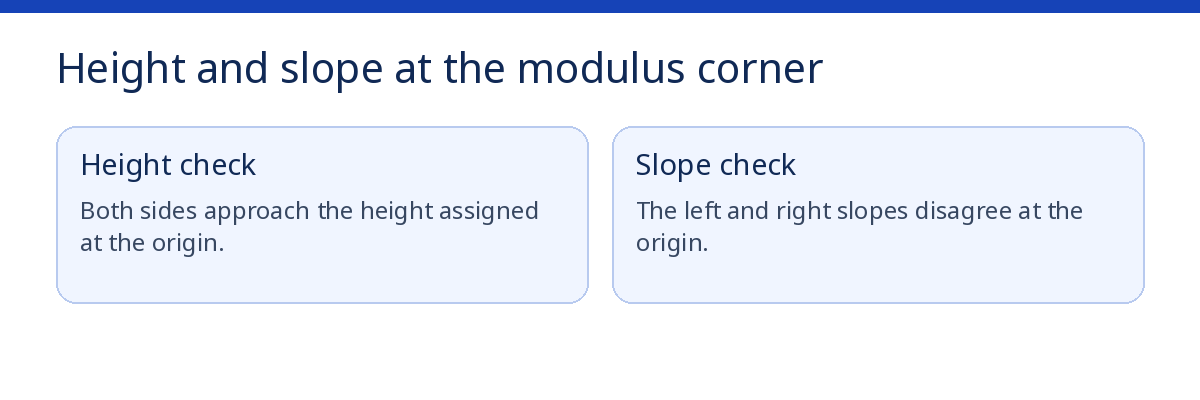
The cover's graph of makes the distinction between continuity and differentiability visible. The two sides meet at the origin, so there is no break in the graph there. But the slope on the left differs from the slope on the right. At an interior point, differentiability requires finite, equal left- and right-hand derivatives, not merely equal left- and right-hand limits of the function.
Differentiability at a point implies continuity there, but continuity alone does not establish differentiability. This gives you an order for checking a join: a failure of continuity rules out differentiability, while a successful continuity check leaves the slopes to be tested. Keep the two comparisons separate: continuity compares heights, whereas the derivative test compares limiting slopes.
Choose a derivative method from the function’s form
The differentiation entries in the index are easier to navigate if you identify how the variables are related before looking for a formula. For a composite expression, the chain rule combines the derivative of the outer function, evaluated at the inner expression, with the derivative of the inner expression. Implicit differentiation applies when a relation involves both variables without first isolating the dependent variable. When differentiating with respect to the independent variable, account for the fact that the dependent variable itself varies.
In a parametric representation, both coordinates are given in terms of a third variable. To obtain the slope by dividing their derivatives with respect to that parameter, the derivative of the horizontal coordinate must be nonzero. The index also points to inverse trigonometric, exponential and logarithmic functions. Logarithmic differentiation is a technique rather than a function family: taking a real logarithm can turn products into sums when the expressions being logged are positive.
Quick self-check: identify the step that needs a rule
Use the chapter index to choose a worked example that targets the decision you find hardest. In a continuity example with unknown constants, write the two limits and the point value separately before forming equations. Ask which equality links the two branches and which one checks the assigned value. If the task is to locate discontinuities instead, ask which parts are already covered by a continuity rule and which points still need a direct check.
For second derivatives, the notes show the product and chain rules being used when differentiating a first derivative. Before reading the calculation, ask which factors depend on the variable and where an inner derivative is needed. Then use the chapter summary to revisit the relevant conditions. This guide focuses on those decisions rather than reproducing worked-example answers or assessment solutions.
Spotted an error? Report a correction. Practise this in the app: notes, formula sheets and mind maps.





























































































































































Loading comments…