Inverse Trigonometric Functions: CBSE Class 12 PYQs and Solutions
CBSEMathematicsTrigonometry
This guide to the CBSE Class 12 Inverse Trigonometric Functions previous-year collection explains the principal value branches that every question depends on. It also shows how board papers test domains of composed expressions, sin⁻¹(sin θ)-type evaluation, graph identification, assertion-reason statements and multi-part subjective items.
Principal value branches behind every question
A trigonometric function is not one-one over its full domain, so it has no single-valued inverse there. It must first be restricted to a branch. Unless a question says otherwise, the collection works in radians and reads inverse notation as the principal branch:
- : domain , range
- : domain , range
- : domain , range
- : domain , range
- : domain , range
- : same domain, range
The brackets carry meaning. The ranges of and are open, so their endpoints are never reached. The sec and cosec ranges each omit one point. Some subjective items also ask for a range of other than its principal branch. Remember that the principal branch is a convention chosen from several possible branches.

Inverse-Trigonometric-Functions|Trigonometry | Class 12 | Previous Year Paper
In the StudentCurio app
A collection of 82 CBSE previous-year questions on inverse trigonometric functions, with worked solutions and exam-style practice. It covers principal values, domains and ranges, identities, equations, graphs and related applications for Class 12 students.
Finding domains of arguments such as cos⁻¹(2x − 5)
Domain questions recur in both the MCQ and subjective sections. A typical stem asks for the domain of or . The method is the same each time: the inner expression must lie in the domain of the outer inverse function.
- For and , solve the double inequality . A linear argument gives one closed interval.
- Quadratic arguments such as , or need care. The inequality can split into two intervals or shrink to very few values.
- For the condition reverses to . This gives a union of two rays, not a single interval.
- For a sum such as , the domain is the intersection of the separate domains.
Range items build on the branch table. If or , scale or divide the principal range accordingly. For a restricted input such as , find the image of only that part of the domain.
Evaluating sin⁻¹(sin θ) when θ lies outside the branch
The largest group in the topic index is principal values and evaluation. Many of these items look like or . The identity holds only when . Likewise, only when .
When the given angle lies outside these intervals, find the angle in the principal range that has the same sine or cosine. Use the period and symmetries such as . Mixed forms, such as the sine inverse of a cosine of a large angle, first need converting into one function.
Combination items, for example , follow a simple rule: evaluate each term inside its own branch, then combine. Negative arguments are the usual trap. Because and have ranges inside , their principal values are never negative.
Identifying inverse function graphs from labelled points
Eleven questions are graph-based. Most show a curve with labelled points such as , or and ask which function it represents.
Start with the horizontal extent. A curve confined to points to sine or cosine inverse. One running across all of points to tangent or cotangent inverse. One with a gap between and points to secant or cosecant inverse. Then check the vertical extent against the branch table, and notice whether the curve approaches a horizontal level or stops at an endpoint.
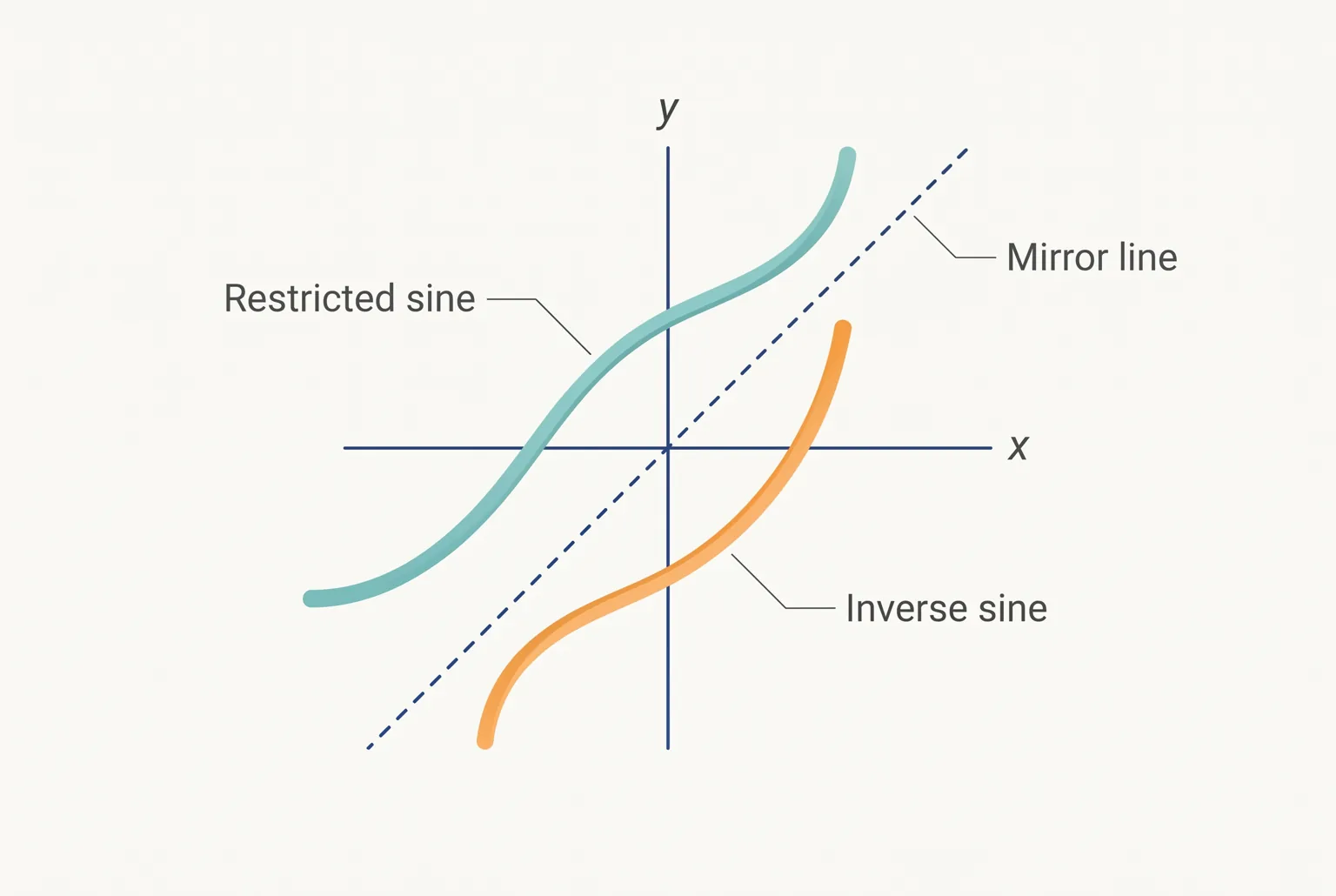
Other items show a trigonometric curve together with the line , or ask for the graph of an inverse. The graph of an inverse is the reflection of the restricted branch in .
Testing assertion-reason statements against the branch table
The eight assertion-reason questions use the standard four options. Their statements concern domains, principal ranges, the maximum of , or the range of an expression such as . Some printed statements are deliberately incorrect.
Do not trust any branch a statement quotes. Check the assertion and the reason separately against the table, and only then decide whether the reason actually explains the assertion. A related MCQ asks which principal branch is not correctly defined, and the same independent checking applies.
Simplification, proofs and 'hence' chains in subjective items
The 40 subjective questions include several framings.
- Simplification under a stated interval. One example simplifies for . Rewrite the inner expression as one ratio of a single angle. Then use the interval to confirm that angle lies in the principal range before cancelling.
- Proofs such as , , rely on a substitution that turns the algebra into a trigonometric ratio.
- 'Hence' chains ask you to find a domain, then solve, for example, , then state the range of a transformed expression.
The collection keeps all 14 printed OR alternatives, including some from related chapters, such as a relations part.
Common slips the added solutions guard against
The added solutions number each step and show the formulas, domain checks, substitutions and principal-value restrictions. Those steps target these errors:
- Writing without first checking that lies in the branch.
- Giving a negative principal value for or of a negative number.
- Using for or instead of .
- Treating open endpoints of and as attained.
- Ignoring the interval attached to a simplification, which decides which branch formula applies.
Working through the 82 questions by topic
The collection prints 82 questions: 42 single-answer MCQs and 40 subjective questions. The exam-year labels run from 2023 to 2026 and keep the set, region and compartment tags taken from the question headers. Marks are not given.
The original source supplied only an MCQ answer key, so every worked solution is marked Added solution. Review notes at the end flag ambiguities and branch conventions.
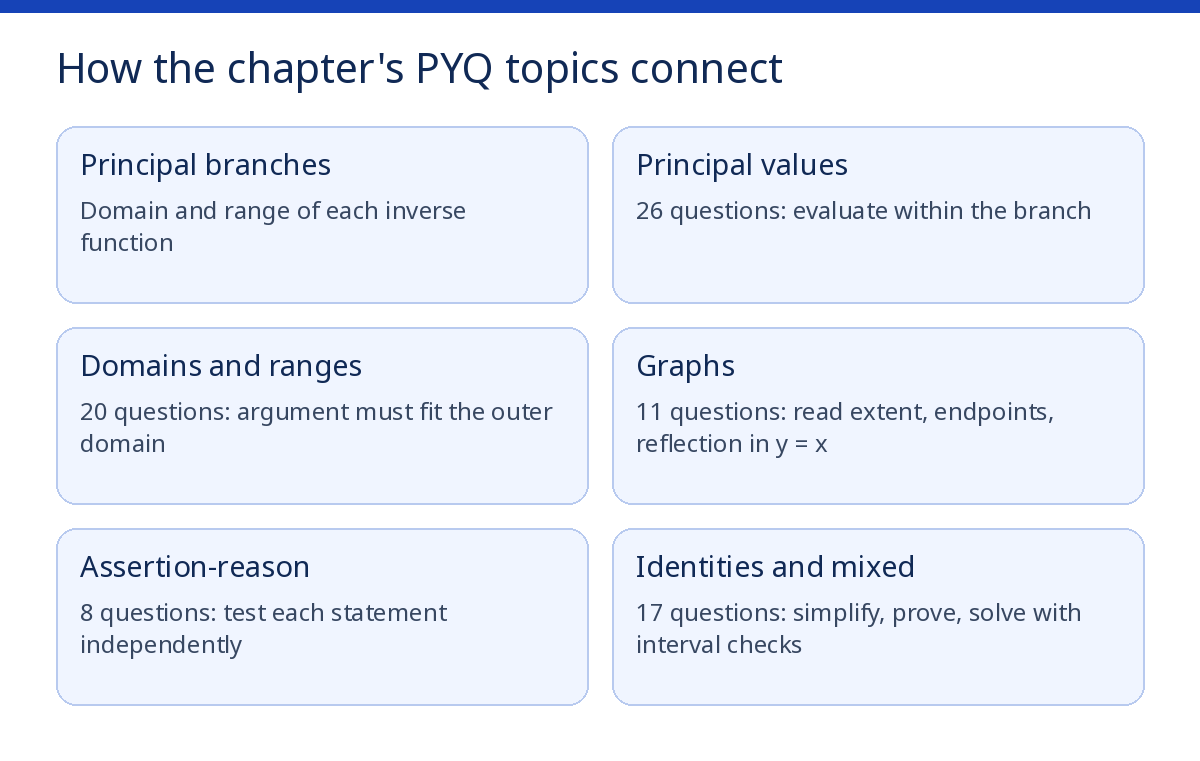
The topic index lists 26 principal-value, 20 domain-and-range, 11 graph, 8 assertion-reason, 8 identity-and-equation and 9 mixed questions. A sensible order is principal values, then domains, then graphs. Leave assertion-reason, identities and mixed items until the branch table is automatic. Attempt each question before selecting View Solution.
Quick self-check: Can you explain why a cosine inverse can never return a negative angle, and why the domain condition for differs from that for ?
Frequently asked questions
Are the worked solutions official CBSE answers?
No. The source provided only an MCQ answer key, and every worked solution in the collection is marked Added solution.
Does the collection show marks for each question?
No. Marks are absent from the supplied labels and are omitted. Exam years, sets and regions are kept from the question headers.
Spotted an error? Report a correction. Practise this in the app: notes, formula sheets and mind maps.





























































































































































Loading comments…