Inverse Trigonometric Functions: Class 12 NCERT Guide
CBSEMathematicsInverse Trigonometric Functions
Chapter 2 of the NCERT Mathematics textbook for CBSE Class 12 explains how a trigonometric value can determine a unique angle. Use its graphs, principal-branch tables and exercises to check when an inverse is defined and when a simplification is valid.
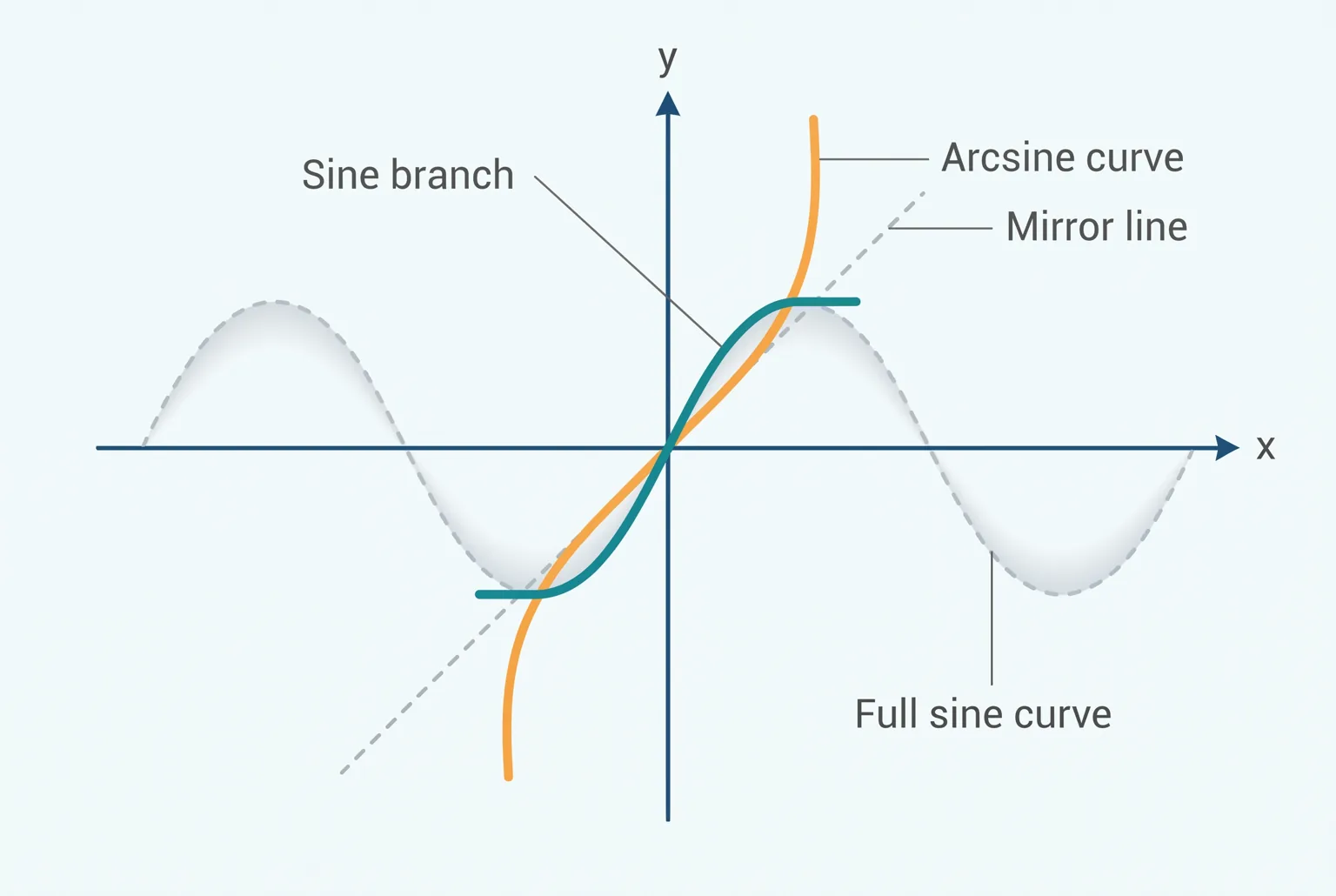
Why trigonometric functions need a restricted domain
The chapter builds on two ideas you have already met: trigonometric functions from Class 11 and invertibility from the preceding Class 12 chapter. To reverse a function, each value in its target set must come from exactly one input. Sine on the whole real line fails this test: it reaches every value between negative one and one, but different angles can have the same sine. That makes the reverse assignment ambiguous.
NCERT resolves this by choosing an interval of angles on which sine is one-to-one while still reaching its entire range. The inverse then takes a sine value as input and returns the unique angle in that interval. Other restrictions can produce other branches. When the textbook names no branch, it means the principal branch.

Inverse Trigonometric Functions | Class 12 | NCERT Textbook
In the StudentCurio app
This NCERT textbook chapter covers principal-value branches, domains and ranges, graphs, and properties of inverse trigonometric functions, with worked examples and exercises. It helps Class 12 students evaluate and simplify expressions, prove identities, and solve related questions.
Read the six principal branches in pairs
The table at the end of Section 2.2 and the chapter summary give both the domain, which tells you what may go in, and the range, which tells you where the returned angle must lie. Compare the rows in pairs to see why knowing the allowed input is not enough to determine the allowed output.
- Arcsine and arccosine both accept . Arcsine returns an angle in , while arccosine returns one in . Both ranges include their endpoints.
- Arctangent and inverse cotangent accept any real number. Their ranges are and respectively. Neither range includes its endpoints.
- Inverse secant and inverse cosecant accept inputs satisfying . Inverse secant returns an angle in ; inverse cosecant returns one in .
Notice the difference between an open interval and a closed interval with a point removed. In the reciprocal-function pair, the endpoints of the angle intervals are included, but an interior angle is excluded because the corresponding original function is undefined there.
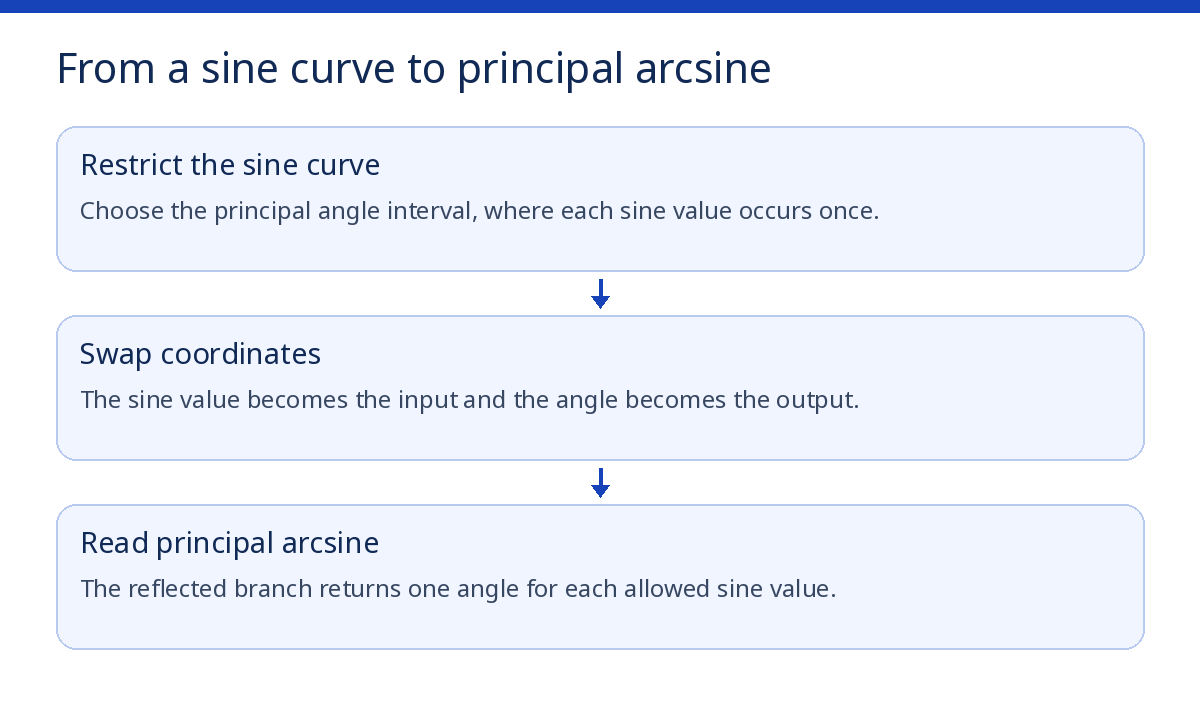
Graph connection: Reflect the branch, not the full curve
Read the sine figures by first locating the restricted part of the original graph. If a point belongs to that branch, the point belongs to its inverse. Swapping the coordinates reflects the branch across the line . This is the graphical reason that the original branch’s angle interval becomes the inverse’s range, while the original branch’s output values become the inverse’s domain.
The full sine curve is not the one to reflect if you want the principal inverse as a function. Where several original angles share a sine value, the reflected curve would assign several angles to a single input. Use the chapter’s paired graphs to connect the interval notation in the table to the part of each curve being reversed.
Two common mistakes: Reciprocals and cancellation
The superscript in denotes an inverse function, not a reciprocal. The expression returns an angle with sine equal to the input. By contrast, takes an angle, finds its sine and takes the reciprocal where the sine is nonzero. The two expressions do different jobs and do not share a domain.
The order of composition matters too. In , the input is a sine value and must lie in . In , the input is an angle, and the equality holds only for . If the starting angle is outside that interval, taking its sine and then applying arcsine still gives a principal angle, but it does not return the original one.
Why the conditions in Section 2.3 matter
The properties section moves from reading a principal value to justifying a simplification. A substitution such as gives more information than : it also places the angle in the principal range. Keep that information when you use a trigonometric identity. An identity may rewrite an expression as the sine of a multiple of the angle, but the new angle need not lie in the same interval as the original one.
This is why an interval printed beside a proof or simplification is part of the question, not an optional hint. Check whether the original expression is defined, then check whether the angle at the cancellation step belongs to the relevant principal range. The chapter notes that some properties hold on only part of an inverse function’s domain.
How to work through the NCERT exercises
Start with Exercise 2.1, which asks for principal values and includes expressions that combine inverse functions. For an individual value, write the corresponding trigonometric equation and check that your chosen angle lies in the required range. When a question combines several inverse functions, identify the range for each term rather than assuming that the same angle interval applies throughout.
In Exercise 2.2, shift your attention to proof and simplification. Read the stated restrictions before choosing a substitution, and note where those restrictions justify a step. The Miscellaneous Exercise then brings together evaluations, identities and equations. When working on an equation, check any candidate in the original expression: the operations you use to find it do not remove the original domain restrictions. The chapter summary is useful for checking a branch after you have identified which function you need.
Textbook passages omitted from this guide
For the branch definitions, this guide uses the matching tables on printed pages 25 and 32. It leaves out the conflicting secant range statement on page 23 and does not reproduce the worked arcsine example on page 26. It also leaves out an intermediate rewrite in Example 4 and the opening cancellation step in Example 6. For inverse compositions, use the explicitly restricted identities given in the chapter’s definitions and properties sections.
Spotted an error? Report a correction. Practise this in the app: notes, formula sheets and mind maps.





























































































































































Loading comments…