Inverse Trigonometric Functions: Class 12 NCERT Notes
CBSEMathematicsInverse Trigonometric Functions
These CBSE Class 12 Mathematics notes explain why trigonometric functions need restricted domains before they can be inverted. Use the graphs, branch table and worked examples to check which inputs are allowed and which angles count as principal values.
Why trigonometric functions need a restricted domain
The notes begin with a rule from the study of functions: to invert a function, it must be one-to-one and onto its stated codomain. One-to-one means that two different inputs cannot give the same output. Onto means that every element of the codomain is reached. Together, these conditions make it possible to reverse the mapping without leaving an input of the inverse undefined or giving it two outputs.
Periodicity is the obstacle for trigonometric functions: the same value occurs at different angles. The notes use sine to show how selecting a suitable interval fixes this. On the selected interval, sine takes every value in its range exactly once. Its range then becomes the domain of the inverse, while the selected angle interval becomes the range of the inverse.

Inverse Trigonometric Functions | Class 12 | NCERT Notes
In the StudentCurio app
These revision notes cover inverse trigonometric functions, including domains, principal-value ranges, graphs, properties and worked examples. They help Class 12 students review the chapter’s key concepts and practise evaluating expressions.
What makes a branch the principal branch?
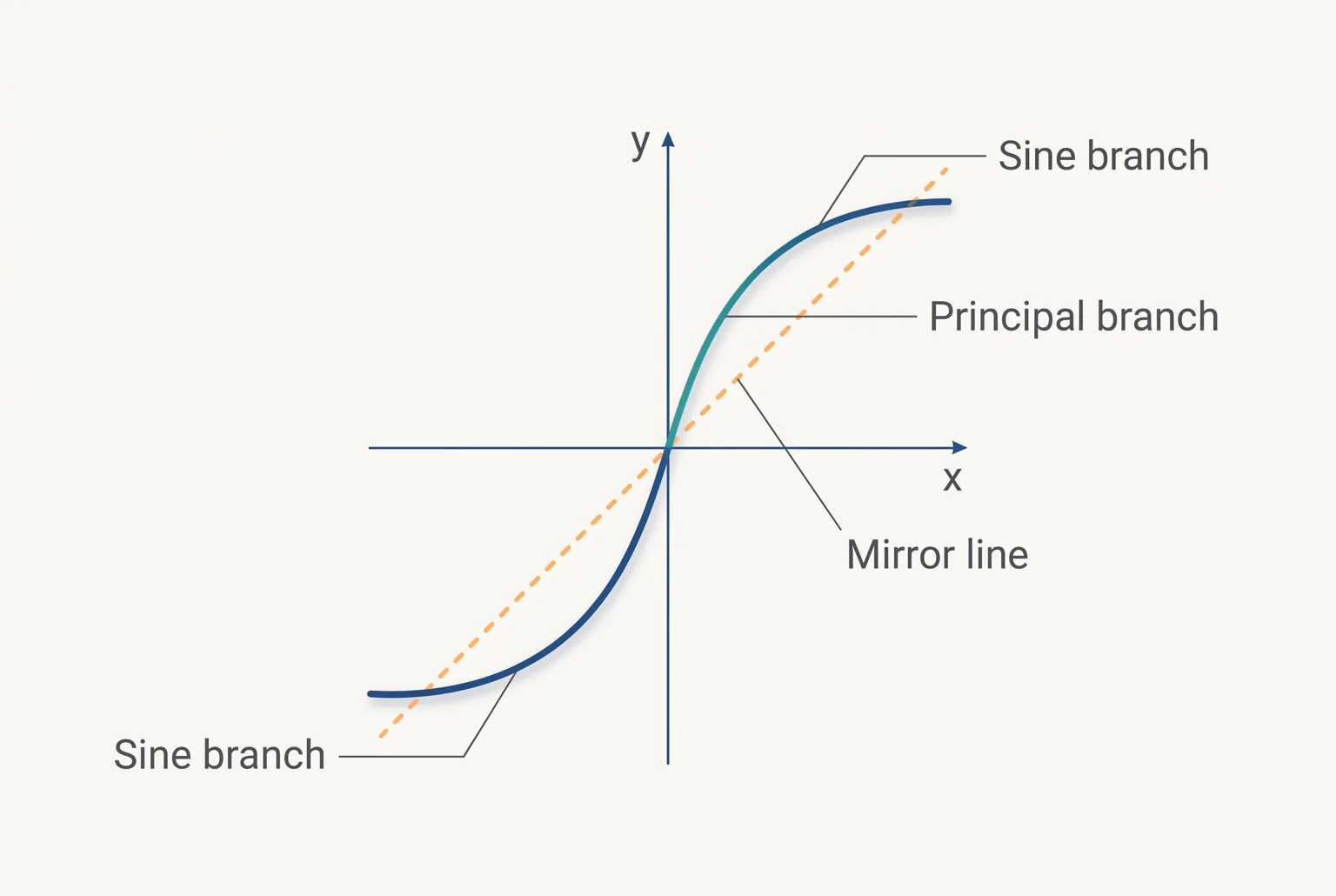
More than one restriction can produce an invertible sine function. The notes compare intervals on which sine reaches the same set of values, even though the angles producing those values differ. Each restriction gives an inverse branch. For inverse sine, the branch with range is the principal branch; the angle it returns is the principal value.
The distinction matters whenever you translate an inverse expression into a trigonometric equation. Knowing that an angle gives the required sine, cosine or tangent is only half the check. It must also lie in the requested branch. The notes use the principal branch when no branch is specified. Their worked example with an explicitly stated non-principal interval shows why you should read that condition before choosing an angle.
Read the six domain and range entries in pairs
The chapter summary gives the domain and principal-value range for all six functions. Compare the entries in pairs: the functions in each pair accept the same inputs, but they need not return angles from the same interval.
- Inverse sine and inverse cosine both accept inputs in . Inverse sine returns angles in , whereas inverse cosine returns angles in . Both ranges include their endpoints.
- Inverse tangent and inverse cotangent both accept every real number, but their output intervals are open: for inverse tangent and for inverse cotangent.
- Inverse secant and inverse cosecant accept inputs at or beyond either end of , including and but excluding the numbers strictly between them. Inverse secant returns angles in except ; inverse cosecant returns angles in except . Those angles are omitted because secant and cosecant, respectively, are undefined there.
What the reflected graphs show
The graph pages present two descriptions of the same transformation. Swapping the coordinates of each point takes to ; geometrically, this is reflection in the line . The exchange makes the domain and range reversal visible: a horizontal coordinate on the original graph becomes a vertical coordinate on the inverse graph.
For the principal inverse, reflect only the part of the original graph whose angle interval defines that branch. Reflecting the full periodic graph would put several points above the same horizontal coordinate, so the reflected relation would fail the vertical-line test. In the notes, the teal curve marks the principal inverse branch. Use it to trace which part of the original curve was selected, rather than treating every reflected part as belonging to that branch.
Common mistakes: reciprocals and misplaced range checks
The superscript in denotes an inverse function, not a reciprocal. Inverse sine takes a sine value as input and returns an angle. The expression takes an angle as input and returns the reciprocal of its sine, provided that sine is nonzero. Nor does inverse notation instruct you to replace the argument with its reciprocal, which might not even be in the inverse function’s domain.
When adding or subtracting inverse trigonometric terms, check each angle against its own branch before combining the terms. A branch restricts what that individual inverse function returns; it does not require the final sum or difference to lie in the same interval. For a nested expression, distinguish the domain check on the inner result from the range check on the angle returned by the outer inverse.
Use the worked examples to practise distinct checks
The chapter index lets you move between the branch graphs, the worked examples and the closing summary. Start with the domain example if you tend to focus on finding angles before checking inputs. It places a square root inside inverse sine, so the square root must be defined and its value must also be an acceptable input for inverse sine. Checking only one condition is not enough.
Next, compare a single principal-value example with one that combines several terms. In the first, look for the step that confirms the chosen angle belongs to the right interval. In the second, identify where that check belongs for each term before the arithmetic begins. Before you move on, pick a function from the summary and explain why a particular excluded value is an input restriction, an output restriction, or both for that function.
Spotted an error? Report a correction. Practise this in the app: notes, formula sheets and mind maps.





























































































































































Loading comments…