Integral Calculus: CBSE Class 12 NCERT Textbook Guide
CBSEMathematicsIntegral Calculus
Chapter 7, **Integrals**, in the NCERT Class 12 Mathematics textbook connects two problems: recovering a function from its derivative and finding an area under suitable conditions. Use its worked examples and exercises to learn how the form of an integrand guides your choice of method.
An indefinite integral is a family of functions
The chapter begins by reversing a familiar task from differential calculus. Instead of finding the derivative of a given function, you look for a function whose derivative is the given integrand. If on an interval, the indefinite integral is . The notation also identifies the variable of integration: here it is .
The constant matters because differentiation cannot distinguish functions that differ only by a constant. Conversely, if two functions have the same derivative throughout an interval, their difference is constant there. That is why one antiderivative is enough to describe the entire family. An extra condition can then select one member of that family. The chapter illustrates this with a prescribed value of the antiderivative at a point: the derivative gives the family, and the point condition fixes the constant. The opening velocity example makes the same distinction: knowing velocity alone does not tell you the object's position at a particular instant.

Integral Calculus | Class 12 | NCERT Textbook
In the StudentCurio app
This textbook chapter covers methods of integration, including standard integrals, substitution, integration by parts and partial fractions, as well as trigonometric and definite integrals. It supports Class 12 students with explanations, worked examples and exercises.
Where standard formulas apply
The standard integral table pairs derivative rules with antiderivative formulas. Read the pairs in both directions: if you recognise a derivative, you can integrate by inspection; if you are unsure of a sign or coefficient, differentiate the proposed antiderivative. The early worked examples also show how to use linearity: split a finite sum into terms, take constant factors outside the integral, and combine the resulting additive constants into one arbitrary constant in the final expression.
The chapter notes that an interval may be left unstated in a formula, but it still matters in a specific problem. The power rule excludes the exponent . For the reciprocal function, use on an interval that does not contain zero. The absolute value makes the logarithm formula valid on negative intervals as well as positive ones; it does not make the integrand defined at zero. Keep the original domain in view even after simplifying an expression.
Substitution: look for the inner derivative
Substitution reverses the chain rule. Look for an expression inside another function, then ask whether its derivative is also present, possibly up to a constant factor. In one worked example, the chapter singles out the expression inside a sine because the factor multiplying the sine is exactly the derivative of that inner expression. In another, it makes successive substitutions, showing that one change of variable can expose a second useful pattern.
When following a worked example, identify what happens to the differential as well as to the expression inside the function. Replacing only the inner expression does not complete the change of variable: the remaining factors and the differential must be accounted for in the new variable. For an indefinite integral, the chapter's examples then return to the original variable. In Exercise 7.2, try naming the inner expression and locating its derivative before doing the integration.
Trigonometric identities can reveal a simpler form
A trigonometric integrand does not always resemble a derivative at first sight. Section 7.3.2 shows how an identity can change that. A double-angle identity can replace a squared trigonometric function with a constant term and a cosine term. A product-to-sum identity can turn a sine–cosine product into separate terms that are easier to integrate.
The worked example on a cube of sine shows two routes: use a triple-angle identity, or rewrite the square factor so that the remaining sine factor supports a substitution. The resulting expressions look different, but both have the same derivative and describe the same family on a common interval. Use that example alongside Exercise 7.3 to practise a specific decision: would an identity expose the derivative needed for substitution, or would it turn the integrand directly into standard terms?
Partial fractions and integration by parts do different jobs
The chapter introduces these methods because inspection alone is not suitable for many integrands. Partial fractions rewrite a rational expression as simpler fractions. In the section on particular integrals, the text previews this idea by factoring a difference of squares in a denominator and splitting the reciprocal into terms with linear denominators. That algebraic step is what makes the standard logarithmic form available.
Integration by parts, by contrast, comes from the product rule for differentiation. One factor is differentiated and another is integrated, leaving a new integral. A useful choice makes that new integral simpler or more recognisable. The distinction is practical: partial fractions simplify the structure of a rational expression before integration, while integration by parts reorganises a product through a derivative identity.
Definite integrals connect antiderivatives to area
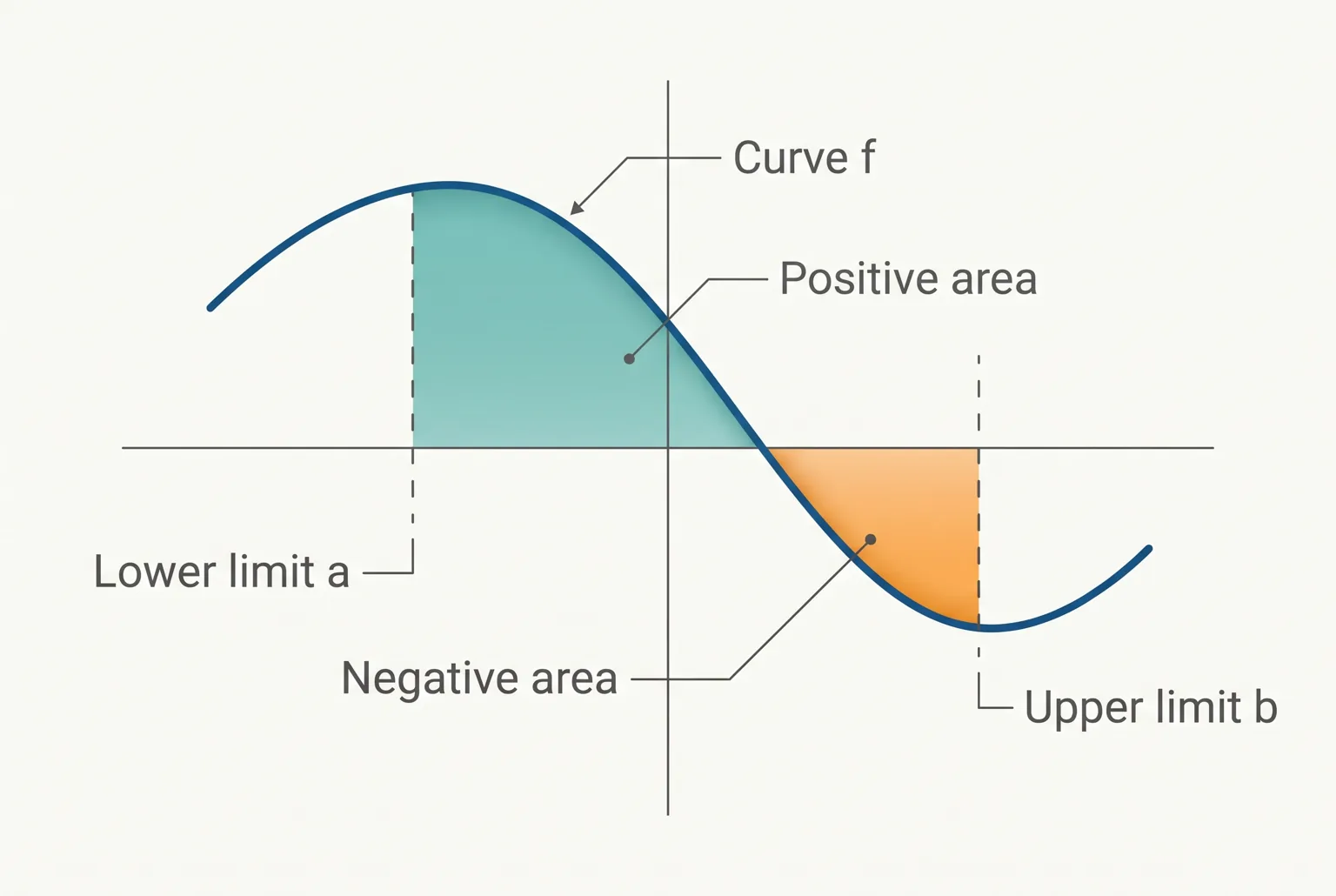
A definite integral over fixed limits gives a value, not a family of functions. The chapter introduces the Fundamental Theorem of Calculus as the bridge between the two kinds of integral. For a continuous integrand on a closed interval, you can evaluate the definite integral by subtracting the antiderivative's value at the lower limit from its value at the upper limit. Any additive constant cancels in the subtraction.
This also explains why the chapter qualifies its opening description of area. With the limits in increasing order, contributions from above the horizontal axis are positive and those from below it are negative. If the function is nonnegative throughout the interval, the definite integral gives the ordinary area between the graph and the axis. Before moving on, ask yourself why an indefinite integral needs an arbitrary constant but an evaluation between fixed limits does not.
Spotted an error? Report a correction. Practise this in the app: notes, formula sheets and mind maps.





























































































































































Loading comments…