Class 12 Integrals: A Guide to the NCERT Notes
CBSEMathematicsIntegral Calculus
These CBSE Class 12 Mathematics notes cover NCERT Chapter 7, Integrals, from families of antiderivatives to definite integrals and their properties. Use the worked examples to practise choosing an integration method, then check whether your result should be a function or a number.
What the notes cover and where to start
The chapter index separates standard formulas and properties from the techniques used when an integrand does not immediately match a known form. It lists substitution, trigonometric identities and standard substitutions before moving to partial fractions and integration by parts. The final entries cover the fundamental theorem, definite integrals by substitution, properties of definite integrals and a chapter summary. The index uses the printed page numbers in the notes, which differ from the PDF page numbers in the excerpt.
If you recognise a formula but struggle to decide when to use it, start with a worked example rather than rereading the whole table. Pause before the first transformation and ask which feature of the integrand makes that step useful. The choice of first step is often more instructive than the final simplification.

Integral Calculus | Class 12 | NCERT Notes
In the StudentCurio app
Covers standard indefinite integrals and techniques including substitution, trigonometric identities, integration by parts and partial fractions, as well as definite integrals and their properties. These revision notes help Class 12 students review integration methods and worked examples.
An indefinite integral is a family of functions
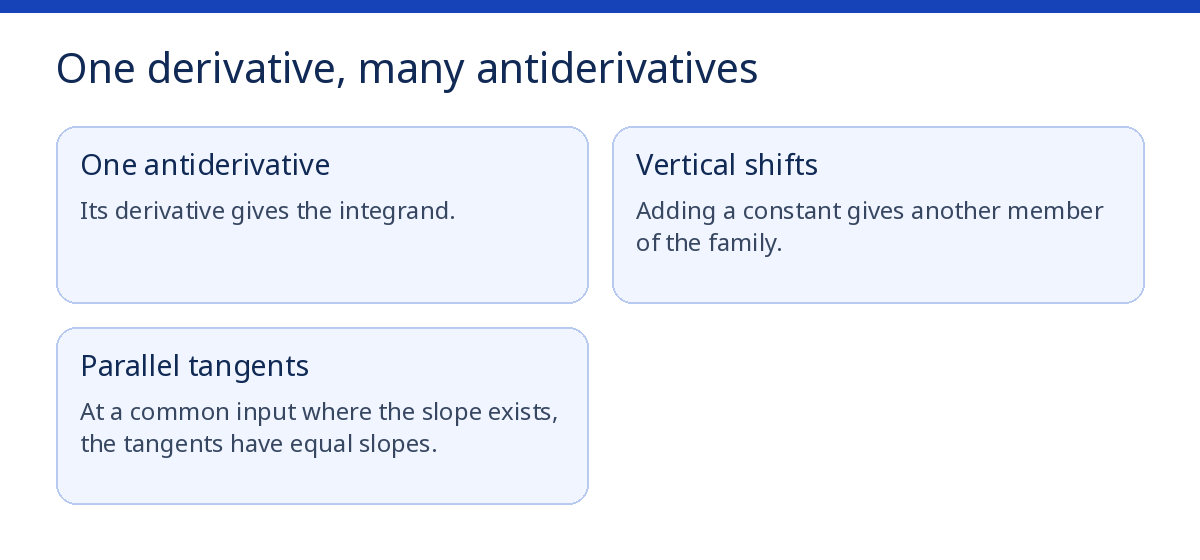
If on an interval, then , where is an arbitrary real constant. Differentiation removes the constant, so all members of the family have the same derivative. The notes illustrate this with vertically shifted square-root curves: at the same positive -coordinate, their tangents are parallel because the slopes agree. An extra condition giving the value of the antiderivative at a point can select one member of the family.
The notes also use linearity to split sums and differences and take constant factors outside an integral. If you integrate separate terms and obtain several constants, combine them into one arbitrary constant in the final expression. To check an indefinite integral, differentiate the expression you obtained and compare it with the original integrand on the interval in question.
When a standard formula applies
The formula table pairs derivatives with their corresponding antiderivatives. Read each pair in both directions: the integral tells you what to write, while the derivative gives you a way to check the sign and any constant factor. For example, the power rule applies where the real powers are defined and differentiable as required, and it excludes .
The excluded case has its own rule: on an interval that does not contain zero. The absolute value allows the formula to work on negative as well as positive intervals; it does not make the integrand defined at zero. Likewise, when an expression has a denominator or a radical, check its real domain before treating an algebraic rewrite as equivalent.
Substitution: match the inner derivative
Substitution reverses the chain rule. When you see a composition and a factor proportional to the derivative of its inner expression, try setting that expression equal to a new variable. For , the differential is . Rewrite the integrand and differential in terms of , keep track of any constant multiplier, and substitute back after integrating an indefinite integral.
The trigonometric examples show why substitution may need an algebraic step first. Rewriting a tangent in terms of sine and cosine can expose a useful denominator, and a product-to-sum identity can turn a trigonometric product into terms that are easier to integrate separately. The point of an identity is to reveal a standard form or a usable derivative, not simply to change the appearance of the integrand.
Partial fractions or integration by parts?
Partial fractions starts with a rational integrand, a quotient of polynomials. The notes describe decomposing it into simpler fractions and integrating the terms separately. For an improper rational expression, first use polynomial division so the remainder fraction has numerator degree smaller than denominator degree. When reviewing a decomposition, recombine the fractions to check the algebra before checking any antiderivatives.
Integration by parts instead reverses the product rule: . A product is a reason to consider the method, not a guarantee that it will help. Look for a choice where you can find from and where differentiating leaves a more manageable integral. Compare that choice with substitution: if one factor already supplies the derivative of an inner expression, substitution may be more direct.
Definite integrals: endpoints and signed area
For a continuous integrand on , the fundamental theorem lets you evaluate the definite integral by finding an antiderivative and calculating . The order is upper endpoint minus lower endpoint. Any additive constant cancels, so the result is a number rather than a family of functions. If you use substitution and evaluate in the new variable, transform both bounds. If you substitute back first, keep the original bounds.
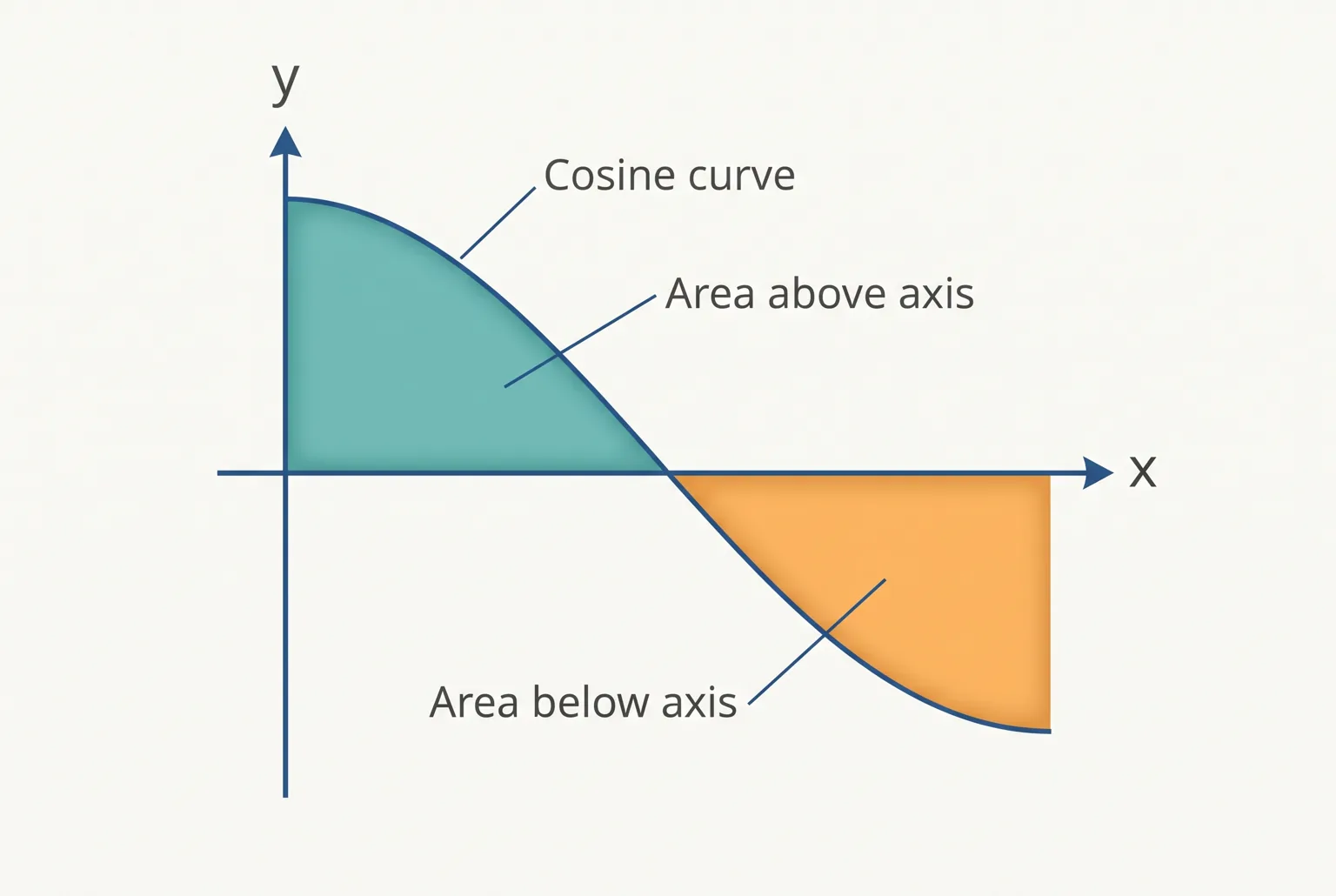
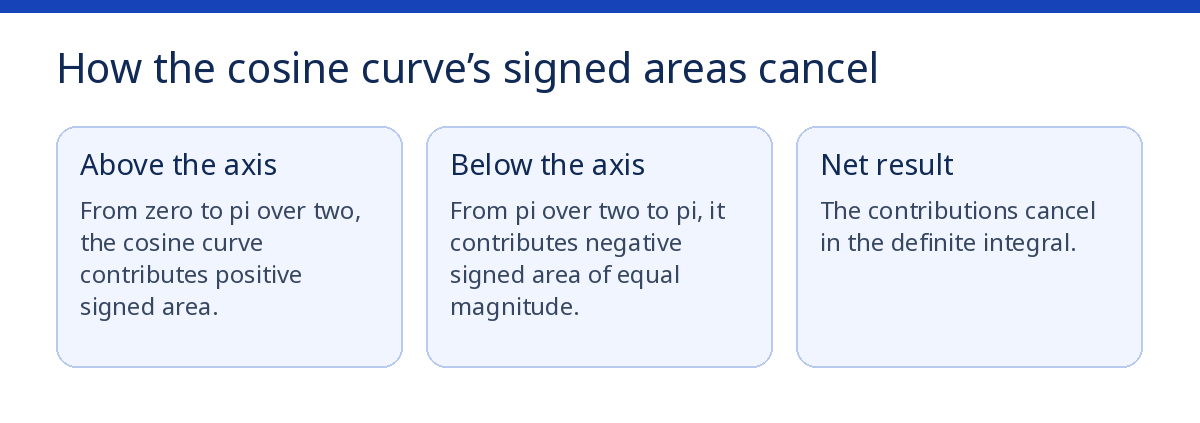
The cover’s cosine diagram illustrates why a definite integral need not equal total geometric area. On , the contribution above the horizontal axis cancels the contribution below it. For total area in this picture, the two magnitudes would be added instead.
Quick self-check before using the chapter summary
Pick an example and cover the working. Can you name the feature that determines your first step? After using the method, can you explain why your answer needs an arbitrary constant, a particular constant fixed by a condition, or no constant at all? These checks distinguish choosing a method from interpreting its result.
This guide omits the flagged exponential reference in Example 1(iii) on printed page 3, the polynomial-degree and motion comparisons on printed page 7, and the flagged square-root quadratic reductions on printed page 21.
Spotted an error? Report a correction. Practise this in the app: notes, formula sheets and mind maps.





























































































































































Loading comments…