Integrals: CBSE Class 12 PYQs on Indefinite Integration
CBSEMathematicsIntegral Calculus
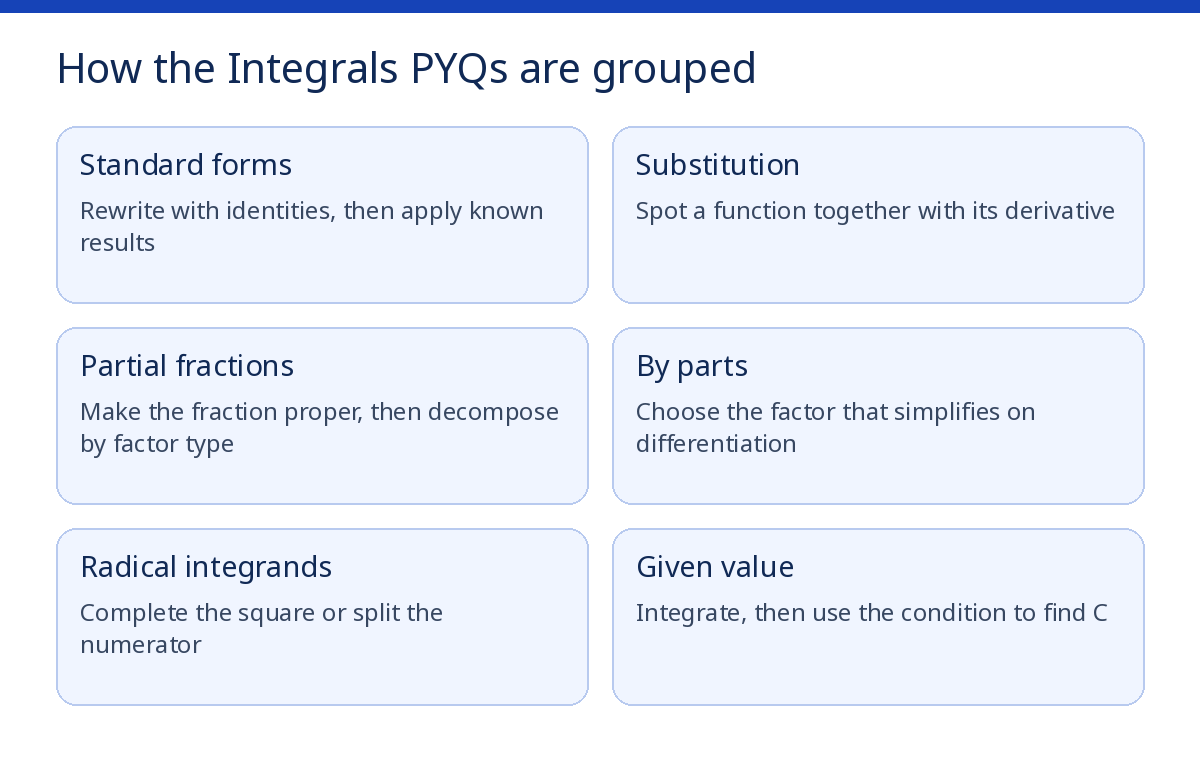
This guide uses a solved collection of CBSE Class 12 board questions on NCERT Chapter 7, Integrals, to explain what the papers test. It covers standard forms and identities, substitution, partial fractions, integration by parts, radical integrands and antiderivatives fixed by a given value.
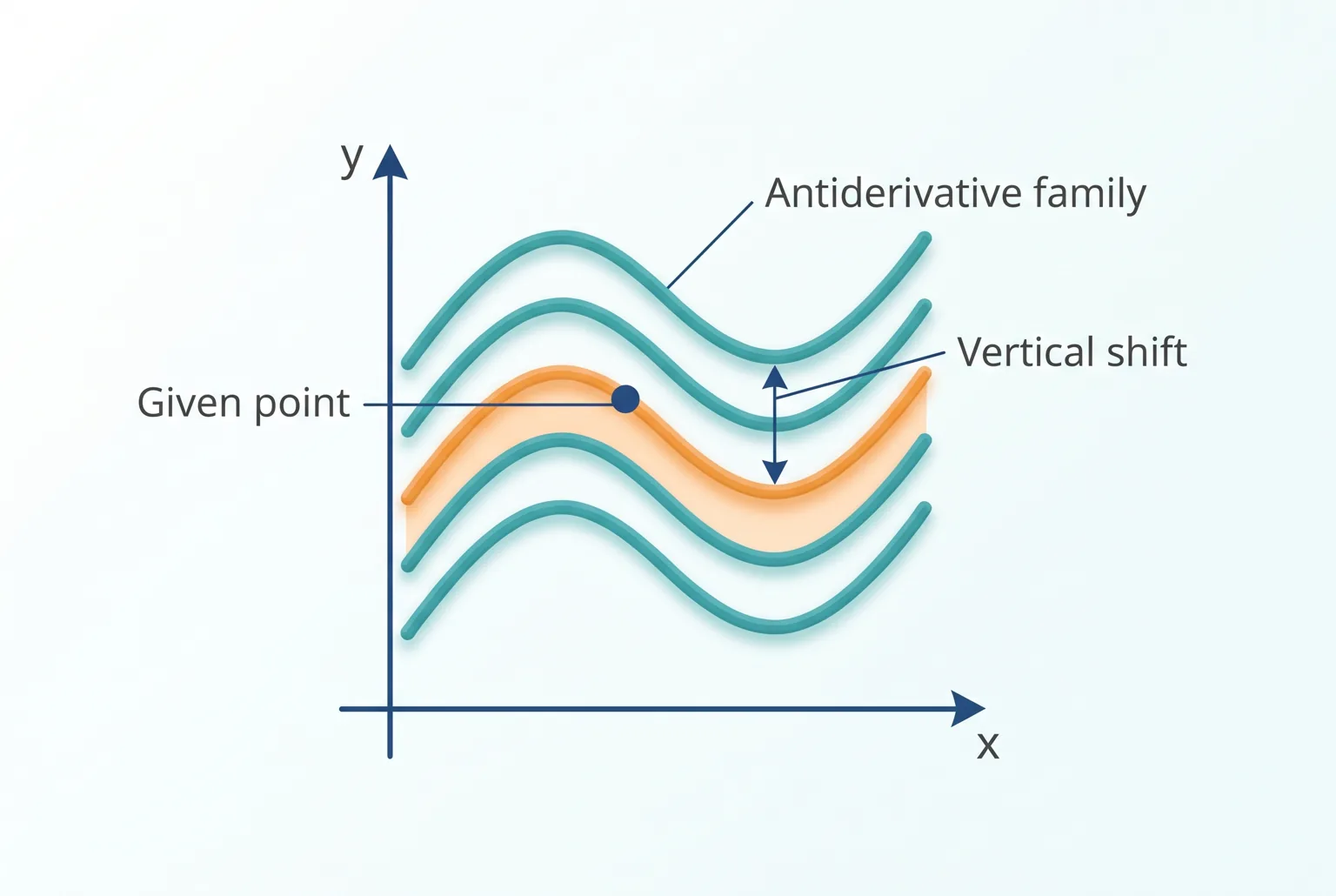
Six tested ideas across 123 Integrals questions
The collection prints 123 previous-year questions with an exam-year coverage of 2022-2026. Each question carries its year and set label, such as Set 65/3/1, compartment or Delhi papers, and links to a numbered worked solution.
Its topic index groups the questions by method:
- Standard integrals and identities (27)
- Substitution (34)
- Partial fractions and rational functions (24)
- Integration by parts (15)
- Algebraic and radical integrals (14)
- Antiderivatives and applications (9)
The questions stay in their original serial order, so use the index to practise one method at a time. Q1–Q49 are MCQs (single correct answer). From Q50 onwards the questions are subjective, and many offer an internal choice between parts (a) and (b). The file ends with source review notes.

Integral Calculus | Class 12 | Previous Year Paper
In the StudentCurio app
A collection of solved CBSE Class 12 previous-year questions on indefinite integration, covering standard integrals, substitution, integration by parts, partial fractions and trigonometric methods. Helps students practise exam-style problems and review worked solutions.
Standard forms hidden behind trigonometric rewriting
Many MCQs become standard integrals once the integrand is rewritten. The results to recall are:
When the variable appears as , as in , a factor appears because .
These identities recur: , , , and for .
Integrands such as or simplify after multiplying by the conjugate, because . Similarly, can be recognised as .
One pattern asks for . Rewriting both numerator terms with a double-angle identity makes the numerator factorise.
In the radical group, . Likewise , which is why one MCQ states the interval before asking for an antiderivative.
Choosing a substitution: √x, exponentials and log x
Substitution is the largest group. The skill is to spot a function and its derivative sitting together:
- with : put . Then , and that factor 2 is easy to lose.
- with : put . Since , a appears in the answer.
- with powers of : put .
- with a function of : put . This can turn a trigonometric integrand into a rational function ready for partial fractions.
Coefficient MCQs test the same idea. A typical stem gives and asks for . You must scale the numerator to the exact derivative of the denominator.
Subjective versions mix powers, such as . Here you need one substitution that clears both roots at once.
Partial fractions versus the derivative-split method
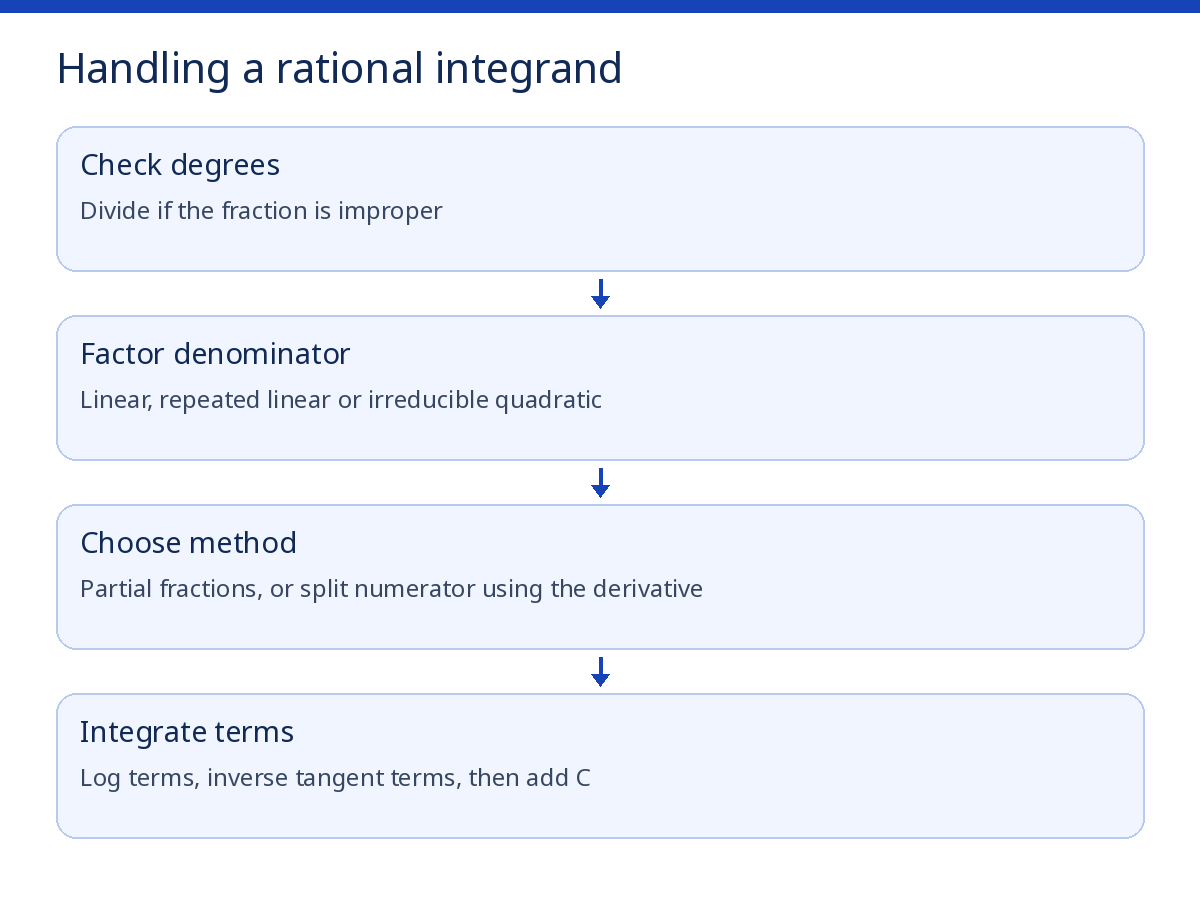
Partial fractions need a proper rational function. If the numerator's degree is not less than the denominator's, divide first.
The papers use three denominator shapes:
- Distinct linear factors, such as , take one constant over each factor.
- Repeated linear factors, such as , need .
- Irreducible quadratic factors, such as , need .
If appears only as , as in , put only while finding the constants. Then integrate in .
A linear numerator over a quadratic, such as , uses a different method. Write the numerator as . This splits the integral into a logarithm term and a completed-square term. The same split handles in the radical group.
Integration by parts and the e^x[f(x)+f'(x)] pattern
The rule for integration by parts is
.
Choose as the factor that becomes simpler when differentiated, such as a logarithm or an inverse trigonometric function. A lone or inverse trigonometric term is integrated by taking 1 as the second function.
Some questions combine methods. For , first substitute , then apply parts. In , the logarithm is the first function; differentiating it leaves a rational integrand that itself needs division and partial fractions, so one question tests two methods.
A related result is . Several MCQs multiply by a rational expression. Your task is to split that expression into a function plus its derivative before using the result. Trigonometric quotients such as use the same idea of a function plus its derivative, after half-angle rewriting.
Antiderivatives fixed by a given value, and the OR definite integrals
One question pattern gives together with a condition such as :
- Integrate term by term and keep the constant .
- Substitute the given value to find .
Use for , and . In MCQs, differentiating an option is a fast way to check it. Some options differ only in the constant, so the given condition is what decides between them.
Many subjective items pair an indefinite integral in part (a) with a definite one in part (b). Two kinds of part (b) recur:
- Modulus sums, such as , need the interval split wherever a term changes sign.
- Integrals over , such as , suit the property .
Common mistakes in constants, signs and absolute values
- Missing scale factor: dropping after rewriting , or the 2 from .
- Missing log factor: forgetting when integrating , or when substituting .
- Missing modulus in logarithms: write , not , unless the sign is known.
- Removing a square root carelessly: , so the sign depends on the interval.
- Stopping in t: after a substitution, the final answer must be rewritten in terms of .
- Missing constant: leaving out , or not evaluating it when a value of is given.
- Skipping division: starting partial fractions on an improper fraction.
Working through the six groups, with a quick self-check
A practical order follows the topic index:
- Standard integrals and identities
- Substitution
- Algebraic and radical integrals
- Partial fractions
- Integration by parts
- Antiderivatives with conditions
Within each group, attempt the MCQs before the subjective items. Try both internal-choice parts before opening the worked solution. Then compare where your substitution, constants and back-substitution differ from the solution, and read the source review notes at the end.
Quick self-check: Can you say, before integrating, whether a rational integrand needs division, partial fractions or the derivative-split method? Can you explain why a given interval matters for a square root?
Frequently asked questions
Which question formats appear in this Integrals collection?
Q1–Q49 are MCQs with a single correct answer. From Q50 onwards the questions are subjective, and many offer an internal choice between parts (a) and (b), sometimes pairing an indefinite integral with a definite one.
Which method has the most questions?
Substitution, with 34 questions in the topic index. It is followed by standard integrals and identities (27) and partial fractions (24).
Spotted an error? Report a correction. Practise this in the app: notes, formula sheets and mind maps.





























































































































































Loading comments…