Differential Equations: Class 12 NCERT Notes Guide
CBSEMathematicsDifferential Equations
These CBSE Class 12 Mathematics notes cover order and degree, verification of solutions, and three methods for solving first-order differential equations. The worked examples help you decide which form to look for before you start integrating.
From derivatives to differential equations
In differentiation, you start with a function and find its derivative. In a differential equation, the function is unknown, and the equation tells you something about its derivatives. The simplest case in the notes gives the derivative directly as a function of the independent variable, so integration recovers a family of possible functions. Other equations relate the derivative to the unknown function itself, so you first need to rearrange the equation or change variables.
The chapter deals with ordinary differential equations: all derivatives are taken with respect to one independent variable. A second or third derivative does not change that classification. The opening pages introduce both fraction and prime notation, which the examples use when identifying derivatives and checking proposed solutions.

Differential Equations | Class 12 | NCERT Notes
In the StudentCurio app
These notes review ordinary differential equations, order and degree, general and particular solutions, separation of variables, and methods for solving homogeneous and first-order linear equations using integrating factors. Worked examples, including initial-value applications, help Class 12 students revise the chapter’s standard solution methods.
Order and degree answer different questions
Order tells you which derivative is the highest one present. Degree, when defined, tells you the highest power of that derivative after the equation is expressed as a polynomial in its derivatives. Identify the highest derivative first. A large exponent on a lower-order derivative does not determine the degree, and powers of the dependent variable itself do not count toward it.
The classification examples distinguish a non-polynomial function of the independent variable from a non-polynomial function of a derivative. A trigonometric coefficient or term involving only the independent variable does not prevent the equation from being polynomial in its derivatives. A sine applied to the derivative itself does. Derivatives under radicals or in denominators call for simplification where possible before you assign a degree. If you square an equation to remove a radical, retain the original sign restriction when checking solutions.
Check the equation and the initial conditions separately
A solution is a function that satisfies the differential equation on its domain. To verify a proposed solution, differentiate it as many times as the equation’s order requires, then substitute the function and its derivatives and check the equality. If the solution is given as an implicit relation, differentiate it implicitly where it defines a differentiable function; you do not have to isolate the dependent variable first.
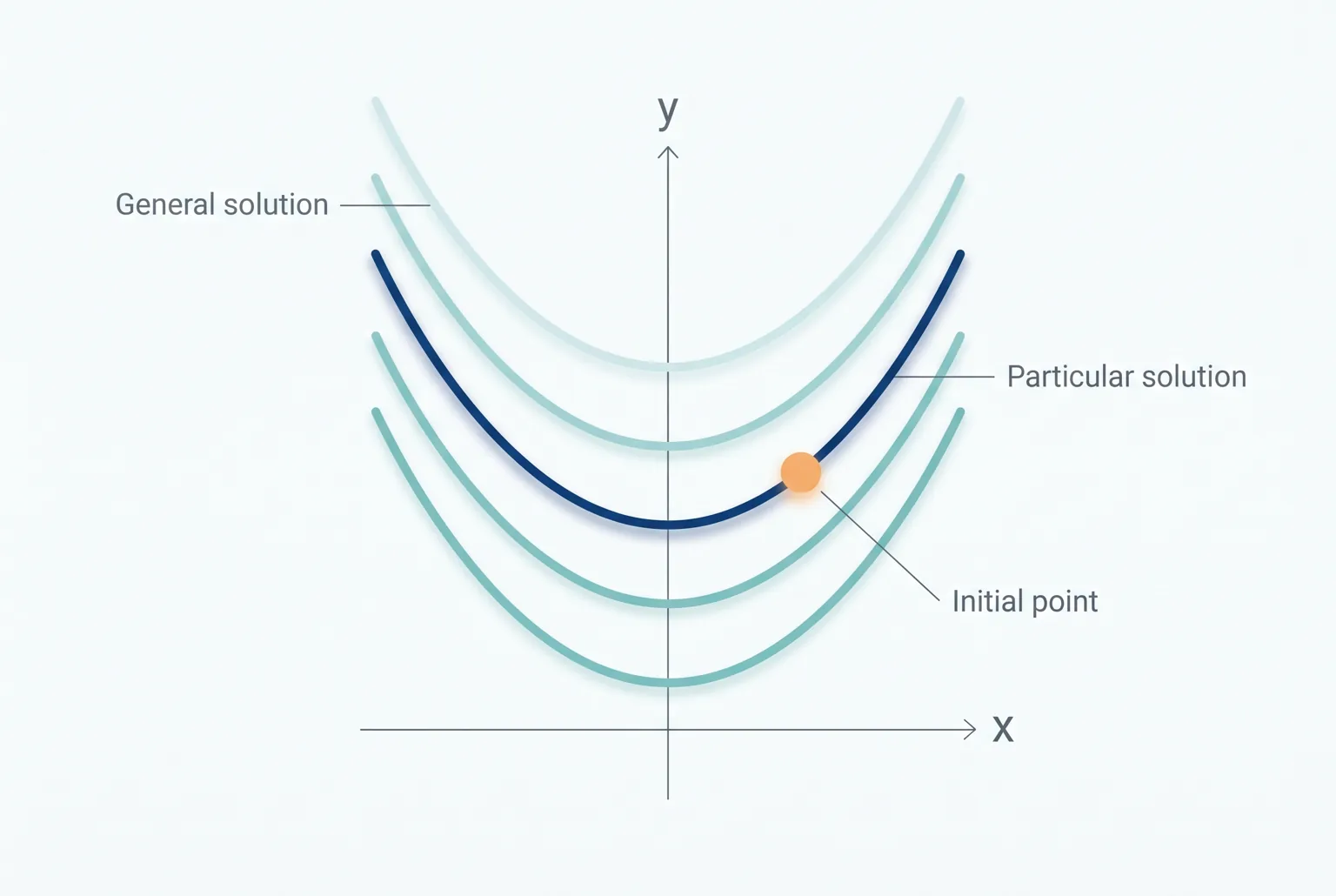
The notes distinguish a general solution, which contains arbitrary constants, from a particular solution, in which those constants have specified values. Initial conditions give values of the function and, where required, its derivatives at a specified point. In the worked verification of an initial value problem, checking the differential equation is only the first step. The function must also satisfy every stated condition at that point.
When separation of variables applies
Look for separation when the right-hand side of can be written as a product . One example in the notes needs a common factor taken out before that product becomes visible. Once the variables are separated, each side can be integrated with respect to its own variable. The constants from the two antiderivatives combine into one arbitrary constant; there is no need to carry two through the calculation.
Before dividing by a factor involving the dependent variable, note where it is zero. Dividing by assumes and can discard a constant solution. If a value makes that factor zero, test the corresponding constant function in the original equation rather than in the divided form.
Use the ratio to recognise a homogeneous equation
For the first-order homogeneous method in these notes, the right-hand side must be homogeneous of degree zero after the equation is written in derivative form. That means it depends only on a ratio such as or . The scaling test checks the same idea: multiplying both variables by the same nonzero factor leaves the expression unchanged wherever the comparison is defined. For a ratio of homogeneous expressions, equal degrees in the numerator and denominator give degree zero.
When the right-hand side depends on , use on a domain where . The product rule gives , not just . When treating as a function of , the corresponding substitution is for . The substitution makes the equation separable; after integration, replace the auxiliary variable with the original ratio.
Why the integrating factor works
For a first-order linear equation, first put it in standard form, with the coefficient of the derivative equal to one. In , both and must depend only on or be constants. If you instead use , they must depend only on or be constants. A first-degree derivative alone does not make an equation linear: its coefficient must not depend on the dependent variable.
The integrating factor is the exponential of an antiderivative of with respect to the independent variable. It is chosen so that after multiplication, the left-hand side is the derivative of the product of the integrating factor and the dependent variable. The notes include examples where normalising the equation requires division by an expression that can vanish. Use the standard form and integrating factor only on intervals where the required coefficients are defined.
Quick self-check: justify the method before integrating
Use the file’s chapter index to jump between the explanations and worked examples. Before reading a worked solution, ask what makes the method applicable. Can you factor the right-hand side into separate functions, express it in terms of a ratio, or identify linear coefficients that depend only on the independent variable? If you rewrite the equation, record any values excluded by the rearrangement. Then compare your reasoning with the example’s setup, not just its final expression.
Spotted an error? Report a correction. Practise this in the app: notes, formula sheets and mind maps.





























































































































































Loading comments…