Class 12 Differential Equations: CBSE Case-Based Assessment
CBSEMathematicsDifferential Equations
This CBSE Class 12 Mathematics assessment pairs case-based questions with step-by-step solutions. Use it to practise translating a situation into a differential equation, recognising its form and checking whether the resulting solution fits the conditions.
What the assessment covers
The PDF contains 18 case studies and 84 subquestions, including OR alternatives. Most cases are multiple choice, while Cases 5–8 use short answers. All questions come before the worked solutions, which follow in the same case order. The clickable index has separate links to each case’s questions and solutions, and individual subquestions link directly to their explanations.
The cases move between recognising the structure of an equation, choosing a method and interpreting a model. Some give you an equation to classify or solve; others describe how a quantity changes and ask you to work from that information. The two formats complement each other: multiple choice lets you check whether you recognise a valid form, while short answers make you show the steps that produce it.

Differential Equations | Class 12 | Case-based Assessment
In the StudentCurio app
Case studies with multiple-choice and short-answer questions cover differential equations, including separable, homogeneous and first-order linear equations, with applications such as cooling, continuous compounding and infection spread. Includes worked solutions for Class 12 students practising CBSE case-based assessments.
Order and degree answer different questions
Order tells you which derivative is highest in the equation. Degree, when defined, tells you the power of that highest-order derivative after the equation has been written as a polynomial in its derivatives, with derivative radicals and fractions cleared where possible. Read these features separately: a high power of a lower-order derivative does not determine the degree.
Case 14 is the focused practice set for this distinction. Before looking at the options, identify the highest derivative and then ask whether the equation has the required polynomial form. If a derivative remains inside an exponential and the equation is not polynomial in its derivatives, degree is not defined. That does not prevent you from identifying the order.
Before dividing: check what separation could lose
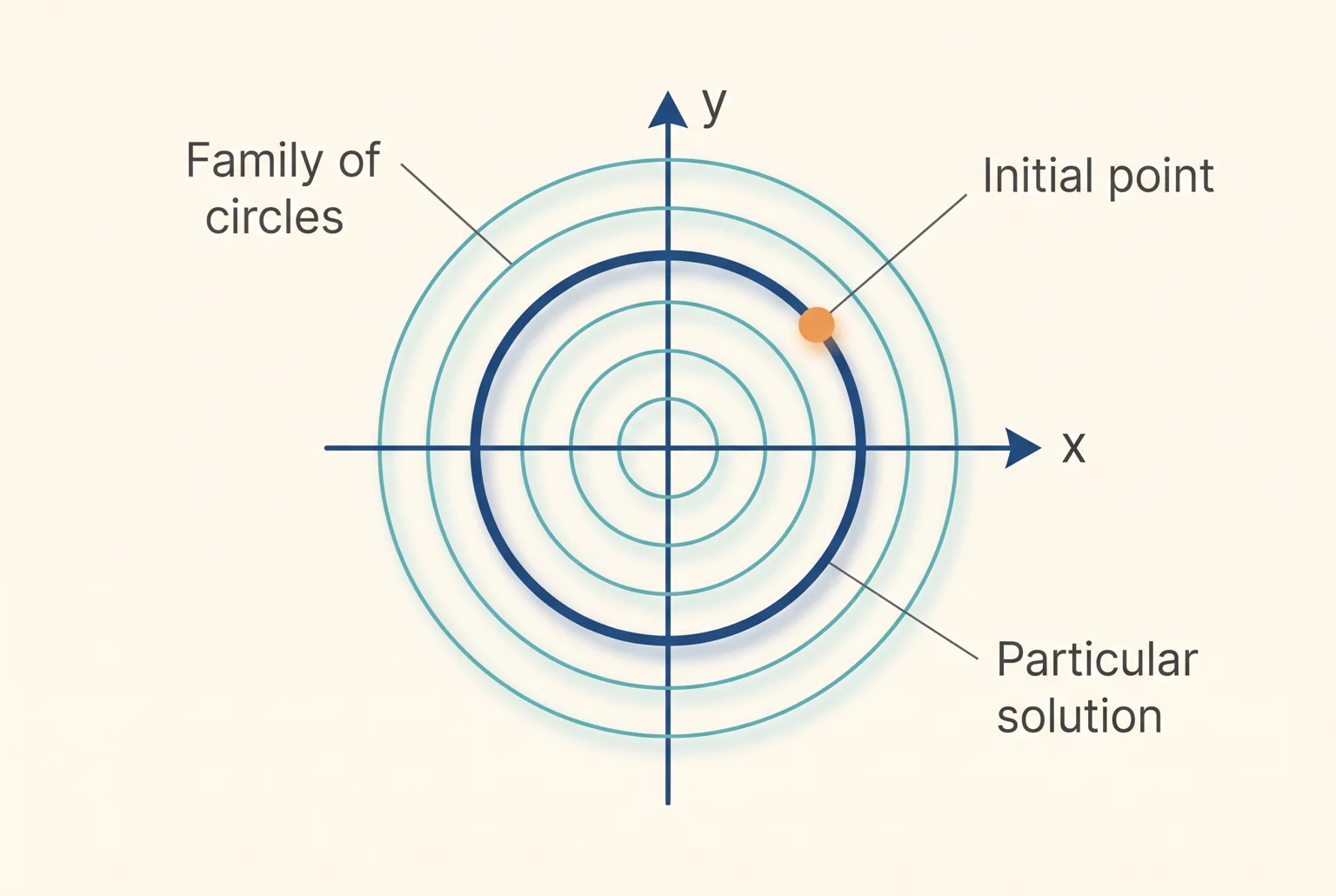
In the separable cases, the aim is to rearrange the equation so that one side contains only the independent variable and its differential, and the other only the dependent variable and its differential. Integration then gives a relation with an arbitrary constant. The circle-family questions connect that relation with geometry: the constant can distinguish one curve from another. An initial condition supplies a point that the required solution must satisfy and can select a particular member of the family.
Before dividing by a factor that depends on the unknown function, check where that factor vanishes. A constant solution can be lost if the rearrangement divides by an expression that is zero along that solution. The original equation, rather than the divided form, is where to check such a possibility.
Recognise when a homogeneous substitution helps
The homogeneous cases ask you to recognise when the right-hand side of a first-order equation depends on the ratio rather than on and separately. On an interval where and the equation is defined, write and remember that varies with . The product rule gives . That extra derivative term is what lets you rewrite the equation in terms of and and then separate the variables where valid.
When reviewing Case 7 or 17, compare your work with the solution at the point where dependence on the ratio is established. If that step is unclear, focus on the algebra that exposes the ratio before revisiting the integration.
When the integrating factor applies
For a first-order linear equation, first write it in standard form, . Read off only after the derivative has coefficient one. The integrating factor is . Multiplying by it makes the left-hand side the derivative of the integrating factor times , so the product can be found by integrating the right-hand side.
The trigonometric example in the worked solutions illustrates why the interval matters. Its coefficients require , so the method is applied on a connected interval that does not cross a zero of . If an initial value is given, work on an allowed interval containing that point.
Compare what drives change in the models
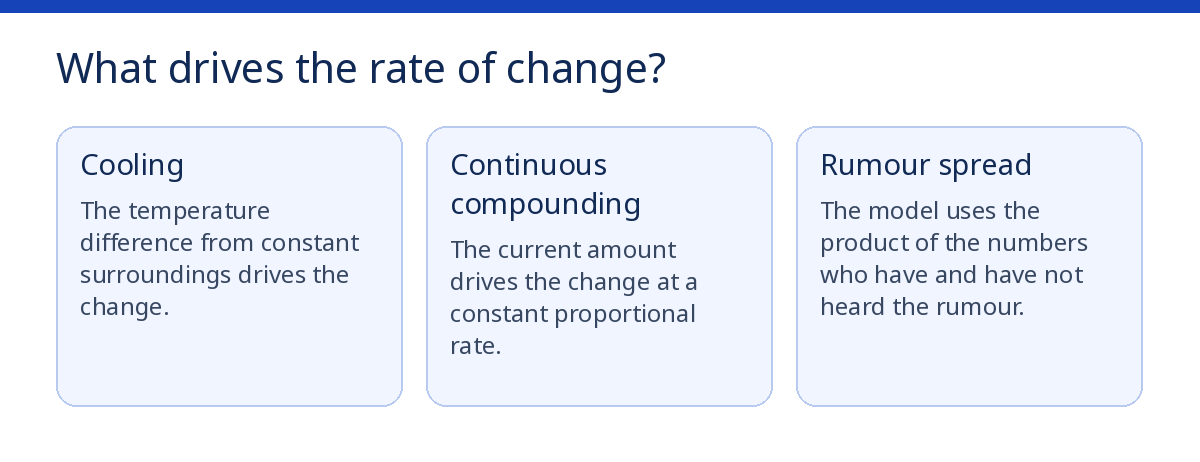
In the cooling cases, the temperature difference from the surroundings drives the change. With constant ambient temperature and a positive cooling constant, the reading moves toward the ambient temperature. Use that behaviour to check whether successive observations could fit the same model before trying to calculate its constants.
In continuous compounding, the amount itself drives the rate of change. Keep the time unit consistent with the quoted annual rate, and convert a percentage to a decimal when using it as a proportionality constant. The rumour case illustrates a different assumption: the rate depends on both the number who have heard it and the number who have not. Comparing these cases helps you see why the wording of a rate statement matters before any integration begins.
Use the solution links to find the first wrong step
Start with the question link and write down what the symbols represent, which conditions are given and why your chosen method fits. Then open the linked solution and compare the reasoning from the start. A wrong final choice might trace back to a misread rate statement, whereas a correct choice can still hide an algebraic step you cannot justify. In the short-answer cases, check whether you can show how a given condition fixes the integration constant, not just recognise the resulting expression.
Read any verification note beside the worked solution before treating a mismatch as your own mistake. This guide leaves out Case Study 1, Q2 because the PDF flags it as having no unique answer as printed.
Spotted an error? Report a correction. Practise this in the app: notes, formula sheets and mind maps.





























































































































































Loading comments…