Determinants: CBSE Class 12 NCERT Textbook Guide
CBSEMathematicsMatrices and Determinants
This guide to Chapter 4 of the Class 12 NCERT Mathematics textbook explains how to evaluate determinants and use them to find triangle areas, determine whether a matrix has an inverse, and solve linear systems.
What a determinant tells you
A determinant is a number associated with a square matrix, not a matrix in its own right. The chapter builds on the preceding NCERT chapter on matrices and works with determinants of orders one, two and three with real entries. The notation means the determinant of , not its modulus. A determinant can therefore be negative, as well as positive or zero. A rectangular matrix has no determinant.
For a matrix of order one, the determinant is its sole entry. For a matrix of order two, : subtract the product on the other diagonal from the product on the main diagonal. The opening example explains why this difference matters: for two linear equations in two unknowns, a nonzero determinant of the coefficient matrix guarantees a unique solution.

Determinants | Class 12 | NCERT Textbook
In the StudentCurio app
This NCERT textbook chapter covers determinant evaluation and properties, minors and cofactors, triangle-area applications, adjoints and inverses, and using matrices to test consistency and solve linear systems. It helps Class 12 students learn the concepts through worked examples and exercises.
Choose a row or column before expanding
For a determinant of order three, expansion replaces one larger calculation with a sum of terms involving determinants of order two. Choose a row or column. For each entry on that line, delete the row and column containing the entry, evaluate the remaining determinant, and multiply it by the entry and the sign given by its position. Add the resulting terms.
The textbook compares expansions along different lines to show that the choice changes the calculation, not the final value. When the question leaves the choice open, use a row or column with the most zeros: each zero entry makes its entire term vanish. Exercise 4.1 also practises a separate property, scaling the whole matrix. For a square matrix of order within the chapter’s scope, . The exponent counts the rows being scaled, not the total number of entries.
Sign check: minors are not cofactors
The determinant left after deleting row and column is the minor . For a determinant of order , the minor has order . The cofactor is , so an even index sum leaves the minor unchanged and an odd index sum reverses its sign. This sign depends on the position, not on whether the entry itself is positive or negative. If you use the cofactor in an expansion, do not apply the position sign again.
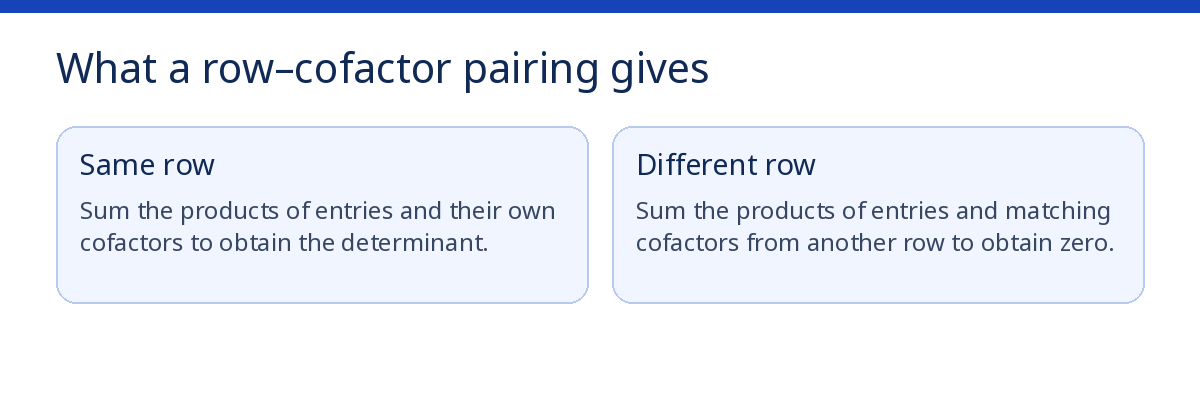
The pairing matters as much as the sign. Entries of a row multiplied by their own cofactors and summed give the determinant; pairing them with the corresponding cofactors of a different row gives zero. The analogous rule holds for columns. In Exercise 4.3, keep the indices visible as you work, especially when a question specifies the expansion line.
When the triangle formula needs absolute value
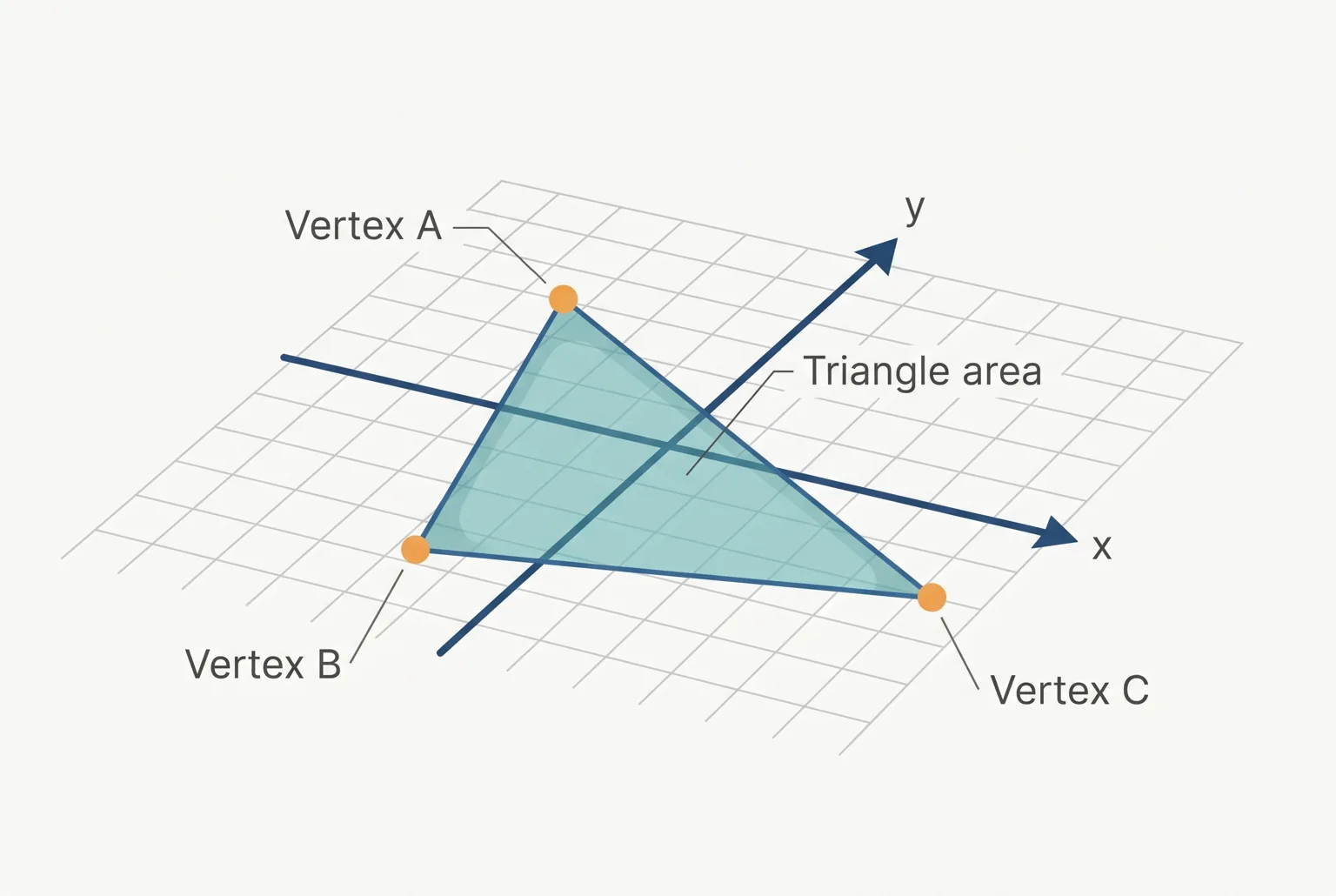
For three coordinate points, put each vertex in a row, with its -coordinate first, its -coordinate second and a in the last column. The triangle’s area is half the absolute value of this determinant, in square units. The determinant gives a signed value, while geometric area is nonnegative.
Exercise 4.2 uses this setup in two directions. When the coordinates are given, calculate the determinant and then take its absolute value. When a positive area is given and a coordinate is unknown, the determinant can equal either twice the area or its negative, so consider both signed equations. A zero determinant means zero area, which gives a test for collinearity. To find the equation of a line through two distinct given points, use them with a variable third point and impose the zero-area condition.
From the cofactor matrix to the inverse
The adjoint is the transpose of the cofactor matrix. First arrange the cofactors in their original positions; then transpose by turning rows into columns. This is a separate step from computing the signs. The textbook connects the adjoint to the determinant through , where is the identity matrix of the same order.
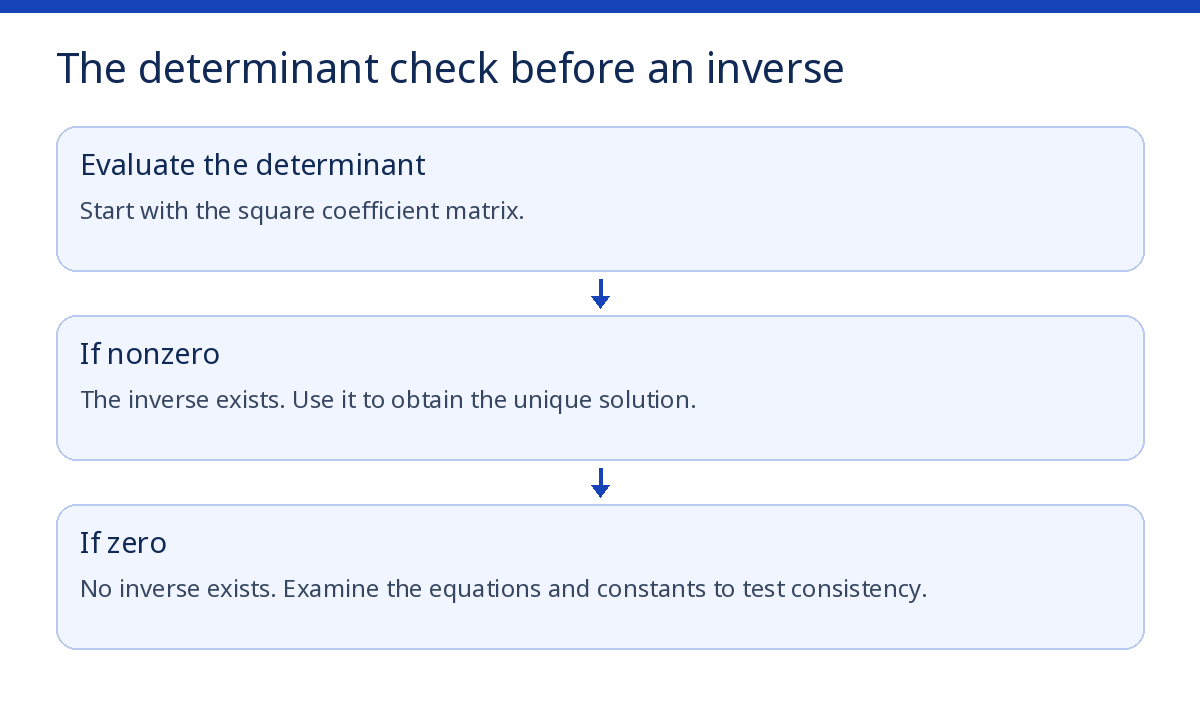
A square matrix is singular if its determinant is zero and nonsingular otherwise. The adjoint identity holds in either case, but only a nonsingular matrix has an inverse. In that case, dividing the adjoint by the determinant gives . In Exercise 4.4, check the determinant before starting a full cofactor calculation if the task asks only for the inverse. A zero determinant settles that question without any division.
What the determinant settles in a linear system
The chapter uses matrices to examine consistency and solve systems in two or three variables. In the matrix equation , put the coefficients of each equation in a row of , using the same variable order throughout. The unknowns make up the column , and the right-hand-side constants go in the corresponding rows of .
For a square coefficient matrix with nonzero determinant, multiplying on the left by the inverse gives the unique solution . A zero determinant rules out that method, but it does not by itself show that the equations are inconsistent. The system may have no solution or infinitely many solutions; the equations and their constants need further examination. Keep those decisions separate: first ask whether an inverse exists, then ask what that tells you about the system.
Self-check: identify the step that went wrong
Use the worked examples to locate an error before repeating a whole calculation. If two expansions give different values, can you trace each term back to its deleted row, deleted column and position sign? If an inverse calculation fails, can you distinguish forgetting the transpose from overlooking a zero determinant? If you get a negative value in a coordinate problem, are you reporting the signed determinant or the geometric area? Each check points you back to a different part of the chapter.
Source note: This guide omits the boxed derivation and the nearby example cross-reference on printed page 85.
Spotted an error? Report a correction. Practise this in the app: notes, formula sheets and mind maps.





























































































































































Loading comments…