Applications of the Integrals: Class 12 NCERT Guide
CBSEMathematicsApplications of the Integrals
This CBSE Class 12 Mathematics chapter shows how definite integrals measure regions bounded by curves, axes and lines. Its diagrams and worked examples help you choose a strip direction, set the limits and distinguish geometric area from a signed integral.
From familiar area formulas to thin strips
The NCERT chapter begins with a limitation of elementary geometry: familiar formulas give the areas of many standard figures, but they do not tell you how to measure every region with a curved boundary. A definite integral gives you a way to handle such regions by adding the contributions of thin strips whose lengths vary from one position to another.
The chapter builds on two ideas from the preceding chapter: the definite integral as the limit of a sum and its evaluation using the Fundamental Theorem of Calculus. Here, the new task is translating a picture into an integral. The diagram tells you what each strip measures and where the strips begin and end. Evaluating the integral is a separate step; correct antiderivative work cannot fix a setup that describes the wrong region.

Applications of the Integrals | Class 12 | NCERT Textbook
In the StudentCurio app
This textbook chapter explains how to find areas bounded by curves and coordinate axes or lines, using vertical and horizontal strips, with examples involving circles, ellipses, straight lines and trigonometric curves. It helps Class 12 students apply definite integrals to area problems.
What vertical and horizontal strips measure
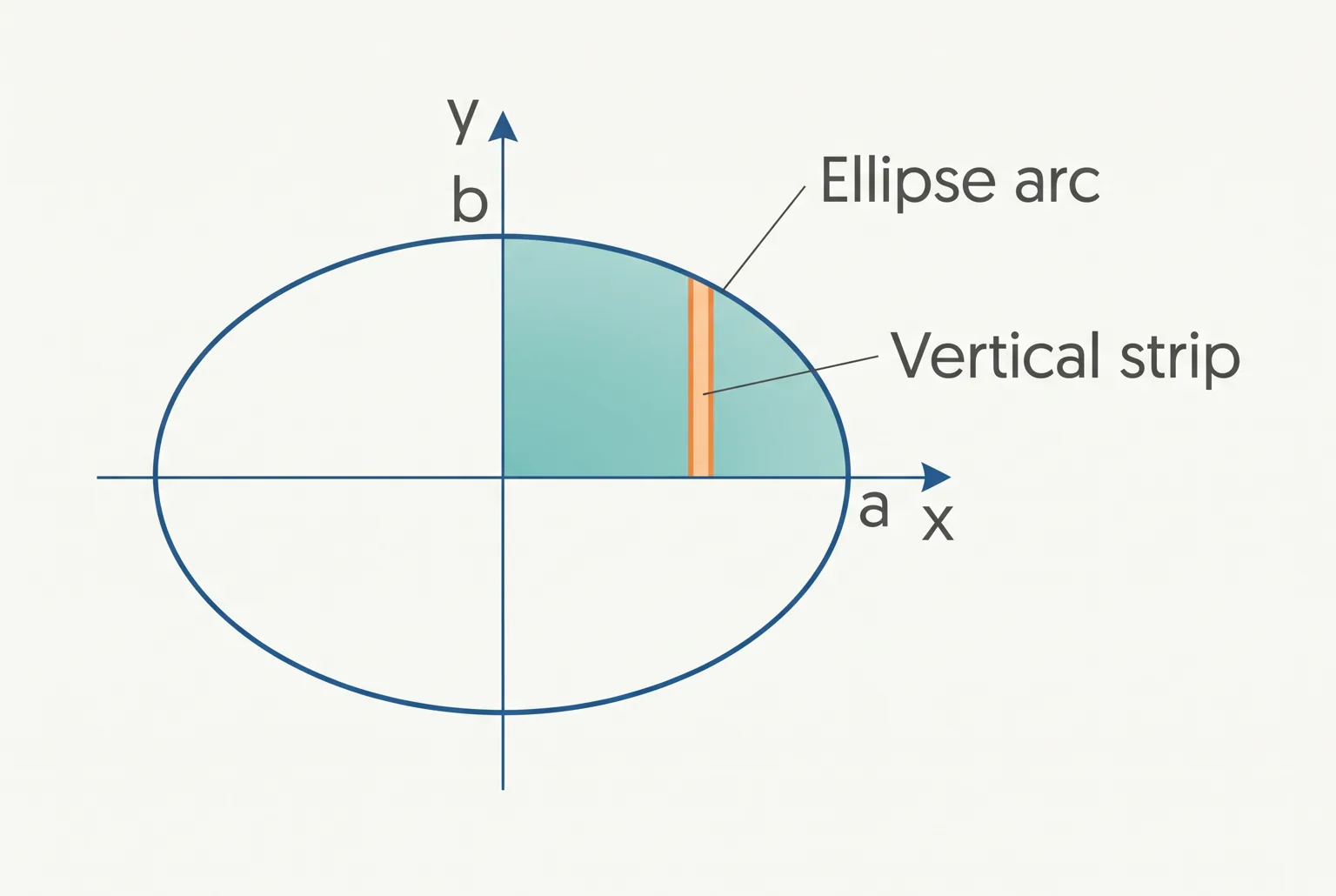
A vertical strip at a fixed value of has width . When the curve is on or above the -axis, the strip extends from the axis up to the curve, so its height is . If the vertical sides of the region are and , with , the area is . The limits describe the horizontal span of the region, even though the strip itself is vertical.
A horizontal strip at a fixed value of has thickness . For a region between the -axis and a curve on or to the right of that axis, the strip extends horizontally from the axis to the curve. The area is , where and are the lower and upper boundaries. Here the limits describe the vertical span.
Common mistake: taking the absolute value too late
A definite integral can be negative, but geometric area cannot. If a curve stays below the -axis throughout the interval, its signed integral is negative, and taking the absolute value of that integral gives the area. In strip language, the height is the positive distance from the curve to the axis, not the negative ordinate.
When a curve has portions on both sides of the axis, taking the absolute value only after integrating across the whole interval does not recover the total area: positive and negative contributions may already have cancelled. Split the interval where the graph crosses the axis and add the magnitudes of the separate integrals. The worked straight-line and cosine examples illustrate the same rule with different numbers of crossings. Use their graphs to see why the split points come from changes of sign rather than from arbitrary subdivisions.
Choosing the branch in circles and ellipses
The worked circle and ellipse examples each reduce the calculation to a first-quadrant region and multiply its area by four. This shortcut is justified because the complete circle and the standard ellipse shown are symmetric about both coordinate axes. If a question asks for only part of a symmetric figure, however, the symmetry of the full curve does not by itself justify multiplying by four. The requested region must contain the corresponding copies.
Solving a circle or ellipse equation for a coordinate gives a positive and a negative square-root branch. The first-quadrant calculation uses the nonnegative branch because both coordinates there are nonnegative. With vertical strips, the expression for describes the arc above the horizontal axis. With horizontal strips, the expression for describes the arc to the right of the vertical axis. The branch is a choice about the boundary of the region, not a choice made during integration.
Quick self-check: switch the direction, not the region
The chapter works out the circle and ellipse using both strip directions. Compare the paired diagrams before reading the evaluations. On each, pick a point inside the first-quadrant region and imagine drawing a strip through it. With a vertical strip, which axis is at one end, and which coordinate gives the strip's length? How do those answers change when the strip is horizontal?
The ellipse makes this comparison especially useful. In standard form, its positive intercepts are on the horizontal axis and on the vertical axis, with . Switching from vertical to horizontal strips changes the expression for the strip length and changes which intercept serves as the upper limit. It does not change the region being measured. If two setups disagree, check their branches and limits against the same diagram before redoing the integration.
Using the examples and exercises together
Use Exercise 8.1 after comparing the two strip directions in the worked examples. It includes area questions on ellipses, a circle and a parabola, so you can practise reading the boundaries rather than assuming every problem asks for the whole figure. For each question, identify the axis or line that closes the region before choosing the variable of integration.
The Miscellaneous Exercise extends the practice to polynomial and trigonometric graphs and a curve defined using an absolute value. Before looking at the answer choices in a multiple-choice item, make a sketch and decide whether each part of the graph lies above or below the relevant axis. If a setup is unclear, return to the example that illustrates the relevant decision: the circle or ellipse for branch choice and strip direction, or the straight line or cosine curve for splitting an interval at a sign change.
Spotted an error? Report a correction. Practise this in the app: notes, formula sheets and mind maps.





























































































































































Loading comments…