Application of Derivatives: Class 12 CBSE Practice and Key Ideas
CBSEMathematicsApplications of Derivatives
This guide covers the Class 12 CBSE chapter Application of Derivatives through its practice sets on rates of change and on increasing and decreasing functions. It explains how to differentiate relations with respect to time, read signed rates, apply the derivative sign test on connected intervals and avoid the domain traps the worked solutions flag.
Differentiating a relation with respect to time
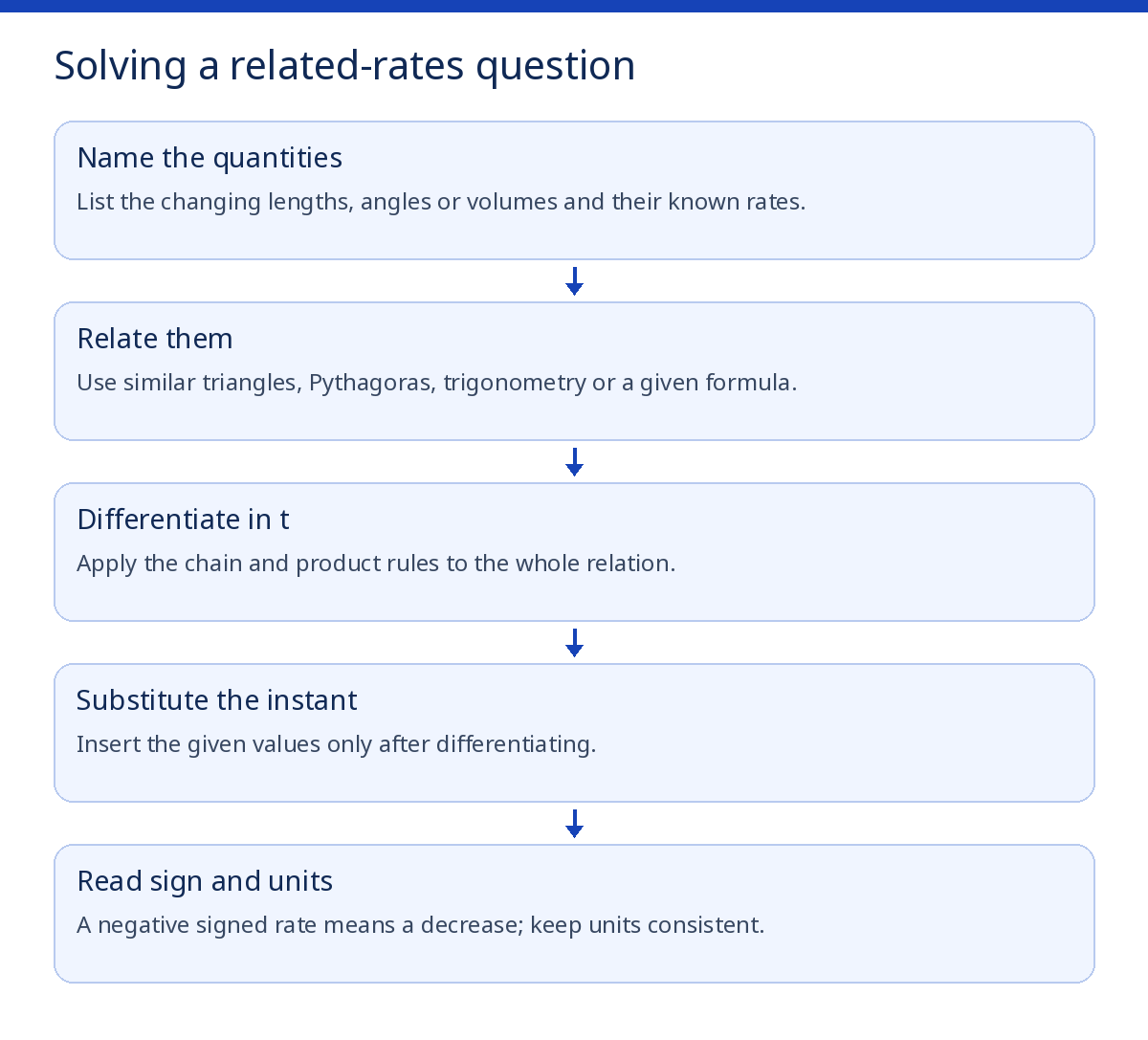
Almost every rate-of-change question follows one pattern. First, write a relation between the quantities. Then differentiate both sides with respect to time using the chain rule.
For a sphere, gives . A known volume rate therefore fixes the radius rate at a given instant. The solutions page reminds you that in time-dependent problems, all lengths vary with time unless the question says otherwise.
Order matters. Differentiate the general relation first, and substitute the instant's values, such as a radius of 15 cm, only afterwards. If you substitute early, you freeze a variable and wrongly make its rate zero.
When two quantities change together, use the product rule. For a cylinder, gives .
Some questions chain two derivatives. One asks how fast the slope of changes. Here the slope is itself a function of , so .

Applications of Derivatives | Class 12 | CBSE Assessment
In the StudentCurio app
A Class 12 CBSE assessment collection with practice questions and worked solutions on rates of change, increasing and decreasing functions, and maxima and minima. It includes optimization problems and objective, short-answer, long-answer, and case-based questions.
Signed rates, rates of decrease and units
The source states that a negative signed rate denotes a decrease.
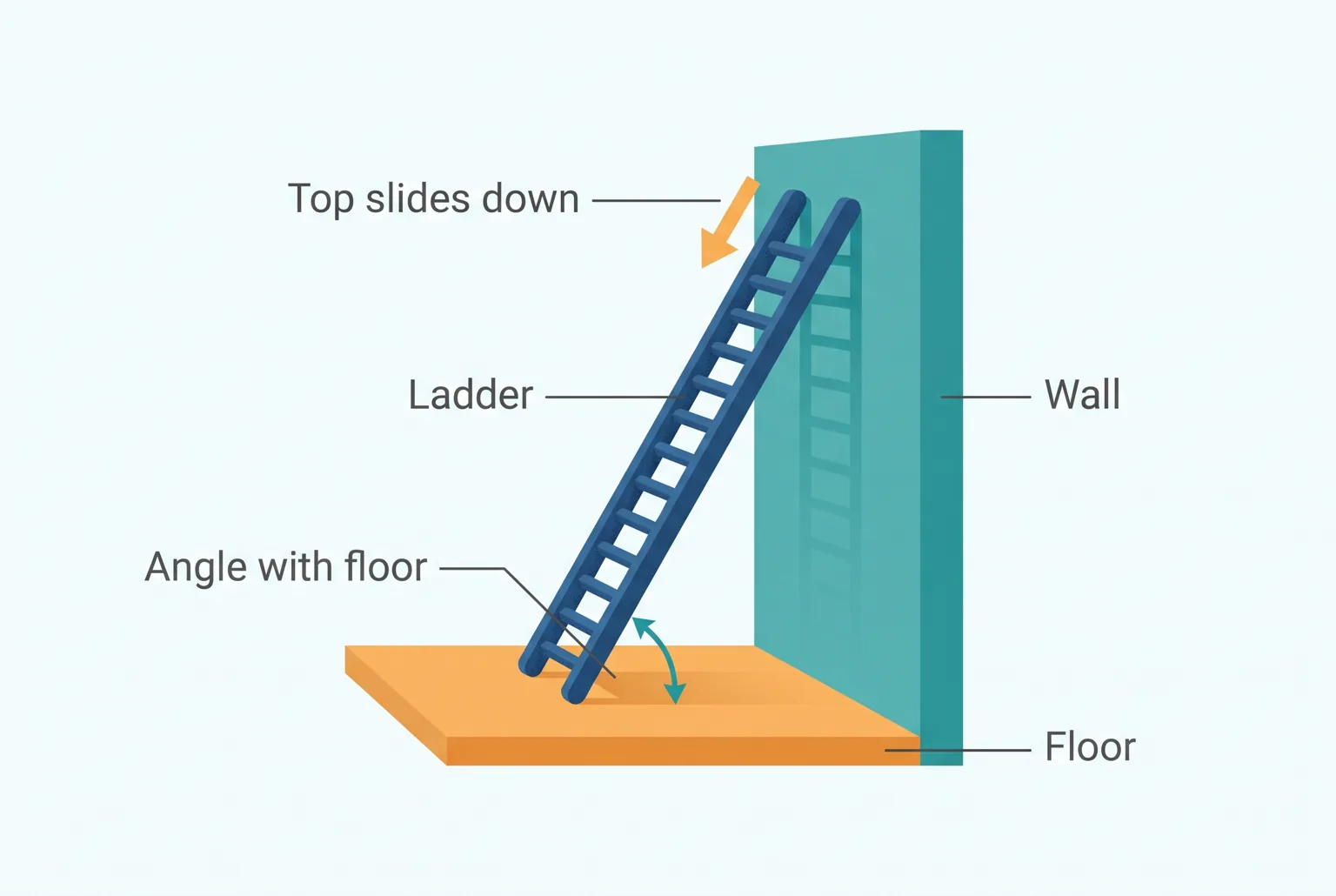
- Ladder question: the top slides down the wall, so the height's rate is entered as negative. The clarification notes that the signed angular rate is also negative, while the requested "rate of decrease" is its positive magnitude.
- Draining pool: the model litres holds for . Its signed rate is negative, even though the question asks how fast water runs out.
The pool question also separates two ideas. The instantaneous rate at s is a derivative. The average outflow over the first 5 s is the change in volume divided by the elapsed time.
Units need the same care:
- A man walking at 6 km/h needs consistent units before you differentiate.
- A plane rising at 100 km/h must be converted when the time is given in minutes.
- A rate with respect to radius, not time, carries units such as cm²/cm.
Geometry that links the changing variables
Long answers often depend on finding the right relation before any differentiation:
- Similar triangles fix the ratio for a conical vessel, funnel or sand pile. Eliminate so that depends on alone, then differentiate. Similar triangles also link a walker's distance from a lamp post to the length of his shadow.
- Pythagoras links a kite's horizontal distance to the string length. Subtract the boy's height first, because the string starts at his hand.
- Trigonometry links the angle of elevation of a tower top to the horizontal distance, after subtracting eye level from the tower's height.
- The cosine rule gives the separation of two people walking along roads inclined at 45°.
Sometimes the question supplies a formula. For the plane, the visible area is . Treat Earth's radius as constant and differentiate with respect to the changing height .
Marginal cost and inverse-variation proofs
The source defines marginal cost as the instantaneous rate of change of total cost at a given output. Differentiate and evaluate it at the stated number of units. Marginal revenue works the same way with .
Short proofs ask you to show that a rate varies inversely as a length. The clarifications stress a key distinction:
- When a circle's area grows at a uniform rate, the rate varies inversely as . The perimeter itself is directly proportional to .
- The cube version concerns the rate , not the total surface area .
Write the constant rate as and keep it symbolic throughout the proof.
The derivative sign test on connected intervals
Topic Practice 2 moves from rates to the shape of a function. The tool is the sign of on each interval.
A typical method has three steps:
- Factorise .
- Mark its zeros on a number line.
- Test the sign of in each resulting interval.
The solutions page adds two conditions:
- The sign test applies on each connected interval of the real domain.
- Isolated zeros of the derivative do not break strict monotonicity when keeps the same sign on either side.
Question forms vary. You may need to:
- show that is strictly increasing on ;
- find intervals for polynomials, trigonometric functions on ranges such as , and for ;
- prove for .
One question asks for a proof that with is strictly increasing, without using derivatives. This tests the definition itself. Another asks you to show a function is neither increasing nor decreasing on .
Common mistakes with domains and poles
The clarifications correct several overreaching claims:
- Gaps in the domain: is decreasing on each of and separately, but not across zero, since .
- Poles: is increasing on each interval between poles, but not globally across them.
- Missing absolute value: needs the absolute value to be real on , where .
- Stated domains: requires . For , require and , and do not merge decreasing intervals across 1.
- Restricted results: for , the increasing conclusion holds only on .
Working through the 158 questions in order
The file has four sets with worked solutions:
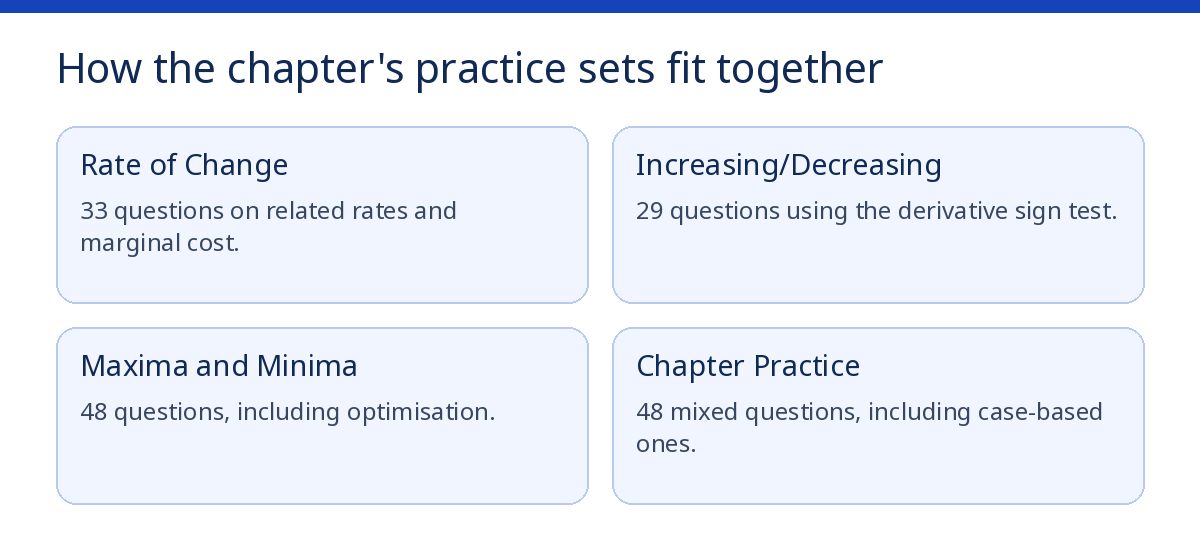
| Set | Topic | Questions | Question pages | Solution pages | |---|---|---|---|---| | Topic Practice 1 | Rate of Change of Quantities | 33 | p. 3 | p. 6 | | Topic Practice 2 | Increasing and Decreasing Functions | 29 | p. 12 | p. 15 | | Topic Practice 3 | Maxima and Minima | 48 | p. 21 | p. 25 | | Chapter Practice | Mixed | 48 | p. 35 | p. 42 |
The formats range from objective and very short answer questions to Short Answer Type I and II and long answers. The Chapter Practice adds case-based questions. Some multi-part monotonicity questions state that each part carries 4 marks. Question numbers restart in each section.
Work the topic sets in order before the mixed set. Attempt each question fully, then compare your setup, signs and domain statements with the worked solution and its clarification. The maxima and minima set, which includes optimisation problems, builds on the sign analysis from Topic Practice 2.
Quick self-check on rates and monotonicity
Before moving on, answer these in words:
- Why must you differentiate before substituting the instant's values?
- When a question asks for a "rate of decrease", how does it relate to the signed derivative?
- Why can a function be decreasing on two separate intervals without being decreasing across the gap between them?
- Which questions in your set restrict the domain, and how does that restriction change your final intervals?
Frequently asked questions
Is this material for CBSE or JEE?
It is a Class 12 CBSE assessment for the Mathematics chapter Application of Derivatives. It uses board-style formats, including objective, short answer, long answer and case-based questions.
Does each practice set include solutions?
Yes. Each of the four sets has its own worked-solutions pages, and the chapter index links each question number to its solution.
Spotted an error? Report a correction. Practise this in the app: notes, formula sheets and mind maps.





























































































































































Loading comments…