Wave Optics: CBSE Class 12 PYQs and Solutions
CBSEPhysicsWave Optics
This guide covers the CBSE Class 12 Physics chapter Wave Optics through a collection of 95 solved previous year questions spanning 2022–2026. It explains the tested ideas: fringe width and angular width in Young's experiment, intensity and coherence, single-slit diffraction, Huygens principle, and why wavelength changes on refraction while frequency does not.
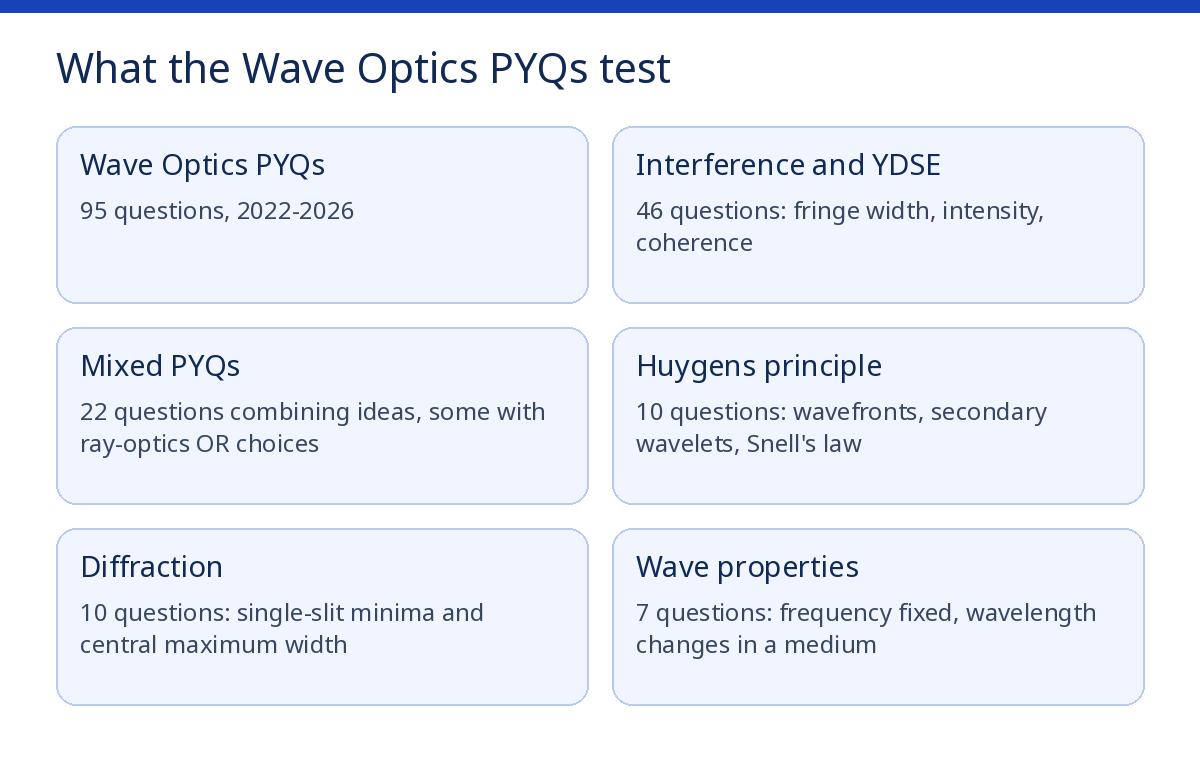
How the 95 Wave Optics questions are spread across sub-topics
The collection lists 95 previous year questions for Chapter 10, with exam-year coverage of 2022–2026. All questions come first, followed by complete solutions. Original question numbers and CBSE labels such as year, set and Delhi or compartment paper are kept. That is why an assertion-reason note may mention "questions 13 to 16".
The topic index groups the questions as follows:
- Interference and Young's experiment: 46 questions
- Mixed wave-optics PYQs: 22 questions
- Wavefronts and Huygens principle: 10 questions
- Diffraction: 10 questions
- Wave properties and optical paths: 7 questions
Young's double-slit experiment (YDSE) accounts for almost half the collection. The questions are split into an MCQ (single correct answer) section, which includes assertion-reason items, and a subjective section with OR-choice questions and a 4-mark case-based question built on a YDSE figure.

Wave Optics | Class 12 | Previous Year Paper
In the StudentCurio app
A comprehensive 91-page collection of solved previous year questions (PYQs) for CBSE Class 12 Physics, covering Huygens' principle, Young's Double Slit Experiment (YDSE), and diffraction patterns.
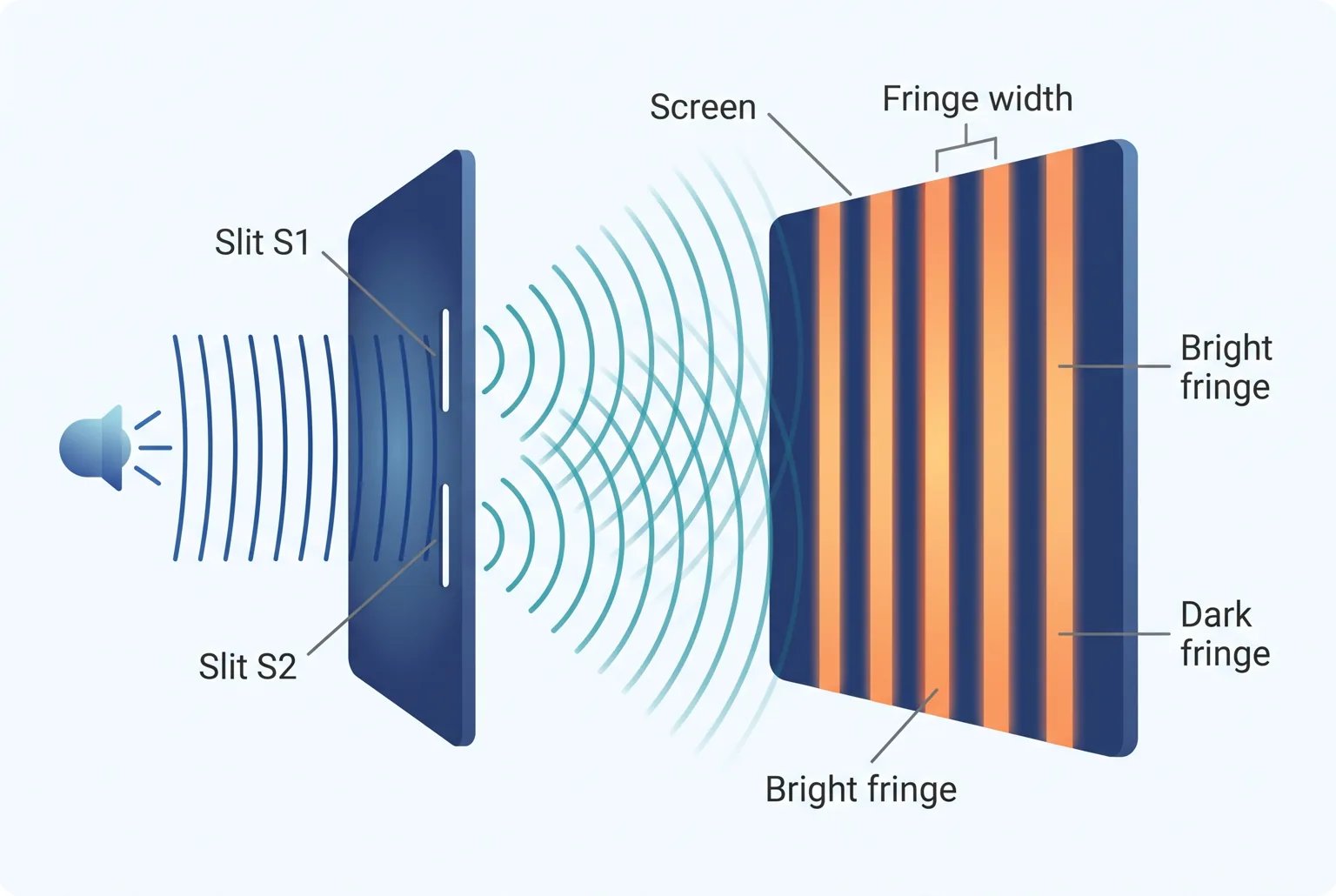
Fringe width, angular width and immersing YDSE in a liquid
Most YDSE questions rest on fringe width , where is the slit-to-screen distance and is the slit separation. The same expression gives the spacing of bright and dark fringes.
The angular width is , which does not contain . Many questions change one quantity, such as moving the screen, changing the wavelength or altering slit separation, and ask for the effect. First decide whether linear or angular width is asked, then check which variables it depends on.
Another recurring pattern places the whole apparatus in a medium of refractive index , for example water with . Inside the medium the wavelength becomes , and every fringe relation must use that value. Fringe-counting questions, such as comparing how many fringes fit a fixed distance with two wavelengths, follow from .
Intensity, phase difference and why coherent sources matter
In the wave picture, intensity is proportional to the square of the amplitude, . For two waves of intensities and with phase difference :
Phase and path difference are linked by . For equal intensities , this becomes . One subjective question asks you to prove that maxima and minima are and zero.
Questions giving a path difference as a fraction of follow a fixed sequence:
- Convert path difference to phase difference.
- Substitute into the intensity relation.
- If only the central-maximum intensity is given, express the answer in terms of it.
Ratio questions use .
Coherence means a constant phase difference between sources, which a sustained pattern requires. Questions ask why two independent sodium lamps fail to show interference, and assertion-reason items test whether light can produce darkness and how energy behaves across fringes.
Single-slit diffraction versus double-slit interference
For a slit of width , minima occur where , with . The central maximum has angular width and linear width . Questions on halving the slit width or moving the screen test this relation.
A subjective question asks why secondary maxima grow weaker with order. The usual reasoning divides the slit into parts whose contributions cancel in pairs, leaving a smaller uncancelled portion for higher orders.
A frequent short-answer task asks for differences between the patterns:
- Double-slit interference: equally spaced fringes, ideally of similar intensity.
- Single-slit diffraction: a central maximum twice as wide as the others, with intensity falling on either side.
Diffraction is noticeable when the aperture or obstacle is comparable to the wavelength, the basis of the sound-versus-light comparison.
Huygens principle and what stays fixed when light refracts
A wavefront is a surface of constant phase. Each point on it acts as a source of secondary wavelets, and their forward envelope gives the new wavefront. One question asks about wavelet amplitude in forward and backward directions, so learn the NCERT wording exactly.
The Snell's law derivation using Huygens principle is set as a subjective question. Draw incident and refracted wavefronts at a plane interface, compare distances covered in equal time at speeds and , and reach .
On refraction, frequency stays the same because the source sets it, while and . A thin-sheet question uses optical path: a sheet of thickness and index adds phase to one beam, shifting the pattern.
Common mistakes in fringe and intensity reasoning
- Mixing linear and angular width. Moving the screen changes but not .
- Forgetting the medium. When the setup is immersed, use throughout.
- Treating intensities like amplitudes. Because , combine amplitudes first, then square.
- Assuming wavelength is fixed on refraction. Only frequency is unchanged across an interface.
- Confusing conditions. In single-slit diffraction, gives dark positions.
A practice order for this Wave Optics PYQ collection
- YDSE MCQs first, fixing the fringe-width relations.
- Intensity questions, once path-to-phase conversion is automatic.
- Diffraction and Huygens groups, including the Snell's law derivation and pattern comparison.
- Mixed PYQs and OR choices last. Some OR options cover ray optics, such as telescopes and microscopes, so revise that chapter alongside.
- Solutions only after attempting each question; compare your step order with the worked version, especially for proofs and the case-based question.
Quick self-check: can you state the bright-fringe condition in YDSE and the single-slit minimum condition, and explain why they look alike but describe different things?
Frequently asked questions
Which Wave Optics topic has the most questions in this collection?
Interference and Young's experiment, with 46 of the 95 questions, according to the topic index.
What question formats are included?
Single-correct MCQs (including assertion-reason items) and subjective questions, which include OR-choice questions and a 4-mark case-based YDSE question.
Are solutions included?
Yes. All questions appear first, followed by complete worked solutions, with links between each question and its solution within the PDF.
Spotted an error? Report a correction. Practise this in the app: notes, formula sheets and mind maps.













































































































































































Loading comments…