CBSE Class 12 Physics 2024 Solved Paper: Set 55/4/1
CBSEPhysics2024 Previous Year Paper
Paper code: 55/4/1 · 2024Practise the full English-language CBSE Class 12 Physics 2024 main examination paper, set 55/4/1, under its three-hour, 70-mark format. Then use the worked explanations to check not just your results, but also your choice of principle, interpretation of diagrams and handling of signs.
This set is one of the year's papers. See every set from 2024, grouped by series.
What this year-wise paper contains
This file presents one complete board examination set rather than a chapter-wise collection. It retains the original English questions, options and diagrams, so you can practise interpreting information as it was presented in the exam. The question-number index lets you return to individual items, and the worked explanations include all printed internal choices. Those alternatives are useful for a second pass: practising both branches afterward is different from attempting both during a timed sitting.
The paper spans electrostatics, circuits, magnetism, optics, semiconductors and modern physics. That mix is the reason to try it in printed order at least once. Without a chapter heading to cue your method, you have to decide whether an item calls for a conservation law, a direction rule, a graph interpretation or a model of microscopic behaviour.

Physics 2024 | Class 12 | Previous Year Paper | Code 55/4/1
In the StudentCurio app
Complete solved CBSE Class 12 Physics 2024 paper, set 55/4/1, with questions and worked solutions spanning topics such as optics, electrostatics, circuits, magnetism, semiconductors and modern physics. Useful for practising the board-exam format and reviewing solution methods.
Use the solutions after a timed attempt
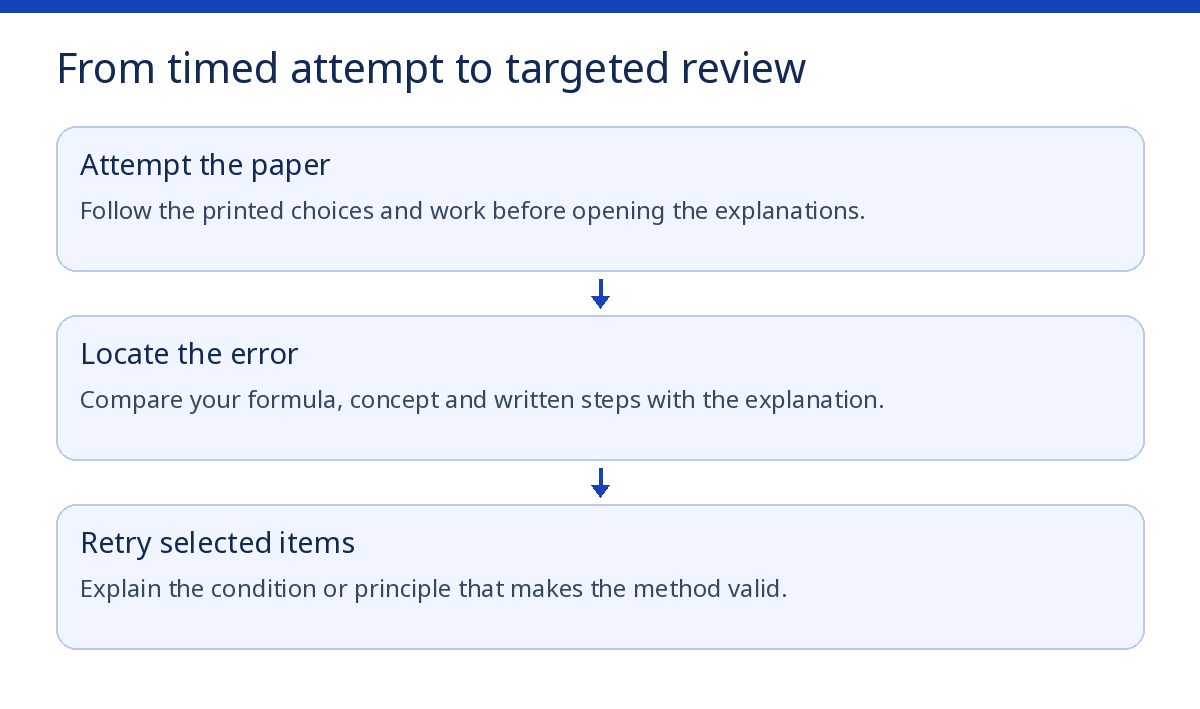
Set aside three hours and work from the question pages before opening the explanations. Follow the printed instructions on internal choices and keep track of items you leave unfinished. In a numerical response, write down what the quantity represents and the relation you intend to use before substituting values. In a written explanation, give the physical reason rather than only the conclusion. This leaves enough evidence in your script to tell where your reasoning went off track.
The solutions separate the formula used, the concept used and the explanation in steps. Use those labels to diagnose different errors. If you chose the right relation but obtained the wrong sign, inspect the substitution or direction convention. If you chose the wrong relation, look for the condition in the question that should have guided you. For assertion–reason items, test each statement separately before deciding whether the reason actually explains the assertion.
Common mistakes: counting twice and mixing currents
For the electrostatic potential energy of a system of point charges, add the contributions from distinct pairs, counting each pair once. Each term involves the product of the two signed charges and their separation. The separation is positive; it is the charge product that determines the sign of the term. Do not confuse this pairwise energy calculation with charge conservation. In a contact problem, conservation accounts for the total charge, while equal sharing in the paper’s conducting-ball setup relies on the balls being identical.
In the galvanometer-and-shunt circuit, distinguish the current through the coil from the total current through the converted ammeter. The coil and shunt are parallel branches, so the potential difference across them is the same, while the total current is the sum of the branch currents. Before comparing a value with an option or a worked step, check which current the wording refers to.
Read directions, graphs and timing separately
The magnetism items give you practice in reading spatial information before calculating. For a straight current-carrying wire, use the right-hand grip rule with your thumb along the conventional current. Your curled fingers give the field’s sense around the wire; the local direction depends on where the observation point lies. Mark that point before translating the direction into compass terms or coordinate axes.
A graph requires a different check: identify both axes before interpreting a slope. With inductive reactance plotted vertically against angular frequency horizontally, makes inductance the slope. In electromagnetic induction, meanwhile, distinguish a large magnetic flux from a large rate of change of flux. For a fixed coil, it is the latter that sets the magnitude of the induced emf. These are different tasks even when each question can be answered with a short relation.
Diagram check: diode polarity and current scale
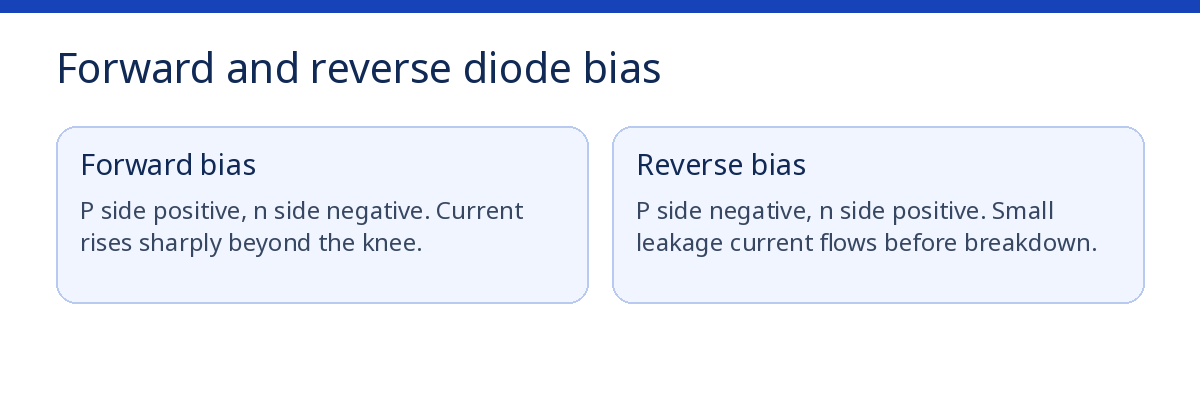
The diode material is useful for connecting a circuit diagram to a characteristic curve. Identify the p and n sides before tracing the supply connections. Forward bias means the p side is connected to the positive terminal and the n side to the negative terminal; reverse bias swaps the connections. In the measurement circuit, the ammeter is in series with the diode, while the voltmeter measures the potential difference across it.
When reviewing your graph, check that voltage is on the horizontal axis and current on the vertical axis. The forward current rises sharply beyond the knee, whereas the reverse leakage current remains small before breakdown. Label the current scales clearly: drawing forward and reverse branches without distinguishing their scales can hide the very difference the characteristic is meant to show.
Keep the physical model in view
In wave optics, a dark interference region does not mean energy has disappeared. Interference redistributes intensity, and energy conservation must be considered across the full pattern rather than at one dark point. In modern physics, make a different distinction: Bohr’s model concerns allowed states in hydrogen, while the Balmer series concerns transitions ending at the second level. An orbit radius and the wavelength of an emitted spectral line are not interchangeable descriptions of the same quantity.
On a second pass, select one item you missed and one you answered correctly but could not explain. For each, state what is conserved, what changes or which assumption makes the model applicable, as appropriate. That check tells you more than remembering an option letter. This guide leaves out the disputed photoelectric single-choice item and the disputed induced-emf timing option; neither is needed to review the independently supported concepts.
Spotted an error? Report a correction. Practise this in the app: notes, formula sheets and mind maps.













































































































































































Loading comments…