CBSE Class 12 Physics 2023 Previous Year Paper: Set 55/3/2
CBSEPhysics2023 Previous Year Paper
Paper code: 55/3/2 · 2023Practise with the complete English-language CBSE Class 12 Physics main examination paper for 2023 in its original three-hour, 70-mark format. This year-wise file pairs set 55/3/2 with worked solutions that identify the formula, explain the concept and show the reasoning in steps.
This set is one of the year's papers. See every set from 2023, grouped by series.
Read the five-section structure before you start
This is a full examination paper, not a chapter-wise worksheet. Its 35 questions move from selecting an option to writing explanations, constructing graphs and tackling multi-part problems. Section A has 18 one-mark questions, including three assertion–reason items. Section B has seven two-mark very short-answer questions, and Section C has five three-mark short-answer questions. Section D has three five-mark long-answer questions, while Section E has two four-mark case-based questions.
There is no overall choice: all question numbers are compulsory. Internal choices appear in two questions each in Sections B, C and E, and in all three questions in Section D. Follow the placement of each printed OR. In Section E, the choice is between versions of the final subpart in each case; it does not replace the earlier subparts.

Physics 2023 | Class 12 | Previous Year Paper | Code 55/3/2
In the StudentCurio app
Complete CBSE Class 12 Physics examination paper for 2023, set 55/3/2, with worked solutions. It includes questions across electricity and magnetism, optics, semiconductors, nuclear physics, alternating current and other syllabus topics.
Map the physics across the paper
The electricity and magnetism questions range from electrostatic fields, potential and capacitance to terminal voltage, induced emf and the moving-coil galvanometer. Alternating current appears through effective values, reactance and average power. These topics call for different starting points: a circuit question may depend on what is held fixed, while an induction question begins by checking whether the magnetic flux changes.
Optics includes both ray diagrams and wave effects. The paper also covers semiconductor charge carriers, junction bias and rectification, alongside the photoelectric effect, de Broglie wavelength, atomic scattering and nuclear binding. Use this spread to spot gaps in application as well as recall. For example, recognising a p–n junction does not tell you whether the prompt is about charge behaviour near the junction or the diode’s role in a rectifier.
When the setup decides which rule applies
Before choosing a formula, underline the words that define the physical model. In the alternating-current questions, distinguish an ideal component from a series circuit containing resistance. For a periodic voltage, the root-mean-square definition uses the mean of the squared voltage over a complete period, then takes the square root. A shortcut derived for a sinusoid should not be applied automatically to a signal defined in separate time intervals.
Make the same check in optics. A ray diagram for a lens or prism tracks directions and geometry, whereas a single-slit diffraction question treats light as a wave. Diffraction becomes significant when an opening or obstacle has dimensions comparable to the wavelength. Identifying which description the question calls for keeps you from assuming that light travels along sharp boundaries where wave spreading matters.
Make plots and diagrams part of your reasoning
Some prompts ask for a graph and an interpretation, not merely a recalled curve. In the resistor-power task, read the fixed quantity in each subpart before choosing a relation. Label both axes and note what stays constant. In nuclear physics, distinguish a graph of binding energy per nucleon against mass number from a plot of the potential energy of a pair of nucleons against separation. The former compares nuclei; the latter describes how the energy of a pair depends on the distance between them.
Check the horizontal axis in alternating current, too. A current-versus-time plot describes how current changes during a cycle at a given source frequency. A question about reactance as the source frequency changes compares different operating frequencies. Those are different uses of a graph, even when both involve the same type of component.
For a ray diagram, mark the optical element and relevant geometry before working with image quantities. Use the diagram to check that your sign convention is consistent with the positions and directions you have drawn.
Quick self-check: can you explain the link?
For an assertion–reason item, make three separate checks: Is the assertion true? Is the reason true? If both are true, does the reason actually explain the assertion? Then consult the options printed in this set. Do not select a letter from memory just because you recognise the format.
For a case-based question, connect each subpart to the passage or figure before writing. The two cases use single-slit diffraction and an electron beam between plates. Ask yourself which information comes from the diagram, which comes from the wording and which principle you must supply. If the prompt asks for a justification, check whether your explanation identifies the physical cause rather than merely restating the outcome.
Attempt the paper first, then use the worked solutions
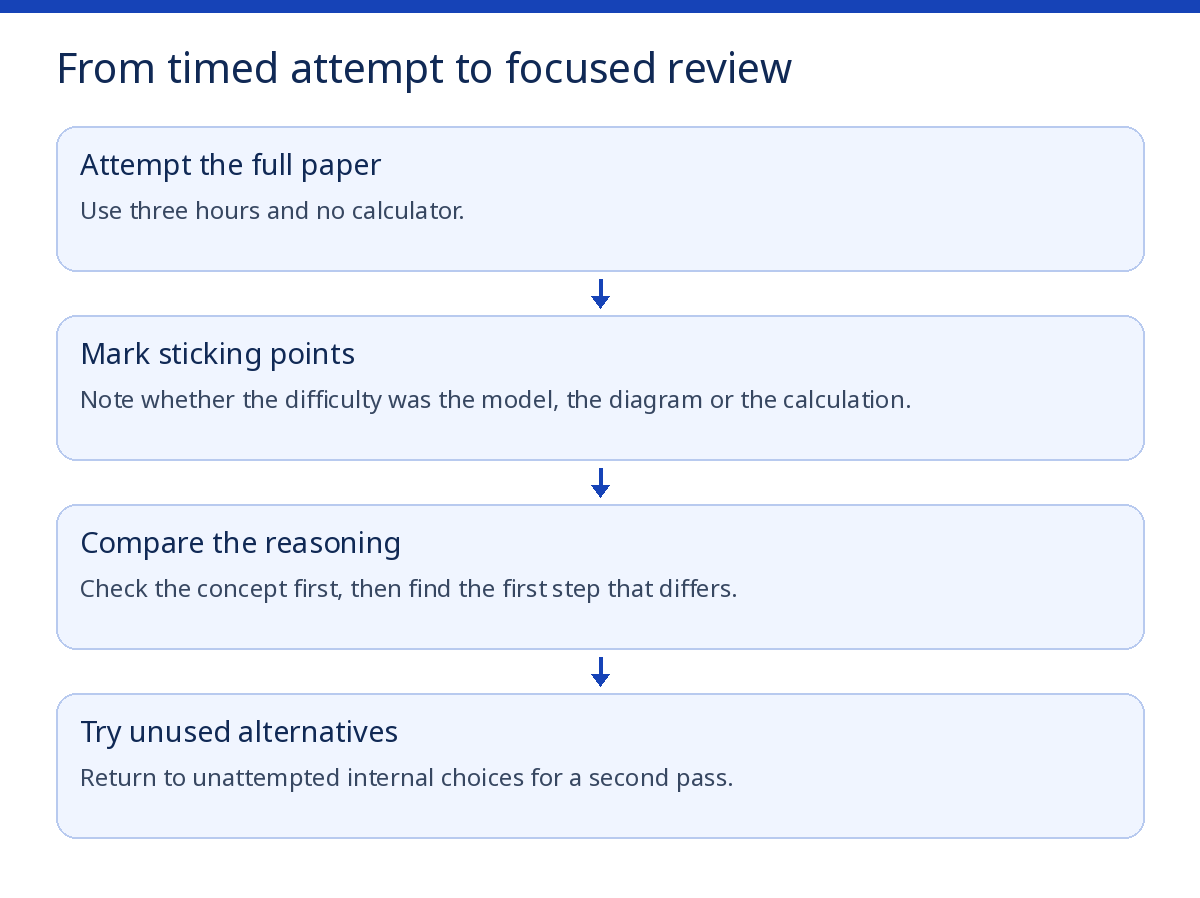
For a timed attempt, use the original three hours, work without a calculator and leave the solutions closed. Choose one printed alternative wherever a choice is offered. If a question stalls you, mark it for a return visit and note whether the sticking point was choosing a model, reading a diagram or carrying out the calculation.
Afterwards, use the question-number links to review the worked solutions. Compare the concept used before checking your algebra: a correct substitution cannot rescue an inapplicable formula. Then locate the first step where your reasoning diverged. If the setup was right but the numerical result differed, check that your quantities were in compatible units before you substituted them. When a constant’s exponent or unit is unclear in the extracted text, consult the printed page rather than guessing from the transcription.
Save the unattempted internal alternatives for a second pass. This guide omits Question 2’s worked result and option label because the extracted question is incomplete and the options cannot be matched reliably to the solution.
Spotted an error? Report a correction. Practise this in the app: notes, formula sheets and mind maps.













































































































































































Loading comments…