CBSE Class 12 Physics 2024 Paper (55/4/3) With Solutions
CBSEPhysics2024 Previous Year Paper
Paper code: 55/4/3 · 2024Practise the complete English version of the 2024 CBSE Class 12 Physics main examination, set 55/4/3. Use the worked solutions to check not only your results but also why each method applies.
This set is one of the year's papers. See every set from 2024, grouped by series.
What this year-wise paper contains
This resource pairs the full 2024 CBSE Class 12 Physics question paper with StudentCurio’s worked solutions for the same set. The paper carries 70 marks and has a three-hour time limit. The file retains the original English questions, options and diagrams, and the explanations cover the printed internal choices as well. It is a record of one board examination, not a chapter-wise question bank or a prediction of what another paper will test.
The solution pages distinguish the formula used, the concept used and the explanation in steps. That layout helps you separate three different problems: forgetting a relation, choosing one that does not fit, and making a mistake after choosing the right method.

Physics 2024 | Class 12 | Previous Year Paper | Code 55/4/3
In the StudentCurio app
Complete 2024 CBSE Class 12 Physics question paper, set 55/4/3, with worked solutions covering questions across multiple chapters. Useful for practising the board exam format and reviewing solution methods.
Attempt the paper before opening the solutions
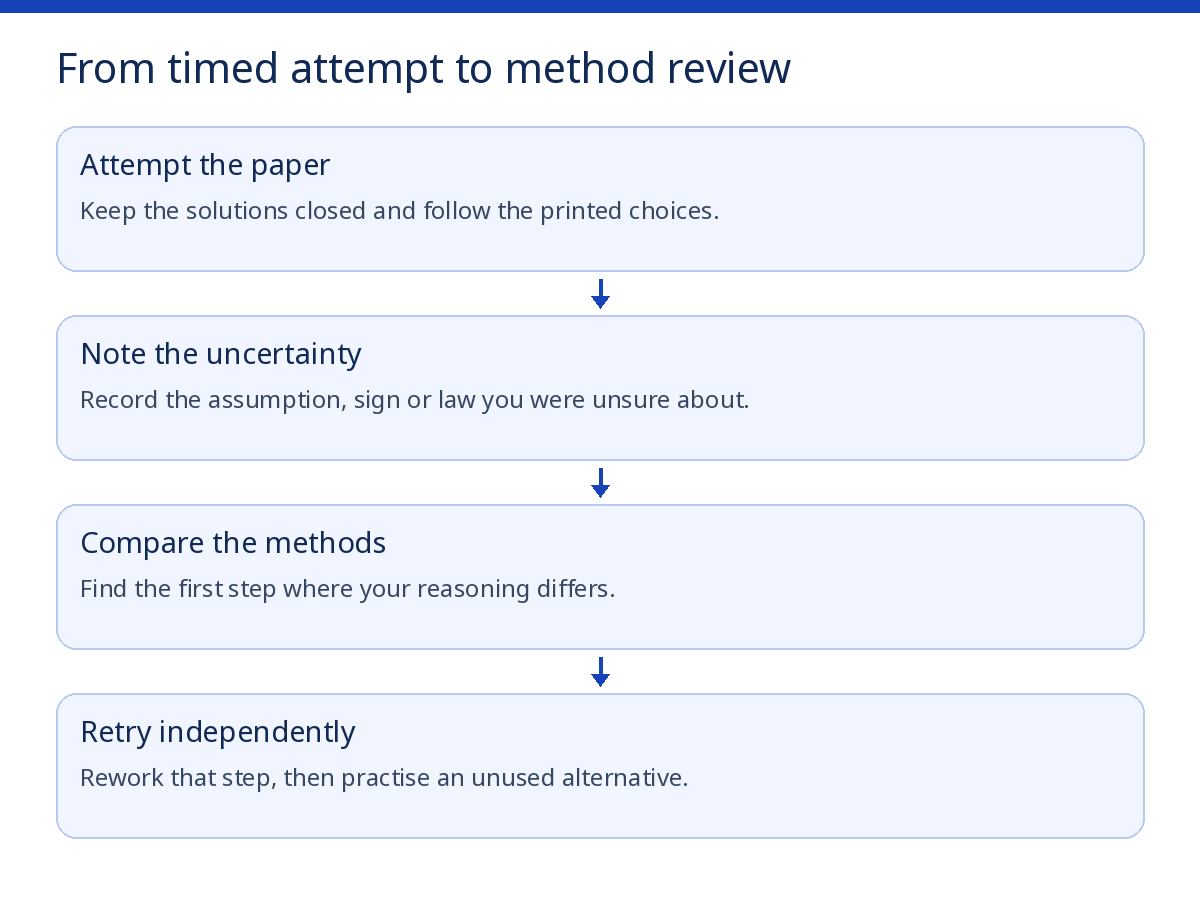
For a board-format practice session, work from the question paper and keep the solutions closed for the three-hour attempt. Follow the printed directions for internal choices. Leave the alternative for review rather than treating both branches as part of the timed task. If a question includes a diagram, refer to it when deciding what a distance, direction or label represents.
When you are unsure, leave a short note beside your work: perhaps you could not select a law, interpret a statement or decide on a sign. Those notes make the review more useful than a list of wrong answers. A result reached by guessing needs a different kind of follow-up from a result that went wrong in the last line of algebra.
Fields and induction: check the physical setup
The paper draws on electric dipoles, fields due to line charges, magnetic flux, electromagnetic induction and electromagnetic waves. A useful starting point is to decide what kind of quantity the question asks for. Potential energy is a scalar, whereas electric field and force have directions. In a line-charge problem, distinguish the field produced by the source from the force on a test charge: the sign of the test charge affects the force, not the source field. The ideal infinite-line relation uses the perpendicular distance from the line.
In induction, distinguish magnetic field from magnetic flux, and flux from its rate of change. Flux depends on the field through the surface and on its orientation. Faraday’s law links induced emf to the change in flux with time, so identifying a large field is not, by itself, a way to identify a large emf.
Common mix-ups in current and instrument questions
In a galvanometer converted to an ammeter, the shunt and galvanometer coil are parallel branches. They have the same potential difference, but their currents need not be equal. Before using a full-scale value, check whether it describes the total current entering the ammeter or the current through the coil. Label those quantities separately in your working so that a correct calculation is not reported as the wrong quantity.
For alternating current, the root-mean-square value is not the ordinary average of the signed current. Square the instantaneous current, average the square over a complete cycle and then take the square root. If you drop a cross term when combining components, be able to justify why its average vanishes for those components over that interval.
Optics and modern physics: identify the model first
The optics material includes refraction at a spherical surface, telescope adjustment and interference. In spherical refraction, identify the interface and the direction of incident light before assigning signs to object distance, image distance and radius of curvature. When reviewing a worked method, check that its description of the image agrees with the sign convention it adopts. In the telescope alternative, notice that normal adjustment is a stated condition of the setup, not a description that applies to every telescope configuration.
The paper also draws on hydrogen spectra, the Bohr model, the photoelectric effect and matter waves. Keep photon energy and particle momentum distinct. A wavelength associated with light and a de Broglie wavelength associated with a material particle refer to different physical quantities; the presence of a wavelength in both questions is not a reason to use the same relation.
Quick self-check for assertion–reason questions
Read the assertion and the reason separately before deciding whether one explains the other. Ask: What physical mechanism would connect these statements? In the material on electrical conduction, for example, distinguish a description of the charge carriers from an explanation of how resistance changes with temperature. Carrier population and scattering are relevant to that explanation; identifying the sign of a carrier does not establish the temperature dependence. In your review, mark whether you misjudged a statement itself or accepted a reason that did not explain the assertion.
Review methods without forcing an answer choice
Compare the first step where your reasoning differs from the worked solution. Was it a missing condition, a direction taken from the diagram, or an algebraic step? Once you have identified the difference, retry that part without looking. Then use an unattempted internal alternative for fresh practice, especially if it calls for a different model rather than another substitution.
This guide omits disputed answer choices and worked results for the wire-placement, induced-emf timing and single-choice photoelectric items. The supplied explanations flag unspecified geometry, a restriction on the timing choice and a lack of a unique choice, respectively. Treat those items as wording issues to review separately, not as reliable checks against a single option.
Spotted an error? Report a correction. Practise this in the app: notes, formula sheets and mind maps.













































































































































































Loading comments…