CBSE Class 12 Physics 2022 Term 2 Paper With Solutions
CBSEPhysics2022 Previous Year Paper
Paper code: 55/2/1 · 2022Practise with the complete English-language 2022 CBSE Class 12 Physics Term 2 paper, set 55/2/1. Use the worked solutions to check not only your calculations, but also the assumptions, diagrams and reasoning behind them.
This set is one of the year's papers. See every set from 2022, grouped by series.
What this 2022 paper contains
This year-wise resource contains the full main-examination paper for CBSE Class 12 Physics, Term 2, 2022, followed by worked solutions. The original English questions, options and diagrams are retained, and the explanations cover the printed internal alternatives. The file links question numbers to their solutions, so you can review a particular response without reading the entire solution section.
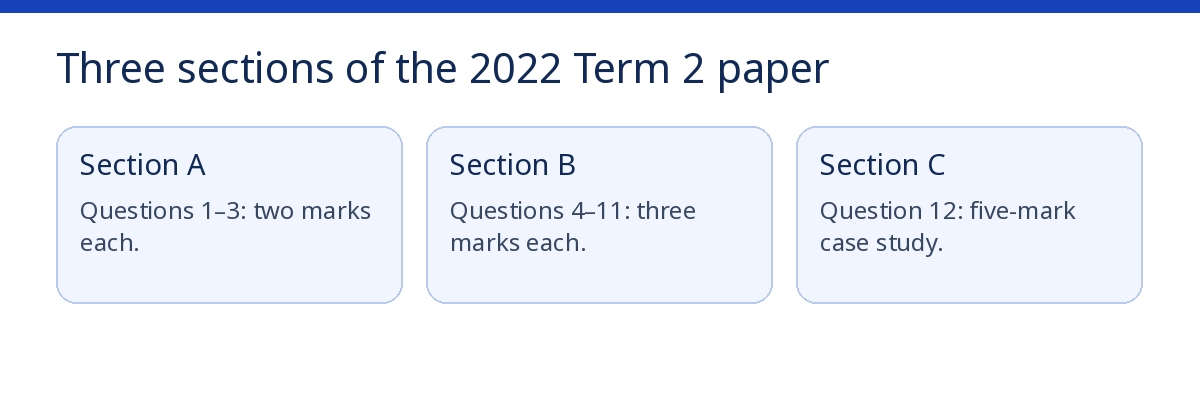
The paper allowed two hours for 35 marks and contained 12 compulsory questions. Section A has three two-mark questions, Section B has eight three-mark questions, and Section C has one five-mark case study. There is no overall choice: where a question offers an internal alternative, attempt only one branch in a timed sitting. The original instructions permitted log tables if needed but prohibited calculators.

Physics 2022 | Class 12 | Previous Year Paper | Code 55/2/1
In the StudentCurio app
Complete CBSE Class 12 Physics Term 2 question paper set 55/2/1 from 2022, with worked solutions for all questions. It covers topics including semiconductors, atomic and nuclear physics, electromagnetic waves, optics and de Broglie waves.
Two roles for the p–n junction
The semiconductor questions connect a microscopic explanation with two device applications. When a p–n junction forms, mobile carriers diffuse and recombine near the junction, leaving fixed ionised donors and acceptors behind. This distinction matters: the depletion region is depleted of mobile majority carriers, not devoid of charge. At equilibrium, drift and diffusion currents balance; zero net current does not mean the junction has no electric field.
Use that idea to compare the solar cell and the full-wave rectifier. In the solar cell, absorbed light generates carriers and the built-in field helps separate them. In the centre-tapped rectifier circuit covered in the paper, the input polarity determines which diode conducts on each half-cycle. When reviewing the circuit, trace the current through the load separately for each half-cycle, then check whether your output waveform agrees with those paths.
Read electromagnetic waves in two ways
The electromagnetic-wave question offers two kinds of practice. One alternative asks you to represent a plane wave through a sketch and field expressions. The other connects parts of the electromagnetic spectrum to their sources and uses. Practise both after the timed attempt: recognising a band of the spectrum is a different skill from interpreting a vector diagram.
For the plane wave in vacuum discussed in the solution, the electric and magnetic fields are perpendicular to each other and to the direction of propagation. They oscillate in phase. On your sketch, distinguish the direction in which each field oscillates from the direction in which the wave travels. Then check that the axes and field expressions describe the same orientation.
Ray optics: check the conditions before using a rule
The ray-optics questions move between an interface, a graph, an instrument and a lens in different media. For total internal reflection, check both the direction of travel and the angle of incidence: the ray must go from the higher-index to the lower-index medium and strike the boundary above the critical angle. The apparent-depth relation uses a different condition: near-normal viewing through a plane interface. Read the graph axes before interpreting its slope, because swapping the axes changes the ratio that the slope represents.
In the telescope alternative, normal adjustment means the final image is at infinity. Use the focal planes to explain why the rays emerge parallel, rather than treating the ray diagram as decoration. For the lens question, distinguish the refractive index of the glass from its index relative to the surrounding medium. Immersion changes that relative index without changing the surface curvatures.
Modern physics: identify the quantity being compared
The paper brings together scattering or photoelectric emission, the Bohr model of hydrogen, nuclear energetics and matter waves. In scattering, distinguish impact parameter, which is defined using the initial undeflected path, from distance of closest approach, which refers to the actual trajectory. In the photoelectric alternative, distinguish the incident frequency from the threshold frequency of the surface. In each case, define the quantity before choosing an equation.
For the hydrogen question, keep the total energy of the bound electron separate from its kinetic and potential energies. In the nuclear question, distinguish the potential-energy curve for a pair of nucleons from the energy balance of a proposed nuclear transformation. For de Broglie waves, start with . Equal speed, equal kinetic energy and acceleration from rest through the same potential difference are different conditions. In the nonrelativistic treatment used here, the last comparison requires attention to charge as well as mass.
Wave optics: keep interference and diffraction distinct
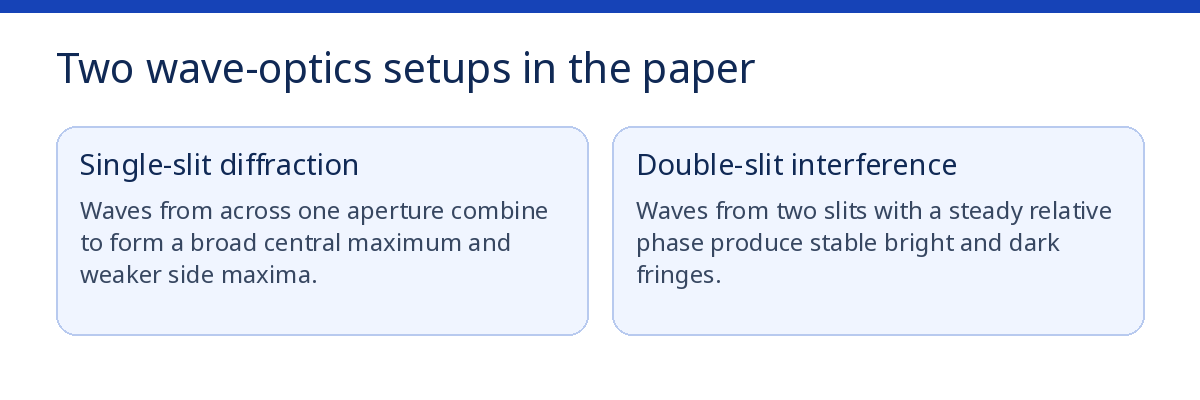
The paper treats single-slit diffraction in a Section B alternative and Young’s double-slit interference in the Section C case study. A single-slit pattern has a broad central maximum and weaker side maxima. In the double-slit case, a stable pattern requires waves with a steady relative phase. Distinguish fringe spacing from brightness: one describes where the bands lie, the other how much intensity reaches them.
This guide omits the case-study option that combines a spacing change with a brightness claim: the worked explanation invokes an illumination model for the brightness part. It also leaves out numerical givens and option text where signs or symbols are unclear in the supplied transcription.
Quick self-check after a timed attempt
Open the solutions after finishing the paper. Their formula, concept and steps layout lets you locate the first point where your reasoning diverged. For a diagram, check labels and directions before comparing the final shape. For a calculation, ask whether you chose a relation that fits the conditions stated in the question.
Can you explain what stays the same and what changes when the same lens is immersed? Can you tell from a rectifier sketch whether the two half-cycles drive the load current in the same direction? Use any hesitation to choose which explanation to revisit. Then attempt the internal alternatives you skipped, without counting them as part of the timed paper.
Spotted an error? Report a correction. Practise this in the app: notes, formula sheets and mind maps.













































































































































































Loading comments…