CBSE Class 12 Physics 2023 Paper (55/2/3) with Solutions
CBSEPhysics2023 Previous Year Paper
Paper code: 55/2/3 · 2023Practise with the complete English-language 2023 CBSE Class 12 Physics main examination paper, set 55/2/3. After an independent attempt, use the worked solutions to check why each method applies, not just whether your result matches.
This set is one of the year's papers. See every set from 2023, grouped by series.
What this year-wise paper includes
This resource presents one complete board-exam set, organised by year rather than by chapter. The paper allows three hours and carries a maximum of 70 marks. It retains the original English questions, options and diagrams. The worked explanations cover all printed internal choices, and the question-number links let you go directly to the item you want to review.
The paper brings together optics, electrostatics, current electricity, semiconductors and nuclear physics. That mix tests something chapter-wise practice can hide: whether you can identify the relevant principle without a chapter heading to cue you. Use the mix to see how topics appear together in this set, not to predict which topics a later board paper will emphasise.

Physics 2023 | Class 12 | Previous Year Paper | Code 55/2/3
In the StudentCurio app
The complete 2023 CBSE Class 12 Physics paper (set 55/2/3) with worked solutions, covering questions across the syllabus, including optics, electrostatics, current electricity, semiconductors and nuclear physics. Useful for board-exam practice and reviewing solution methods.
Attempt the paper before opening the solutions
For a full practice sitting, use the printed three-hour limit and follow the original instructions about internal choices. Where the paper asks you to choose an alternative, do not treat both as compulsory. Save the unused alternative for untimed practice, when you can try it independently and then check the worked explanation.
For a numerical question, write the governing relation before substituting values. For a conceptual question with options, note a short reason for your selection, even if the paper does not require one. This lets you distinguish a correct choice backed by sound reasoning from one you made by elimination without being sure of the principle. If you run out of time, mark where you stopped so you can separate unfinished work from a gap in understanding.
When the formula applies: fields and circuits
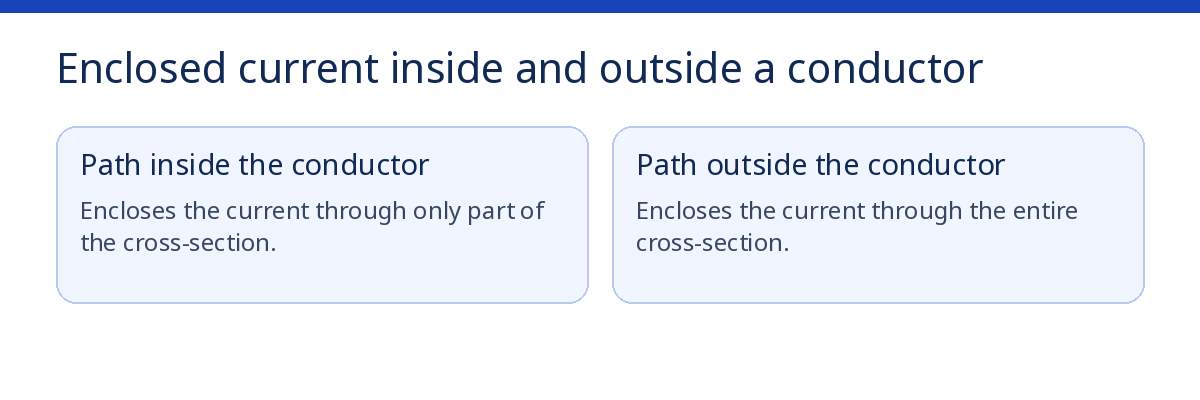
In the magnetic-field material, Ampère’s law distinguishes enclosed current from the total current carried by a conductor. For a long cylindrical conductor with uniform current density, a circular path centred on the axis and lying inside the conductor encloses only the current through the cross-section within that path. A path outside encloses the full current. Uniform current density is what lets you equate the fraction of current enclosed with the fraction of cross-sectional area enclosed.
In the cell model, gives the terminal voltage of a cell supplying current, where is its emf and is its internal resistance. The voltage across the external terminals is not the internal drop . For a different kind of current-electricity problem, check whether the current varies with time. If it does, the net charge transferred over an interval comes from over that interval, not from multiplying the final current by the elapsed time.
Good to remember: what stays fixed in optics
At a stationary boundary between two media, light keeps its frequency on refraction, even when its speed changes. The relation shows why a change in speed at fixed frequency means a change in wavelength. In the refractive-index relation , distinguish the speed of light in vacuum, , from its speed in the medium, . If a travel time is given in nanoseconds, convert it to seconds before calculating speed in metres per second.
In the usual small-angle model of Young’s double-slit experiment, gives the fringe spacing for monochromatic light. Here is the slit-to-screen distance and is the slit separation. Equal spacing follows within that approximation for fixed wavelength and geometry; it is not an unrestricted claim about every interference pattern.
Distinguish junction behaviour from nuclear properties
In a p–n junction, mobile electrons and holes diffuse and recombine near the boundary, leaving behind fixed ionised dopants. The dopant atoms themselves do not migrate to form the depletion layer. Bias describes a different aspect of the junction: it conducts much more readily in forward bias than in reverse bias below breakdown, but reverse current is not necessarily zero.
For carrier concentrations, applies at thermal equilibrium at a given temperature. Here and are the electron and hole concentrations, and is the intrinsic carrier concentration. The relation fixes their product, not the two concentrations separately.
In nuclear physics, the empirical radius relation uses mass number , not atomic number. Binding energy per nucleon, by contrast, measures the energy needed per nucleon on average to break up a nucleus. A size comparison and a binding comparison therefore answer different questions.
Quick self-check: find the first step to revise
The worked explanations separate the formula or principle, the concept and the steps. Use those parts to pinpoint where your reasoning went off track. If you chose the right equation, check the assumptions, substitutions and unit conversions before looking at the final result. If the arithmetic was sound but the method did not apply, write down the condition you missed instead of copying the calculation.
Ask yourself: What would have to change for this argument to stop working? For instance, zero work by an electric field on a charge taken around a closed path follows from the conservative nature of an electrostatic field. The same reasoning does not apply to an electric field induced by a changing magnetic field. Once you can explain the distinction without looking, retry the question or attempt an unused internal choice without the solution beside you.
Spotted an error? Report a correction. Practise this in the app: notes, formula sheets and mind maps.













































































































































































Loading comments…