Electrostatic Potential and Capacitance: Class 12 NCERT Guide
CBSEPhysicsElectrostatic Potential and Capacitance
This CBSE Class 12 Physics guide follows the NCERT chapter from work done on a test charge to the link between electric potential and field. Use the textbook’s derivations and examples to practise the sign, reference and distance checks that make these ideas easier to apply.
What the NCERT textbook chapter covers
This NCERT textbook file is Chapter 2 of Class 12 Physics. It covers electric potential and potential energy, equipotential surfaces, conductors and dielectrics, capacitance, capacitor combinations, and energy stored in capacitors. The opening pages build the vocabulary of work, energy and potential difference that you will meet again when studying capacitors.
+The textbook develops the ideas through derivations, diagrams, worked examples and end-of-chapter exercises. The opening examples have distinct purposes: one connects the potential due to a point charge to the work of bringing in a second charge, another uses the signed contributions of two charges to locate zero potential, and a third asks you to distinguish the signs of potential difference, energy change and work.

Electrostatic Potential and Capacitance | Class 12 | NCERT Textbook
In the StudentCurio app
This textbook chapter covers electric potential and potential energy, equipotential surfaces, conductors and dielectrics, capacitance, capacitor combinations, and energy stored in capacitors. It helps Class 12 students learn the concepts and work through examples and end-of-chapter exercises.
Why electrostatic work is path independent
The electrostatic force between stationary charges is conservative: its work in moving a test charge depends only on the starting and ending positions. This is what allows the textbook to define a potential energy difference between two points without specifying the route between them. In the point-charge derivation, it also lets you choose a radial path because that path makes the calculation simpler, not because the charge has to travel radially.
+The chapter considers a test charge small enough not to disturb the source configuration. An external force balances the electric force while the test charge is moved slowly without changing its kinetic energy. Under that condition, the external work equals the change in potential energy, and the electric field does the opposite amount of work: . If the field repels the test charge and you move it toward the source, the field does negative work and the potential energy increases.
Sign check: Potential is not potential energy
Electric potential difference is the change in potential energy per unit test charge: . The potential difference belongs to the source configuration; the energy change depends on which charge you move through it. For the same move from lower to higher potential, a positive test charge gains potential energy while a negative one loses it. Keep the starting and ending points in the same order before multiplying by the signed charge.
+The zero of potential is a reference choice. Adding the same constant to the potential at both points does not change the potential difference. When the chapter sets the potential at infinity to zero for a point charge, the potential at a point can be read as the external work per unit positive test charge in bringing it there from infinity without changing its kinetic energy.
From one point charge to several
For a point charge , with zero potential at infinity, at a distance . The sign of the potential is the sign of the source charge. Compare the textbook’s graphs: the potential varies as , whereas the field magnitude varies as . The two quantities describe the same source, but they do not fall off at the same rate.
+For several point charges, calculate each contribution at the same observation point and add the results algebraically. Potential is a scalar, so there are no vector components to resolve, but the signs of the charges still matter. When reading the two-charge example, sketch the regions along the line before writing the sum. A coordinate can be signed, but each denominator represents a positive distance from a source charge. Its expression can change when the observation point crosses a charge.
When the dipole shortcut applies
An electric dipole has equal and opposite charges separated by a distance . Its net charge is zero, but its potential need not vanish: at a general observation point, the distances to the two charges are different. On the equatorial plane, those distances are equal, so the two scalar contributions cancel exactly. This conclusion does not require a large-distance approximation.
+For a finite dipole at distances from its centre, the chapter obtains , where is the dipole moment magnitude and is measured from the dipole moment direction. At a fixed angle where the potential is nonzero, this falls off faster than the potential of a single point charge. If the observation point is not far from the finite dipole, use the separate point-charge contributions rather than the approximation.
Read equipotential diagrams alongside field lines
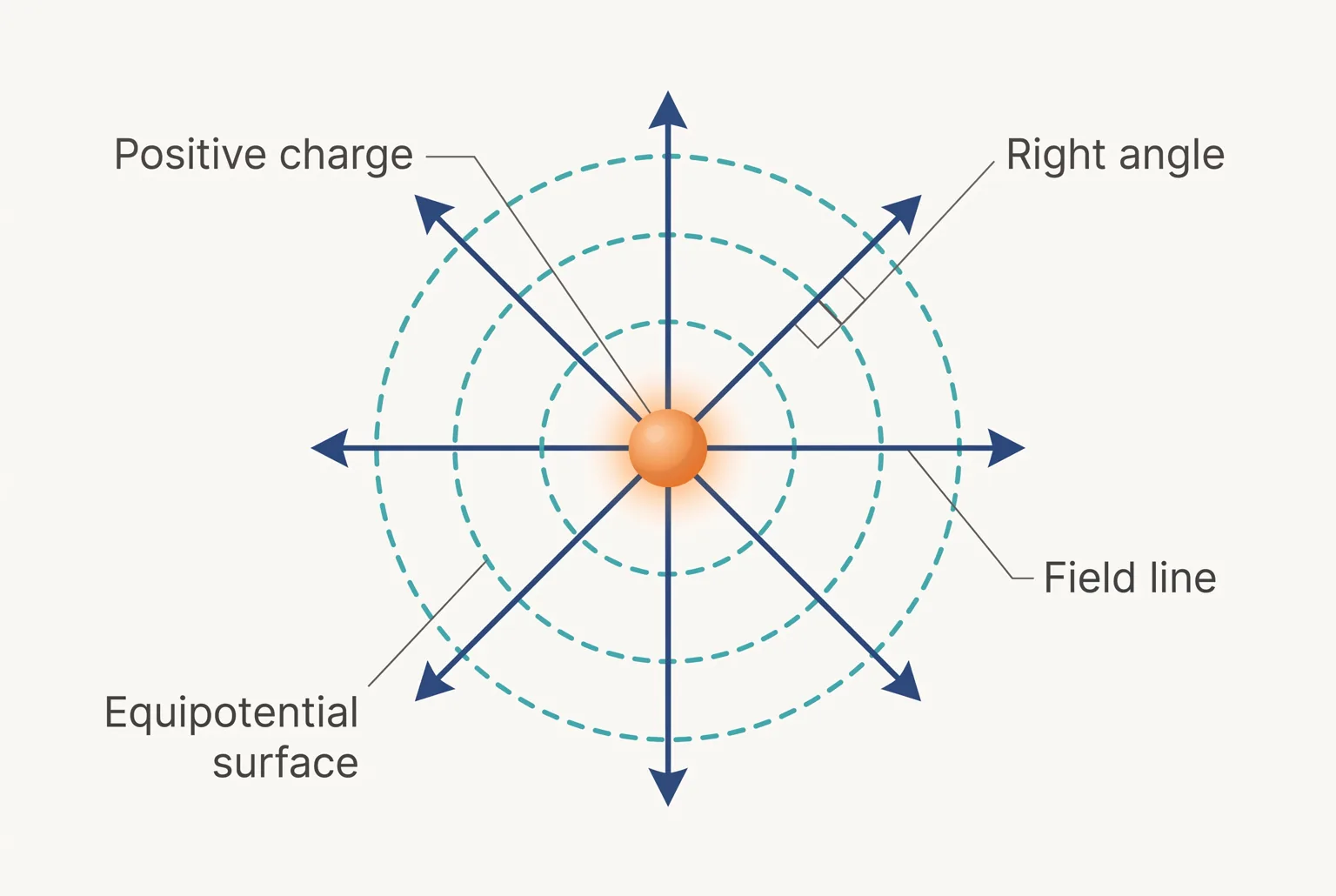
An equipotential surface has the same potential at every point, so moving a charge along it produces no change in potential energy. Where the electric field is nonzero, it is perpendicular to the surface: a field component along the surface would do work and contradict the constant potential. The field points in the direction of steepest decrease in potential, and its magnitude gives the local rate of decrease per unit distance in that direction.
+Compare the concentric spherical surfaces around a point charge with the parallel planes in a uniform field. Then use the uniformly charged spherical shell to check the distinction between zero field and zero potential. The field inside the shell is zero, so the potential does not change as you move within it. With the reference at infinity, that constant equals the surface potential, which need not be zero.
Spotted an error? Report a correction. Practise this in the app: notes, formula sheets and mind maps.













































































































































































Loading comments…