Comprehensive Guide to CBSE Class 12 Atomic Physics Case Studies
CBSEPhysicsAtomic Physics
Master the intricacies of Rutherford’s scattering, Bohr’s atomic model, and hydrogen spectral series through targeted case-based assessments and conceptual analysis.
Navigating the Foundations of Atomic Structure
The study of atoms in the CBSE Class 12 Physics curriculum transitions from classical observations to quantum mechanical postulates. This StudentCurio resource provides nine distinct case-based assessments designed to bridge the gap between theoretical derivations and experimental evidence. It covers the pivotal experiments of Rutherford, Geiger, and Marsden, alongside the mathematical framework introduced by Niels Bohr. By engaging with these cases, learners can practice interpreting complex data sets, such as the specific scattering ratios of -particles and the discrete wavelengths of the hydrogen emission spectrum.
The resource is structured to provide immediate feedback, featuring 43 questions that range from conceptual multiple-choice queries to advanced mathematical modifications of Bohr’s rules. For students preparing for the CBSE board exams, these case studies serve as a high-value tool for understanding why certain atomic models were discarded and how the current nuclear model accounts for the stability of matter. The material specifically highlights the use of labelled transition diagrams and atomic models to visualize electron behavior during excitation and de-excitation.

Atomic Physics | Class 12 | CBSE Case-based Assessment
In the StudentCurio app
A set of 9 case-based assessments for CBSE Class 12 Physics, featuring detailed scenarios and solutions for Rutherford’s alpha scattering experiment, Bohr’s atomic model, and spectral series.
Rutherford’s Scattering and the Nuclear Discovery
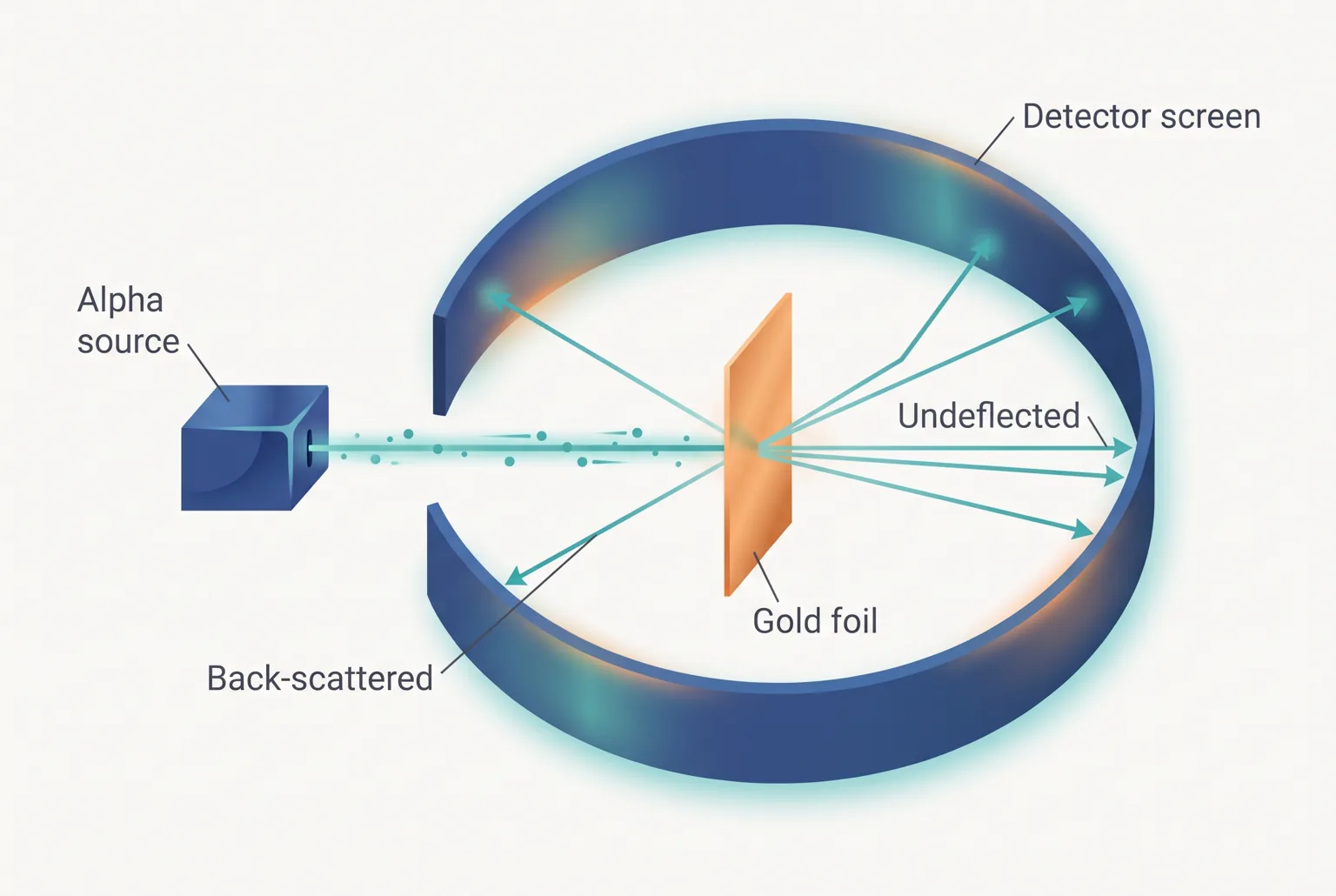
The Geiger–Marsden -particle scattering experiment remains a cornerstone of atomic physics. The source material details the experimental setup: a radioactive bismuth-214 source emitting 5.5 MeV -particles directed at a gold foil with a thickness of m. This specific thickness is significant because it minimizes multiple scatterings, allowing for a single-scattering calculation where the trajectory depends primarily on the impact parameter.
Key observations provided in the resource include the fact that most particles pass undeflected, while only about 0.14% scatter more than , and a mere 1 in 8,000 deflect more than . These results prove that the atom’s positive charge and nearly all its mass are concentrated in a tiny nucleus. The case studies challenge students to identify why the planetary model of Rutherford, while revolutionary, faced stability issues regarding accelerating electrons and classical electromagnetic radiation losses.
Bohr’s Postulates and Quantisation Rules
To address the limitations of the Rutherford model, Niels Bohr introduced the concept of stationary orbits. The material explains that in these permitted orbits, electrons do not radiate energy. The primary condition for these orbits is the quantisation of angular momentum, expressed as , where is the principal quantum number. This resource provides a deep dive into how this quantisation leads to discrete energy levels, effectively explaining the stable behavior of electrons that classical physics could not.
Furthermore, the case studies explore the Bohr–de Broglie description, where discrete radii result from the electron's orbit containing an integer number of de Broglie wavelengths. This connection is vital for understanding the wave-particle duality inherent in modern atomic models. Learners are tasked with calculating orbital speeds, radii, and energy levels for various quantum states, reinforcing the proportionality relationships such as how angular speed varies with and energy scales with .
Analyzing Hydrogen Spectral Transitions
The emission and absorption spectra of hydrogen are explained through electron transitions between these quantised energy levels. The source material utilizes the Rydberg relation, , where is the Rydberg constant (). It categorizes the spectral series based on their final energy level: the Lyman series (ultraviolet, ), the Balmer series (visible/UV, ), and the Paschen series (infrared, ).
Specific exercises within the resource require students to determine limiting wavelengths (where the upper level tends to infinity) and the maximum number of spectral lines emitted when an atom cascades from an excited state back to the ground state. For instance, if an atom is excited to , it can follow multiple downward paths, resulting in a specific number of distinct emission lines. The material emphasizes the distinction between wavenumber and frequency, a common point of confusion in spectral calculations.
Hypothetical Models and Mathematical Adaptations
A unique feature of this assessment set is the inclusion of hypothetical scenarios where the fundamental quantisation rules are modified. In one scenario, the allowed angular momentum is changed to . This forces students to apply the principles of physics—such as the balance between Coulomb attraction and centripetal force—to derive new expressions for radius, velocity, and ionisation energy rather than relying on memorized formulas.
In these modified models, the Coulomb law and electron mass remain constant, but the resulting ground-state properties (like the Bohr radius) change significantly. These problems test the learner’s ability to manipulate variables and understand the underlying mechanics of the Bohr model. By calculating ionisation energies for these 'other planet' atoms, students gain a robust understanding of how sensitive atomic structure is to the specific values of Planck’s constant and quantisation conditions.
Energy Relations in the Bound Atom
The resource provides detailed schematics for the energy levels of hydrogen and singly ionised helium (). For hydrogen, the energy in the -th state is defined by . The case studies explore the relationships between kinetic energy (KE), potential energy (PE), and total energy (TE). A critical takeaway is that as an electron moves to a higher allowed orbit (increasing ), its potential energy and total energy increase (becoming less negative), while its kinetic energy and orbital velocity decrease.
Additionally, the material covers energy transfer between species. For example, it presents a scenario where hydrogen atoms transfer excitation energy to ions via collisions. Students must use the respective energy level formulas for different atomic numbers () to identify the resulting quantum states. This comparative analysis between hydrogen and hydrogen-like ions is essential for mastering the broader applications of the Bohr model in the CBSE Class 12 syllabus.
Summary of Essential Formulas and Constants
- Angular Momentum Quantisation: .
- Hydrogen Energy Levels: .
- Rydberg Formula: .
- Photon Energy: .
- Impact Parameter (): Related to the scattering angle in -particle experiments; for head-on collisions.
- Velocity and Radius: Radius is proportional to , while velocity is inversely proportional to .
Frequently asked questions
What happens to the impact parameter in a head-on collision?
In a head-on encounter between an -particle and a nucleus, the impact parameter is zero, resulting in a deflection of .
Which hydrogen spectral series is visible to the human eye?
The first several lines of the Balmer series () are in the visible region, while its limit lies in the near ultraviolet.
How is the stability of an atom explained in Bohr's model compared to Rutherford's?
Unlike Rutherford's model where accelerating electrons would lose energy and spiral inward, Bohr postulated 'stationary orbits' where electrons do not radiate electromagnetic energy, ensuring atomic stability.
What is the relation between the Rydberg constant and the mass of the nucleus?
The standard Rydberg constant () is defined for an infinitely massive nucleus and is considered a universal constant in the context of these calculations.
Spotted an error? Report a correction. Practise this in the app: notes, formula sheets and mind maps.













































































































































































Loading comments…