CBSE Class 12 Physics 2025 Question Paper with Solutions
CBSEPhysics2025 Previous Year Paper
Paper code: 55/1/1 · 2025Practise the English version of the CBSE Class 12 Physics 2025 main examination, paper code 55/1/1. Use the full paper for a three-hour attempt, then review the worked explanations to see where your choice of principle, setup or reasoning differed.
This set is one of the year's papers. See every set from 2025, grouped by series.
What this year-wise paper contains
This is a full CBSE Class 12 board paper, not a chapter worksheet. The paper carries 70 marks and has a duration of three hours. The file retains the original English questions, options and diagrams, so you can practise interpreting the same information that was presented in the examination rather than relying on rewritten prompts.
The worked explanations are organised by question number and distinguish the formula used, the concept used and the steps. They also cover the printed internal choices. That structure lets you check a specific part of your reasoning without treating the final answer as the only measure of understanding. The paper code identifies the version you are using when you refer back to a question or diagram.

Physics 2025 | Class 12 | Previous Year Paper | Code 55/1/1
In the StudentCurio app
Complete CBSE Class 12 Physics 2025 examination paper with worked solutions, covering questions across the syllabus. Helps students practise the board-paper format and review solution methods.
What the paper asks you to do
The questions move between different kinds of physics reasoning. In electricity and magnetism, the paper includes relationships involving resistance, magnetic force, induction, alternating-current power and the terminal voltage of a cell. These topics do not all call for the same kind of setup: a wire-resistance problem depends on geometry, while a magnetic-force problem can depend on the direction of vector components as well as their magnitudes.
The paper also includes apparent depth, diffraction and interference, alongside topics such as the photoelectric effect, matter waves, nuclear binding energy and semiconductor junctions. Some questions ask you to read a graph or select an option; others ask you to judge an assertion and its reason or work through a calculation. The full-paper format makes you decide which kind of reasoning is needed before you begin.
Good to remember: name the axes and the quantity
In a force-versus- graph, the slope describes how the plotted force changes with inverse squared separation, not how it changes with separation itself. When the graph uses signed force values, the sign of the slope and its magnitude communicate different information. Before drawing an inference, check the axis labels and the sign convention used in the question.
The same habit is useful in modern physics. A stopping-potential graph relates stopping potential to incident frequency in the photoelectric effect. A nuclear binding-energy graph, by contrast, may plot binding energy per nucleon rather than total binding energy. Dividing by the number of nucleons changes what is being compared. In review, name the plotted quantity before explaining what a slope or a peak tells you.
When a familiar formula applies
Use the explanations to check the conditions behind an equation, not just whether you remembered it. For example, uses the conductor’s cross-sectional area, not its diameter. For a circular cross-section, that area varies with the square of the diameter. If a comparison keeps resistivity fixed, length and area are the quantities to track separately.
In optics, the simple apparent-depth relation for an object in water viewed from air applies to near-normal viewing through a plane surface. It is not a general rule for viewing at any angle. Likewise, the first minimum in single-slit diffraction and the intensity from two coherent waves are different tasks. The former asks for a condition for a minimum; the latter depends on the relative phase and the intensities of the contributing waves.
Common mistake: stopping at whether both statements are true
For an assertion–reason item, make three separate judgments: whether the assertion is true, whether the reason is true, and whether the reason actually explains the assertion. Two true statements about the same topic do not necessarily have the required explanatory link. The paper’s semiconductor material offers a useful distinction: identifying the majority carriers in each type of semiconductor is a different issue from explaining what is needed to form a working junction.
When you review this format, try writing one sentence that connects the reason to the assertion before checking the explanation. If your sentence merely restates both claims, you have not yet shown a causal or logical connection. This makes the question useful even if you already recognise the correct option.
How to attempt the paper and review your work
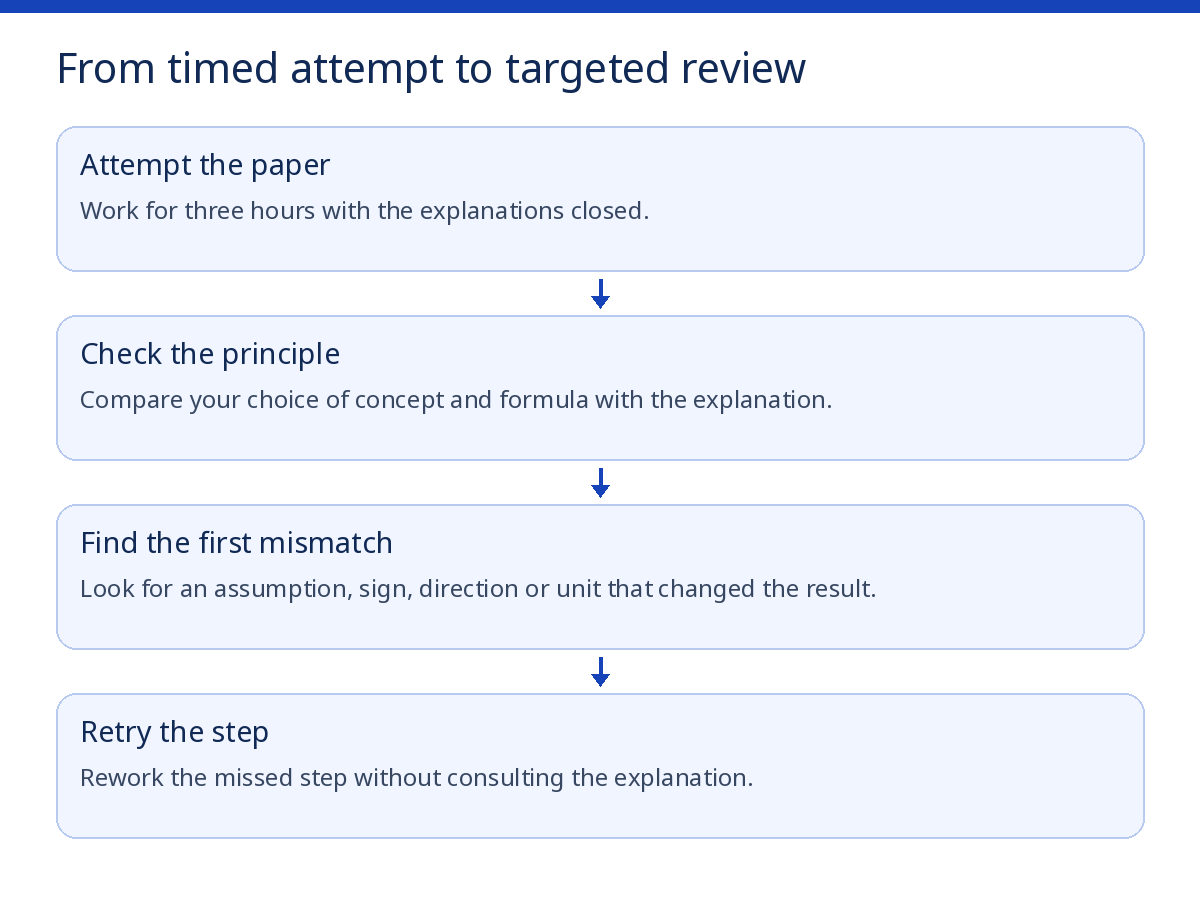
For a board-format attempt, set aside the stated three hours and keep the worked explanations closed. Follow the printed directions for internal choices. Where a choice is offered, attempt one alternative during the timed sitting; save the other for a later, untimed check. That keeps your timed attempt distinct from the extra practice available in the file.
In review, compare your work with the explanation from the beginning, not just at the last line. Check whether you identified the right principle, used it under the right conditions and carried the signs, directions or units through correctly. Mark the first point of divergence. For example, a magnetic-force calculation with the right magnitude but the wrong direction calls for a check of the cross product, not another round of arithmetic. Then retry that step without looking at the explanation.
Spotted an error? Report a correction. Practise this in the app: notes, formula sheets and mind maps.













































































































































































Loading comments…