CBSE Class 12 Physics 2023 Previous Year Paper with Solutions
CBSEPhysics2023 Previous Year Paper
Paper code: 55/2/1 · 2023Practise with the full English-language CBSE Class 12 Physics main examination paper from 2023. This guide shows how to use the three-hour paper and its worked solutions to check not just your answers, but also the assumptions behind your reasoning.
This set is one of the year's papers. See every set from 2023, grouped by series.
What this 2023 paper includes
This is a year-wise previous year paper, not a chapter-wise worksheet. It presents the complete 2023 CBSE Class 12 Physics main examination paper, set 55/2/1, with a time limit of 3 hours and a maximum of 70 marks. The file retains the original English questions, options and diagrams. Its question-number navigation lets you revisit individual items, and the worked explanations include all printed internal choices.
The paper covers topics including electrostatics, current electricity, magnetism, electromagnetic waves, optics, atomic and nuclear physics, and semiconductors. Working through it in paper order lets you practise switching between topics without a chapter heading telling you which principle to use. Returning to selected questions afterwards serves a different purpose: it lets you isolate a method or assumption that slowed you down.

Physics 2023 | Class 12 | Previous Year Paper | Code 55/2/1
In the StudentCurio app
Complete CBSE Class 12 Physics paper for 2023 with worked solutions, covering questions across the syllabus, including electrostatics, optics, electromagnetism, atomic and nuclear physics, and semiconductors. Helps students practise the board-exam format and review solution methods.
Separate the timed attempt from the solution review
For a mock attempt, set aside the printed three hours, keep the worked explanations closed and follow the paper’s directions on internal choices. If you want extra practice, try the alternatives you did not select after the timed sitting. That way, the extra questions help with revision without changing the conditions of your first attempt.
The worked solutions separate Formula used, Concept used and Explanation in steps. Compare your work with those three parts in order. A wrong result can come from choosing the wrong physical model, applying a valid relation outside its conditions, or making a mistake during substitution. If your final answer matches but your reasoning does not, revisit the concept rather than treating the match as sufficient.
When the electric-field and circuit rules apply
In electrostatics, check what quantity the question asks you to compare. The electric field magnitude of a fixed point charge varies as , where is distance from the charge. An electric dipole’s axial potential also has an inverse-square dependence in the far-field approximation, but this is a different quantity and a different charge arrangement. The approximation requires the observation distance to be much larger than the dipole separation; the shared power of distance does not make the two rules interchangeable.
For circuit questions, distinguish emf from terminal voltage. When a cell delivers current, its terminal voltage is the emf minus the drop across the internal resistance. In a Joule-heating calculation using constant current and resistance, check that time is in seconds if you are using amperes and ohms and want the energy in joules.
Common mistakes with paths and boundaries
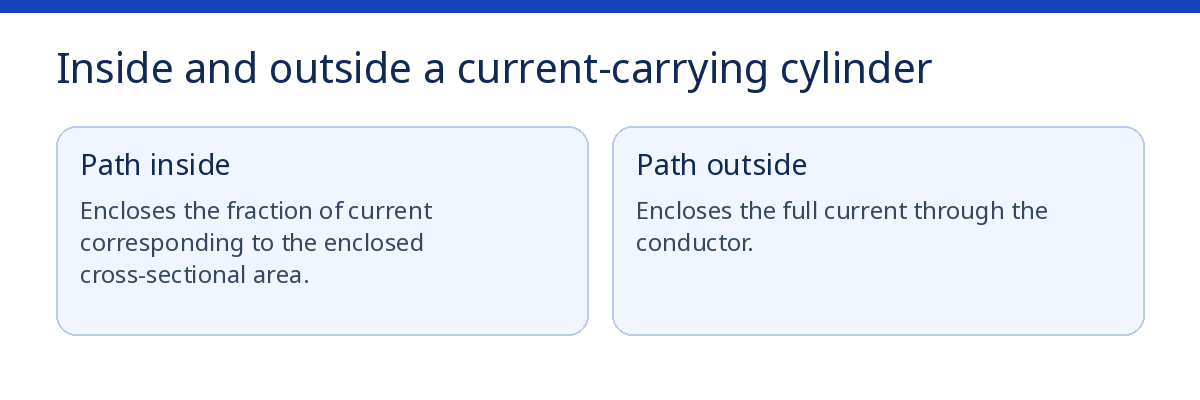
In the magnetic-field treatment of a long cylindrical conductor, the circular path used with Ampère’s law encloses only part of the current when it lies inside the conductor. With uniform current density, the fraction enclosed is set by the fraction of the cross-sectional area inside the path. A path outside the conductor encloses the full current. Check which region the path lies in before selecting a field expression.
Keep a separate distinction in mind when reviewing electric fields: zero work around a closed path is a property of an electrostatic field. An electric field induced by a changing magnetic field need not have that property. This guide omits the answer option for the closed-path assertion because its wording needs that electrostatic qualification.
Track what changes in optics
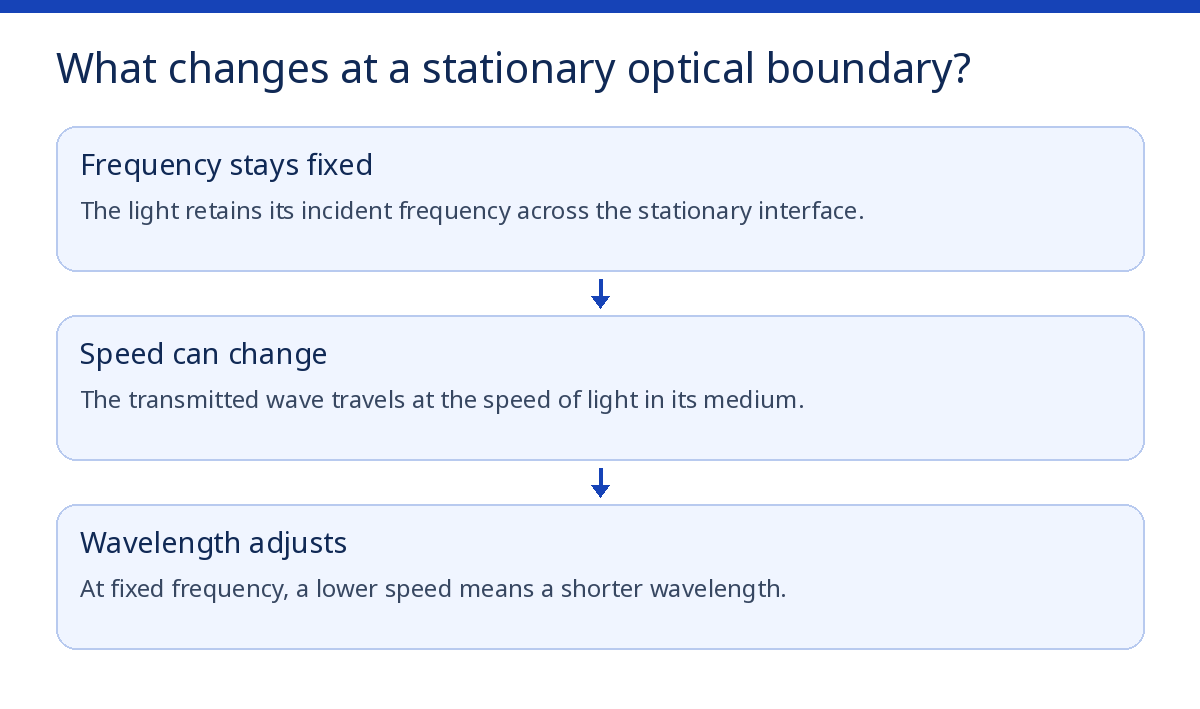
At a stationary interface, reflected and refracted light retain the frequency of the incident light. A change in wave speed therefore means a change in wavelength, not frequency. When comparing light in two media, use with the speed and wavelength for the same medium. Mixing the speed from one medium with the wavelength from another can give an incorrect frequency even if the algebra is consistent.
In Young’s double-slit interference, the usual fringe-spacing relation, , is used for monochromatic light in the paraxial approximation, where the angles considered are small. Here, is the slit-to-screen distance and is the slit separation. When reviewing the explanation, distinguish the spacing between successive fringes from the position of a particular fringe.
Distinguish photon energy from nuclear binding
Photoelectric emission and atomic transitions both involve photon energy, but the comparisons are different. For photoelectric emission, compare with the material’s work function: a photon must supply at least that threshold energy. For an atomic emission transition, the photon energy equals the drop between the initial and final energy levels. A larger drop corresponds to a shorter wavelength, so the wavelength ranking reverses the energy ranking.
Nuclear binding questions require another distinction: binding energy per nucleon is not the total binding energy. It expresses binding relative to the number of constituents, which makes it useful when comparing nuclei of different sizes. In your review, name the quantity being compared before drawing a conclusion about how strongly the nuclei are bound.
Quick self-check: what moves in a semiconductor?
Before reopening the worked solutions, explain the difference between mobile carriers and fixed ions at a p–n junction. Electrons and holes diffuse along their concentration gradients and can recombine near the junction. The depletion layer is associated with the fixed ions left behind, not with dopant atoms migrating across the junction.
Then ask what assumption lets you use , where and are the electron and hole concentrations and is the intrinsic carrier concentration. The relation applies at thermal equilibrium, with evaluated at the temperature in question. If you can identify both what moves in the junction and what makes the concentration relation applicable, you have checked two different kinds of reasoning: a physical mechanism and the condition for using an equation.
Spotted an error? Report a correction. Practise this in the app: notes, formula sheets and mind maps.













































































































































































Loading comments…