Ray Optics and Optical Instruments: Class 12 NCERT Guide
CBSEPhysicsRay Optics
This NCERT Physics chapter for CBSE Class 12 shows how to trace light rays, predict where images form, and explain when light stays inside a medium. Use its diagrams, worked examples, and exercises to connect each formula with the physical conditions that make it valid.
What the ray model lets you explain
The chapter starts with a question: if light is an electromagnetic wave, why can we draw its path as a straight line? The ray model is useful when the wavelength is much smaller than the objects or features that the light encounters. A ray represents a path of propagation, and a bundle of rays represents a beam. The model lets you focus on where light goes without denying its wave nature.
The supplied pages develop reflection by spherical mirrors, refraction at transparent boundaries, and total internal reflection. The chapter also covers lenses, prisms, and optical instruments, including microscopes and telescopes. The connecting idea is that tracing what happens at each surface helps you understand what a whole optical system does.

Ray Optics | Class 12 | NCERT Textbook
In the StudentCurio app
This textbook chapter covers reflection and spherical mirrors, refraction, total internal reflection, lenses, prisms, and optical instruments including microscopes and telescopes, with examples and exercises. It supports Class 12 students learning ray-optics concepts and applying the relevant formulas.
How a spherical mirror forms an image
The law of reflection applies at every point on a curved mirror just as it does on a plane mirror: the angle of incidence equals the angle of reflection, with both angles measured from the local normal. On a spherical mirror, that normal lies along the radius joining the point of incidence to the centre of curvature. This is why a ray directed along that line retraces its path after reflection.
In the chapter’s diagrams, two conveniently chosen rays locate the image of an object point. If the reflected rays actually meet, the image is real. If only their backward extensions meet, the image is virtual. This distinction also explains the two kinds of principal focus: a concave mirror brings incoming rays parallel to the principal axis together, while a convex mirror makes them appear to spread from its focus. These focus descriptions assume paraxial rays.
When the mirror formulas apply
Paraxial rays strike close to the pole and make small angles with the principal axis. The textbook uses the small-angle approximation in its derivation of , where is focal length and is radius of curvature. The relation describes the paraxial focus; it does not assert that all rays striking a spherical mirror meet at exactly the same point.
For spherical mirrors in this approximation, the mirror equation is , where and are the signed object and image distances. The derivation uses a concave mirror forming a real image, but the equation also applies to convex mirrors and virtual images under the same convention. Measure distances from the pole: along the incident light is positive, and against it is negative. Heights above the principal axis are positive and heights below it are negative. In , the sign tells you the image’s orientation relative to the object, while the magnitude tells you the size ratio.
Refraction: track the direction at each boundary
Refraction changes the direction of a ray that enters a medium of different refractive index at an oblique angle. In Snell’s law, , the subscripts identify the incident and receiving media, respectively. Measure both angles from the normal. The ray bends towards the normal on entering an optically denser medium and away from it on entering an optically rarer one, provided a refracted ray exists. Optical density is not mass density, and the relative refractive index can depend on wavelength.
The parallel-sided slab diagram shows why parallel need not mean on the same line: with the same surrounding medium on both sides, the second refraction restores the incident direction, but the emergent ray is laterally displaced at oblique incidence. The apparent-depth diagram illustrates a different effect. For viewing water from air near the normal, the apparent depth is the real depth divided by water’s refractive index relative to air. The near-normal condition matters; this simple ratio is not a general rule for oblique viewing.
Critical angle: three cases to distinguish
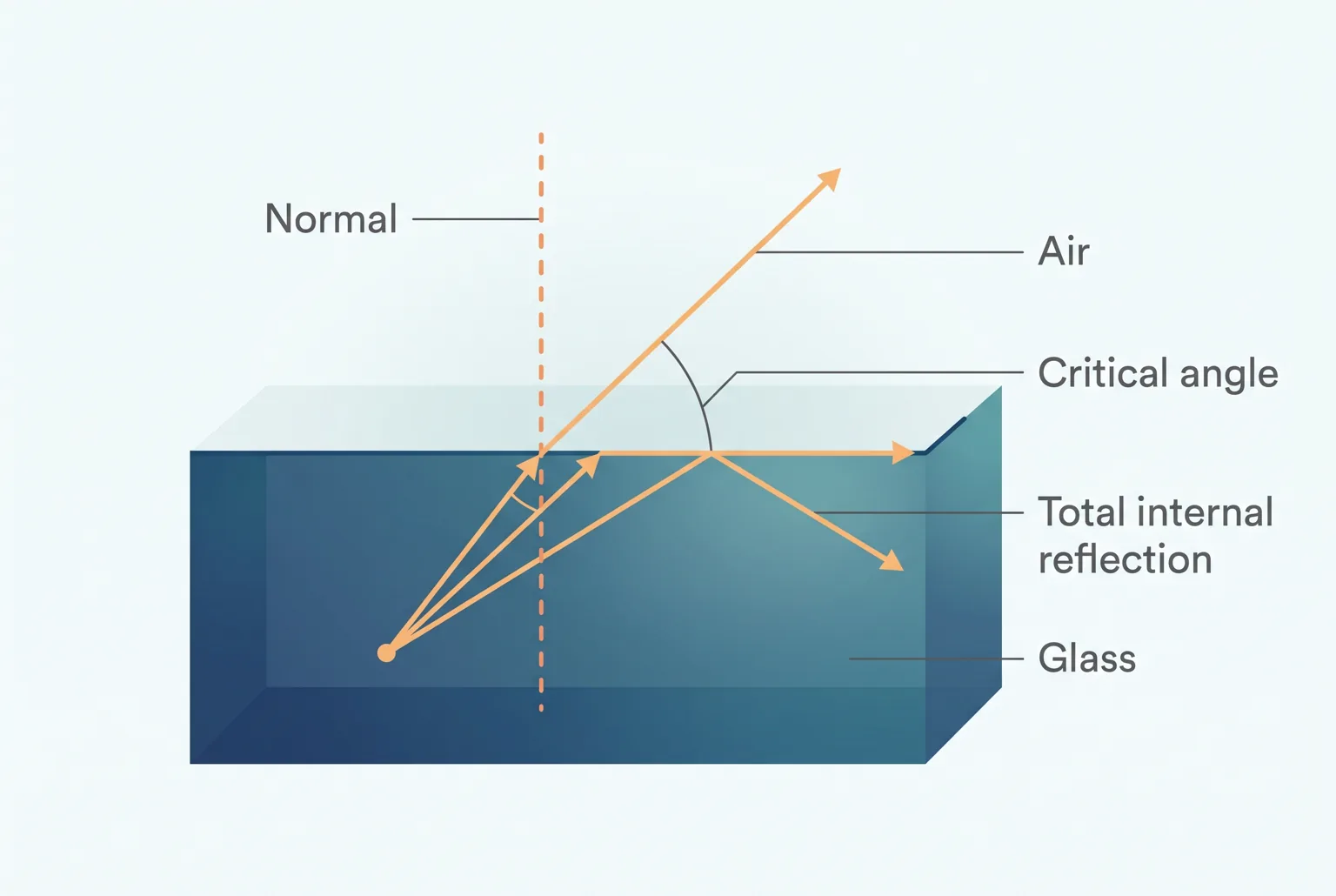
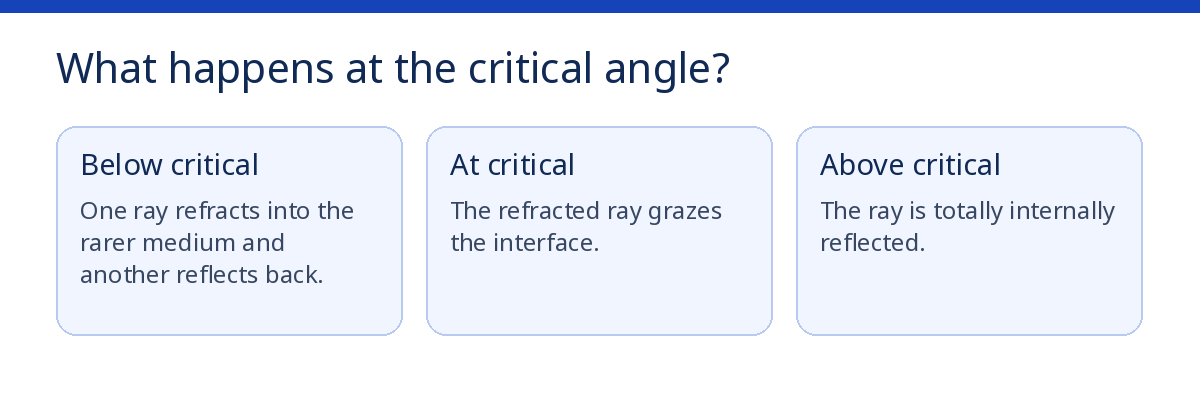
Start by checking that light is travelling from an optically denser medium to an optically rarer one. Only then is there a critical angle, given by , where medium 1 is the denser incident medium. Below the critical angle, there is a refracted ray as well as an internally reflected ray. At the critical angle, the refracted ray grazes the boundary, making a right angle with the normal. Total internal reflection occurs above the critical angle, when there is no transmitted ray into the second medium.
The prism and optical fibre diagrams put this test to work. A suitably designed prism redirects light by total internal reflection. An optical fibre has a core with a higher refractive index than the cladding. Light launched suitably into the core can meet the core–cladding boundary above the critical angle repeatedly and remain guided along the fibre.
Use the textbook diagrams before the exercises
Trace the incident ray and mark the normal before looking at the reflected or refracted path in a figure. For a mirror exercise, sketch where you expect an image to form, assign signs, and then compare that prediction with what the equation tells you. Read a worked example for the link between the geometry and the calculation, not just for the final number. Before moving on, try explaining why a virtual image still has a definite location even though the rays do not meet there.
Editorial note: The dense flint glass row in Table 9.1 is omitted because its printed refractive index and critical angle do not agree with the chapter’s relation.
Spotted an error? Report a correction. Practise this in the app: notes, formula sheets and mind maps.













































































































































































Loading comments…