CBSE Class 12 Physics 2022 Term 2: Solved Previous Year Paper
CBSEPhysics2022 Previous Year Paper
Paper code: 55/5/1 · 2022Use the full 2022 CBSE Class 12 Physics Term 2 paper for a two-hour practice attempt, then compare your reasoning with the worked explanations. The guide highlights where the choice of model, the conditions for a formula or the reading of a diagram matter.
This set is one of the year's papers. See every set from 2022, grouped by series.
What the 2022 paper includes
This year-wise resource contains the English version of the CBSE Class 12 Physics main examination paper for 2022 Term 2, code 55/5/1. The paper carries 35 marks and has a time limit of 2 hours. The file retains the original questions, options and diagrams. Its worked explanations cover the printed internal choices and separate the formula used, the concept behind it and the steps in the reasoning.
Use the question-paper portion for your first attempt and save the explanations for review. The front-page question links let you go directly to an explanation when you are ready to check it. Treat the coverage as a record of what appeared in this Term 2 paper, not as a checklist for the entire Class 12 Physics syllabus.

Physics 2022 | Class 12 | Previous Year Paper | Code 55/5/1
In the StudentCurio app
A solved CBSE Class 12 Physics Term 2 paper from 2022, covering topics including electronic devices, atomic and nuclear physics, wave optics, and ray optics. It helps students practise exam questions and review worked solutions.
Electronic devices: Read the bias before the graph
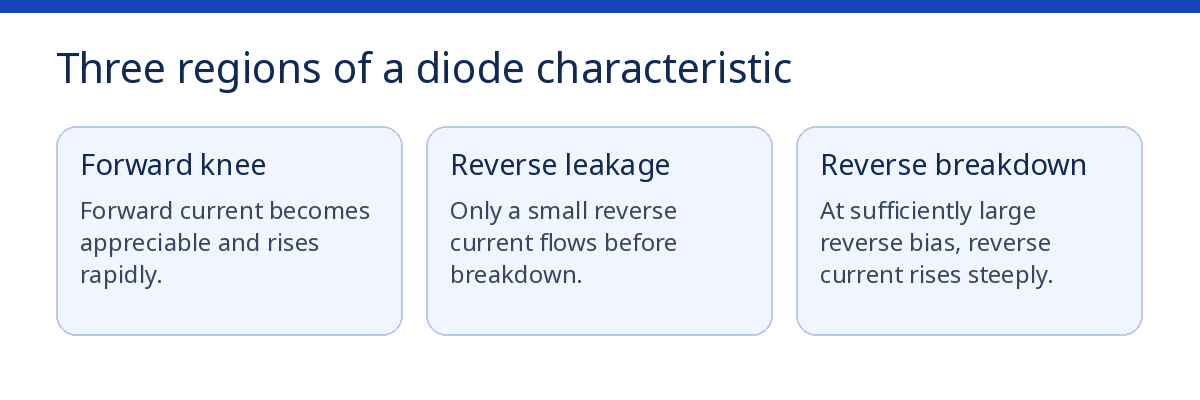
The electronics questions connect diode bias, current–voltage characteristics, half-wave rectification and photodiode operation. In the ideal half-wave model, the diode conducts during one input half-cycle and blocks during the other. When sketching the output, first identify the diode orientation and the points across which the output is measured. The waveform is the voltage across the load, not a copy of the alternating input.
Common mistake: Treating the forward knee and reverse breakdown as two names for the same event. The knee is an approximate point beyond which forward current rises appreciably; it is not an exact switch-on voltage. Reverse breakdown occurs at sufficiently large reverse bias. A photodiode’s reverse-biased operation is a different use of the reverse region: the aim is to collect light-generated charge and distinguish its current from the dark current, not to reach breakdown.
Atomic and nuclear physics: Check what your model assumes
The scattering material asks you to connect an observed pattern with a model of the atom. Distinguish the evidence for a small nucleus from the limitations of Rutherford’s classical orbit model: explaining scattering does not, by itself, explain why atoms remain stable or why they produce discrete line spectra. When comparing targets, ask whether the target is massive enough for its recoil to be neglected. A light target cannot be treated like a nearly stationary heavy scattering centre.
The nuclear-energy material calls for a different check: identify all the masses on the initial and final sides of the stated process before applying . An incoming particle belongs on the initial side, and any instruction to neglect a mass applies only as specified. A positive denotes energy released.
A useful connection: Photon energy and electron emission
The photon questions give you two ways to link wavelength to a physical quantity: for energy and for momentum. In the ordinary one-photon photoelectric model, emission is possible only if a photon supplies at least the work function of the surface. At fixed frequency, increasing intensity does not change the energy per photon. Once the frequency is above threshold, more incident photons can increase the emission rate.
The momentum comparison tests a separate distinction. Equal momentum does not imply equal speed for a photon and a hydrogen atom. The relation is appropriate for the atom in the nonrelativistic regime; it is not a speed formula for the photon. Check which object each relation describes before substituting values.
Wave optics: Identify the arrangement before choosing a rule
In single-slit diffraction, contributions from across one aperture combine to produce a broad central maximum and weaker secondary maxima. In two-slit interference, the contributions from two slits give a different bright-fringe condition. Identifying the arrangement is therefore part of the physics, not just a label for the diagram.
When the rule applies: For single-slit diffraction, locates minima for nonzero integer with , where is the slit width. It does not locate the secondary bright fringes, whose positions are only approximately halfway between adjacent minima. The numerical wave-optics internal choice mixes single-slit wording with a two-slit coincidence interpretation. Its numerical results are omitted from this guide; use the separate diffraction explanation to review the distinction.
Ray optics: Mark the normals and compare the paths
The ray-optics material includes lens power, refraction through a prism, critical-angle reasoning and a reflecting telescope. For lens power, use the signed focal length in metres so that gives the power in dioptres. In ray diagrams, track which surface the ray reaches and measure incidence from that surface’s normal.
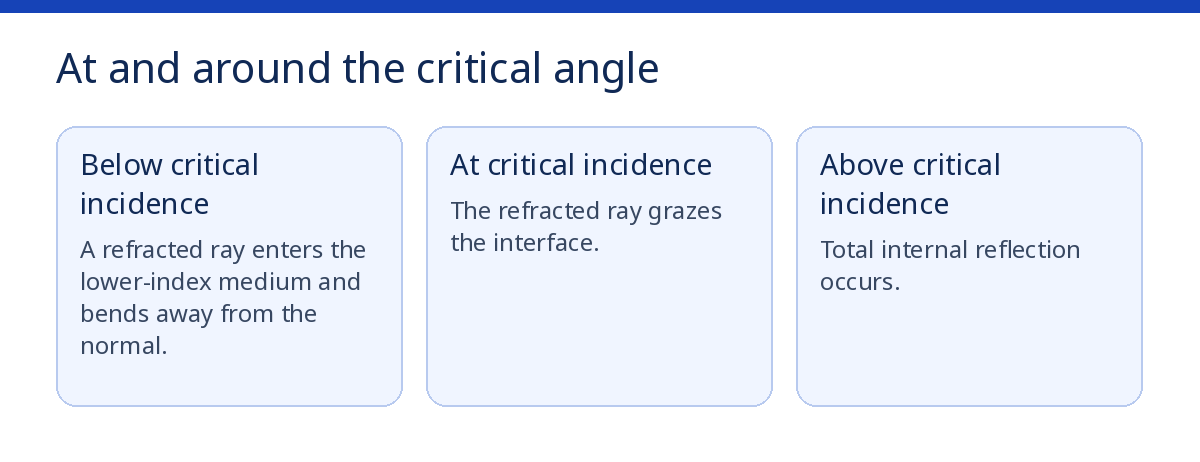
At an interface from higher to lower refractive index, grazing refraction occurs at the critical angle; total internal reflection requires incidence above it. In the prism material, keep grazing emergence distinct from minimum deviation. Grazing describes the outgoing ray along a face, whereas minimum deviation describes a symmetric path through the prism. For the reflecting telescope, distinguish the primary mirror’s formation of a real intermediate image from the eyepiece’s role in magnifying it.
Review the first step that changed your answer
When checking an attempt, read the concept and formula labels before reading the full steps. If your approach differs, identify where it first diverged: the model you chose, a condition you missed, a sign or unit, or a feature you misread in a diagram. Then retry from that point without the explanation. Review the other branch of an internal choice separately so that you practise its reasoning without using it to revise your timed attempt.
Spotted an error? Report a correction. Practise this in the app: notes, formula sheets and mind maps.













































































































































































Loading comments…