CBSE Class 12 Physics 2022 Supplementary Paper Guide
CBSEPhysics2022 Previous Year Paper
Paper code: 55/6/2 · 2022Use this full, year-wise CBSE Class 12 Physics supplementary paper to practise the 2022 exam format, then use the worked solutions to review your diagrams, reasoning and calculations.
This set is one of the year's papers. See every set from 2022, grouped by series.
How the 2022 supplementary paper is organised
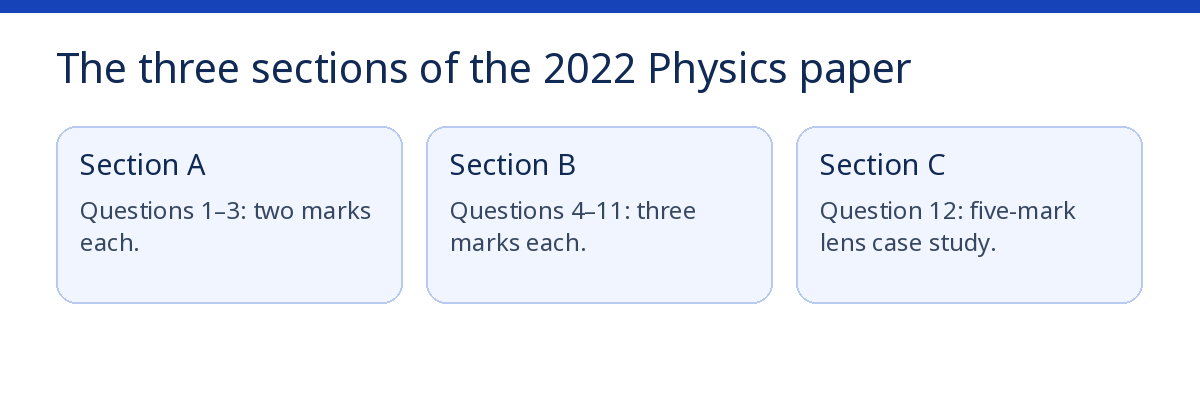
This English-language paper is labelled Supplementary / Compartment and carries the code 55/6/2. The writing time is two hours and the maximum is 35 marks. Section A has three questions worth two marks each; Section B has eight worth three marks each; and Section C has one five-mark case study on lenses. The file pairs the full question paper with step-by-step explanations, including the printed internal alternatives.
All 12 questions are compulsory, but where an internal choice appears, attempt only one alternative in a timed sitting. There is no overall choice. The printed instructions allow log tables if needed but prohibit calculators. Keep those conditions when you use this particular paper as a mock.

Physics Supplementary 2022 | Class 12 | Previous Year Paper | Code 55/6/2
In the StudentCurio app
A CBSE Class 12 Physics supplementary examination paper for 2022 with worked solutions. It includes questions across topics such as wave optics, ray optics, electronic devices, electromagnetic waves, atomic physics and nuclear physics.
Wave optics: distinguish the patterns before calculating
The wave-optics questions move from the conditions for coherence to double-slit fringe positions, single-slit diffraction and the use of a wavefront construction in refraction. To read the patterns correctly, first identify which geometry produces them. In ideal double-slit interference, the fringes are equally spaced; in single-slit diffraction, the broad central bright region and the weaker side peaks are features of a different intensity pattern.
Common mix-up: a spacing is not a position. The usual double-slit fringe-spacing expression, , assumes small observation angles; here is the screen distance and is the slit separation. A position measured from the centre also depends on whether you are locating a bright or dark fringe and how you count its order. In the wavefront alternative, distinguish the normal to the wavefront, which gives the ray direction, from the normal to the interface, from which the refraction angles are measured.
Ray optics: give each diagram a job
Section B offers a choice between a compound microscope and refraction at a spherical surface. In the microscope diagram, separate the objective’s intermediate image from the final image viewed through the eyepiece. The question specifies the least distance of distinct vision, so do not substitute the arrangement for a final image at infinity. For the spherical surface, label the two media, the pole and the centre of curvature before assigning signs to the distances. The standard relation assumes paraxial rays, for which the small-angle approximation is valid.
The lens case study changes the emphasis from derivation to interpreting what changes in a setup. It brings together lens power, the surrounding medium, colour and a pair of separated lenses. Unit check for lens power: use the signed focal length in metres when calculating power in dioptres. Before comparing powers across media, check the lens index relative to the medium rather than treating the glass index alone as decisive.
Semiconductors and electromagnetic waves: explain the mechanism
The electronic-devices questions approach semiconductors from three directions: carrier populations in doped material, the formation of a junction barrier, and the diode’s current–voltage characteristic. Keep bulk electrical neutrality separate from the local charge distribution near a junction. Similarly, a description of the barrier is not a complete explanation of the current curve: distinguish ordinary reverse bias from breakdown, where the behaviour changes sharply. When reviewing your graph, check that the regions discussed in your written explanation are identifiable on the sketch.
The electromagnetic-wave alternatives test different skills. One concerns radio propagation and the practical context of electrical demonstrations; the other uses a field diagram and the electromagnetic spectrum. In a field sketch, label the propagation direction separately from the directions of the electric and magnetic fields.
Modern physics: identify what each model compares
The modern-physics portion includes scattering, hydrogen energy levels and spectra, matter waves, photoemission, and nuclear mass and density. These questions share a useful distinction: the quantities being compared are not interchangeable. In an atomic spectrum, a photon’s energy corresponds to the difference between two levels, not to the energy of either level alone. For a matter wave, the relevant quantity is particle momentum; in photoemission, incident photon energy is compared with the metal’s threshold.
Quick self-check: Can you explain why an atomic level energy, a photon energy and a nuclear reaction energy need different starting quantities even though all three can be expressed in electronvolts? For nuclear questions, distinguish a comparison of total masses before and after a reaction from a comparison of mass per unit nuclear volume.
Use the worked solutions as a second pass
Work from the question pages first. Then use the solution pages’ formula, concept and explanation labels to locate the first point where your reasoning diverged. For a derivation, check the diagram and approximation before comparing the algebra. For a numerical response, check the units and sign convention before comparing the result. Review the unused internal alternative afterwards so that the timed sitting and the topic review serve different purposes.
For details that are unclear in the extracted text, consult the original question pages. This guide omits the double-slit numerical setup because its opening line is incomplete in the extract, and leaves out the spherical-refraction worked algebra because the signed and unsigned distance notation is inconsistent. It also does not use the lens-solution header’s wording about separation or repeat the radio-wave demonstration prompt’s absolute claim.
Spotted an error? Report a correction. Practise this in the app: notes, formula sheets and mind maps.













































































































































































Loading comments…