Case-based Analysis of Electromagnetic Waves for CBSE Physics
CBSEPhysicsElectromagnetic Waves
Explore 12 detailed case studies and 55 practice questions covering the electromagnetic spectrum, wave field equations, and environmental radiation dynamics designed for Class 12 CBSE Physics preparation.
Understanding the Source and its Curriculum Alignment
This StudentCurio resource is a specialized assessment tool for Class 12 learners, focusing exclusively on Chapter 8 of the CBSE Physics syllabus: Electromagnetic Waves. It deviates from traditional textbook structures by presenting all content through 12 thematic case studies. These include 55 questions that range from conceptual multiple-choice items to complex field-equation derivations. The material is designed to bridge the gap between theoretical Maxwellian predictions and practical technological applications, such as microwave ovens, mobile communication, and satellite navigation. Because this document focuses on case-based learning, it serves as a rigorous testing ground for students who have already reviewed basic definitions and are ready to apply their knowledge to specific scenarios. The guide includes a clickable index and two-way navigation between questions and their corresponding step-by-step solutions to facilitate self-paced evaluation.

Electromagnetic Waves | Class 12 Physics| CBSE Case-based Assessment
In the StudentCurio app
This document provides 12 detailed case studies and 55 practice questions with step-by-step solutions for Class 12 Physics, covering the electromagnetic spectrum, wave characteristics, and real-world applications.
The Electromagnetic Spectrum and Wave Relations
The material covers the full breadth of the electromagnetic spectrum, from radio waves to gamma rays. Central to this study is the fundamental relationship between frequency and wavelength in a vacuum, defined by the speed of light . Students are required to distinguish between different bands based on their production methods and interaction with matter. For instance, the resource highlights that while all electromagnetic waves travel at in a vacuum, their effects vary significantly: radio waves result from accelerated charges in wires, while infrared radiation stems from molecular vibrations in hot bodies. The guide emphasizes the importance of the school-level ordering of the spectrum, prompting learners to identify which waves possess the longest wavelengths (radio waves) versus the highest photon energy and shortest wavelengths (gamma rays).
Mechanics of Microwave Heating and Dielectric Absorption
A significant portion of the assessment investigates the physics of microwave ovens. It clarifies that heating is not necessarily a result of a 'sharp molecular resonance' at a single frequency but involves dielectric absorption over a broad range. Domestic ovens typically operate near . At this frequency, the alternating electric field of the microwave drives polar water molecules in food, converting electromagnetic energy into internal thermal motion. The material provides critical safety and material science distinctions, explaining why microwave-safe containers like low-loss ceramics are used while ordinary metals are avoided due to their tendency to reflect waves and cause arcing at sharp edges. This section demonstrates how energy is delivered directly to the water-containing constituents of food, contrasting with conventional heating where a vessel is heated first.
Field Equations and Propagation Dynamics
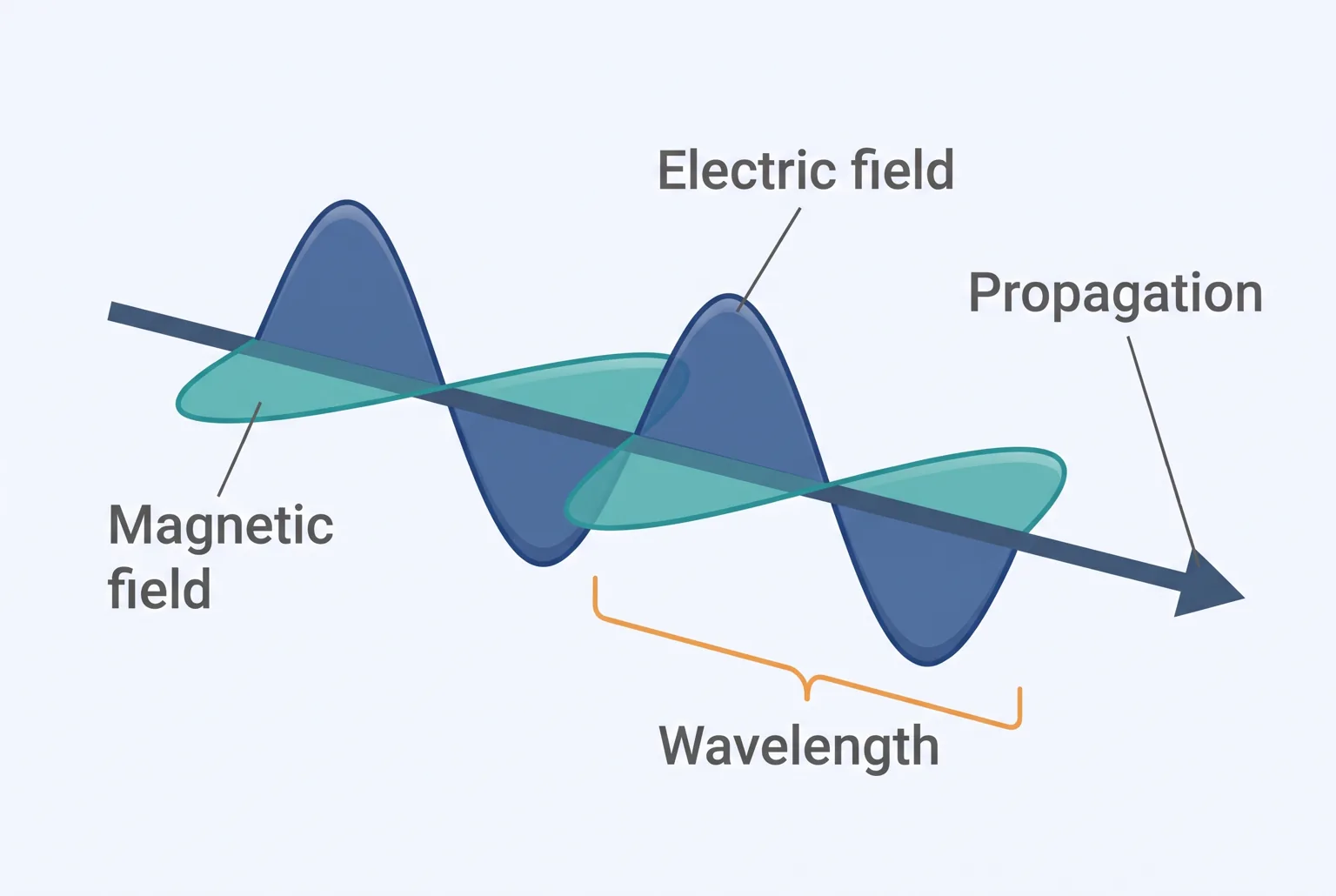
The resource provides detailed scenarios involving the mathematical description of plane progressive waves. Learners must apply the principle that in a vacuum, the electric field , the magnetic field , and the direction of propagation are mutually perpendicular. The direction of energy transport is defined by the vector cross product . The assessment requires students to derive or identify field equations, such as determining the electric field vector when the magnetic field is given as . It further explores the equality of energy densities, where the electric energy density and the magnetic energy density contribute equally to the wave's total energy. These calculations are essential for understanding how oscillating charges support the coupled evolution of fields through space.
Atmospheric Physics and Environmental Radiation
Case studies within the document examine the Earth’s atmosphere as a medium for electromagnetic interaction. Specific attention is given to the stratosphere, which houses the ozone layer. This layer is biologically vital as it absorbs harmful ultraviolet radiation from the Sun. The resource also delves into the greenhouse effect, explaining how Earth's outgoing thermal radiation—which is predominantly in the infrared spectrum—is trapped by atmospheric gases, maintaining the planet's temperature. By connecting these concepts to the ionosphere and layers like the Kennelly-Heaviside (E region) and Appleton (F region), the material provides a comprehensive look at how different frequencies of the electromagnetic spectrum interact with the various strata of the Earth's environment to enable communication and sustain life.
Momentum, Radiation Pressure, and Energy Transfer
Electromagnetic waves do not just transport energy; they also carry linear momentum. The assessment introduces learners to the Nichols and Hull experiment of 1903, which provided experimental proof of radiation pressure. Students must learn to calculate momentum transfer () based on surface properties. For a perfectly absorbing surface at normal incidence, the momentum delivered is , where is the energy transferred. However, for a perfectly reflecting surface, this momentum transfer doubles to . This section of the resource is highly numerical, challenging students to calculate radiation pressure using the intensity of the incident wave ( for absorption). These concepts are vital for understanding the mechanical effects of light on matter, particularly when dealing with isotropic point sources and peak field magnitudes.
Common Mistakes to Avoid
- Confusing EM Waves with Particle Radiation: Do not categorize cathode rays (electrons), beta rays (electrons/positrons), or primary cosmic rays (charged particles) as electromagnetic waves. Only photons constitute EM radiation.
- Wavelength vs. Frequency Shifts: When a wave passes from a vacuum into a dielectric medium, the frequency remains constant while the speed and wavelength change based on the relative permittivity and permeability .
- Transverse vs. Longitudinal: Never assume electromagnetic waves can be longitudinal. Their transverse nature is fundamentally established by the phenomenon of polarisation.
- Antenna Scale Assumptions: While efficient antennas are often comparable in size to the wavelength (like half-wave dipoles), there is no universal rule that they must be exactly one whole wavelength long.
- Phase Relationships: In a linearly polarised plane wave in a vacuum, the electric and magnetic fields are in phase and perpendicular, not out of phase.
Quick Self-Check
- Can you determine the propagation direction if the electric field oscillates along the -axis and the magnetic field along the -axis?
- What happens to the wavelength of a wave when it enters a nonmagnetic medium with a relative permittivity of ?
- Why is the greenhouse effect associated with infrared radiation rather than ultraviolet radiation?
- How does the momentum transfer to a surface change if it is modified from a black, absorbing surface to a highly reflective mirror?
- Which fundamental constant links the permittivity of free space and permeability to the speed of light ?
Frequently asked questions
What is the typical frequency used in domestic microwave ovens according to this resource?
Domestic microwave ovens commonly operate at a frequency of approximately .
Which atmospheric layer contains the highest concentration of ozone?
The main ozone layer is located within the stratosphere.
How does the resource define the relationship between the speeds of different EM waves in a vacuum?
In a vacuum, all electromagnetic waves—including gamma rays, X-rays, and microwaves—travel at the same speed ().
What experiment confirmed the existence of radiation pressure?
The 1903 experiment by Nichols and Hull demonstrated the mechanical momentum of radiation and measured radiation pressure.
What is the mathematical relationship for the speed of light in a vacuum using permittivity and permeability?
The speed of light in free space is given by .
Spotted an error? Report a correction. Practise this in the app: notes, formula sheets and mind maps.













































































































































































Loading comments…