Electric Charges and Fields: Class 12 CBSE Practice Guide
CBSEPhysicsElectric Charges and Fields
Electric Charges and Fields is Chapter 1 of Class 12 CBSE Physics, and this assessment's first topic set tests the basic properties of charge in depth. This guide explains quantisation, additivity, conservation and invariance, charging by rubbing, contact and earthing, conductors versus insulators, and how the 250-question practice is organised.
Quantisation: checking whether a charge is possible
Every charge on a body is a whole-number multiple of the elementary charge: , where C and is an integer. Many 1-mark and case-based items turn this into a test. Divide the stated charge by . A whole number means the value is allowed. A fraction such as means no body can carry exactly that charge, so a reported measurement must contain an error.
The same relation counts electrons. A body that gains electrons becomes negative (), and a body that loses them becomes positive.
We do not notice quantisation in daily life because everyday charges, of the order of microcoulombs or nanocoulombs, contain billions of elementary charges. A step of one is far too small to detect, so charge appears continuous.
Transferred electrons also carry mass, with kg. Decide whether a body's mass rises or falls from which body receives the electrons.

Electric Charges and Fields | Class 12 | CBSE Assessment
In the StudentCurio app
Class 12 Electric Charges and Fields CBSE assessment: 250 original MCQ, case-based and long-answer questions by NCERT topic with step-by-step solutions. Covers electric charge and its properties, Coulomb's law, electric field and field lines, electric dipoles, electric flux and Gauss's law with its applications, with questions ordered from 1-mark MCQs to 5-mark long answers.
Additivity, conservation and invariance are separate properties
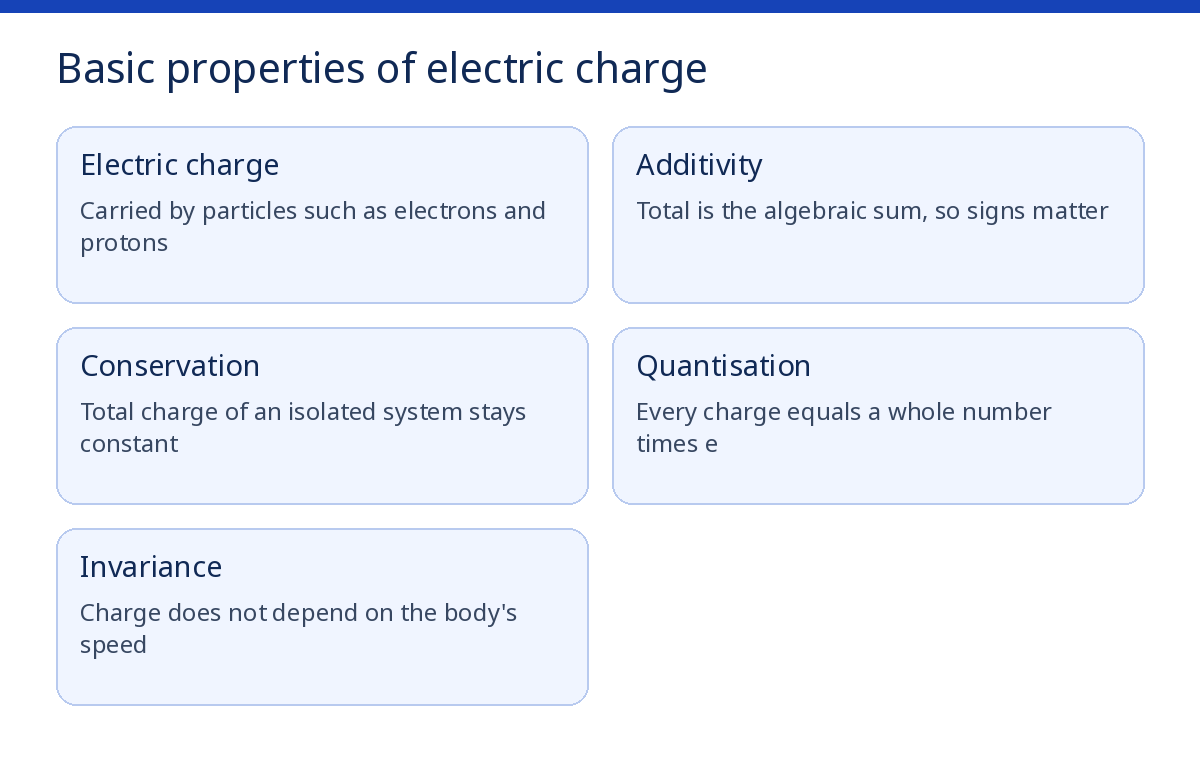
Additivity means the total charge of a system is the algebraic sum of its charges, so signs must be kept. This marks a real difference from mass. Mass is always positive, but charges can cancel: and add to zero.
Conservation means the total charge of an isolated system stays constant. Rubbing only transfers electrons, so whatever one body gains the other loses. Even when particles are created or destroyed, positive and negative charge appear or disappear in equal amounts. For example, an electron is created together with a positron.
Invariance means a body's charge has the same value whatever its speed, or the frame it is observed from. Do not confuse it with quantisation. Assertion–reason items in this set use four fixed options, and they reward knowing exactly which property a statement describes.
Charging by rubbing: electrons move, protons stay
Protons are locked inside nuclei and do not move during rubbing. Only electrons transfer. A glass rod rubbed with silk becomes positive because it loses electrons, and the silk becomes equally negative.
One case-based question supplies a ranked list of materials. A material higher in the list becomes positive when rubbed with any material lower in it. Read the sign from the positions, then use for magnitudes. The partner body always carries an equal and opposite charge.
Application questions link charge build-up to safety. A charged comb picks up paper more strongly on a dry day than on a humid one. The source also uses fuel tankers dragging metal chains, slightly conducting aircraft tyres, and a spark from a door handle after walking on a nylon carpet. In each case, charge builds up through friction and needs a conducting path to escape safely.
Sharing charge on contact and connecting to earth
When identical metal spheres touch, the total charge is conserved and shared equally. In a chain of contacts, recompute each step using the charges the spheres hold at that moment, not their starting values.
To count the electrons that moved, divide the change in one sphere's charge by . A sphere whose charge becomes more positive has lost electrons.
The earth is a huge conductor that can supply or take up charge. When a charged conductor is earthed, electrons flow to or from it until it becomes neutral. Your body is also a conductor linked to the earth. This is why a metal rod held directly in the hand is hard to charge by rubbing, and why touching an insulated charged sphere discharges it.
Conductors, insulators and why neutral objects are attracted
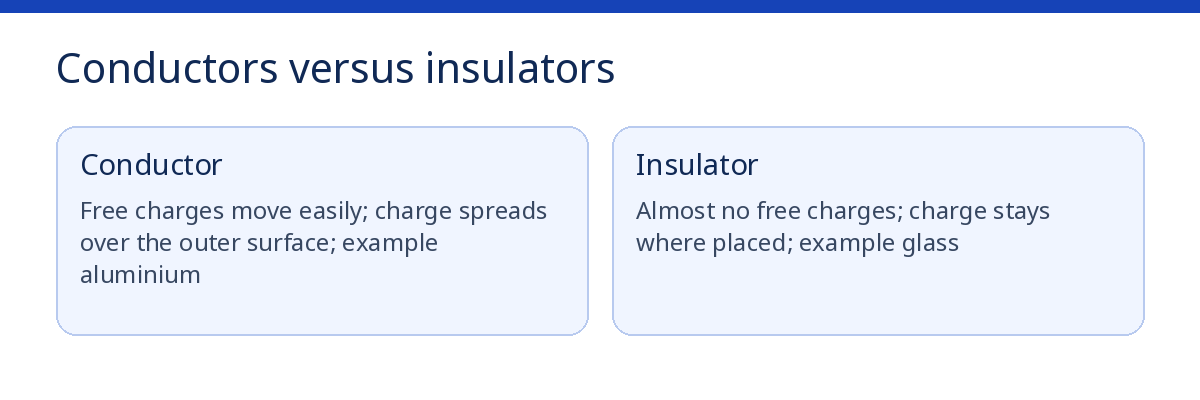
Conductors contain free charges, such as electrons, that move easily. Charge given to a conductor spreads over its outer surface. Insulators have almost no free charges, so charge stays where it is placed. The source names aluminium and glass as examples of each.
A charged body can attract a neutral one through polarisation. The charge pulls on the electron clouds of the neutral body's molecules. The near side gains charge opposite to the charged body, and the far side gains like charge. The nearer, opposite charge is attracted more strongly than the farther charge is repelled, so the net force is an attraction.
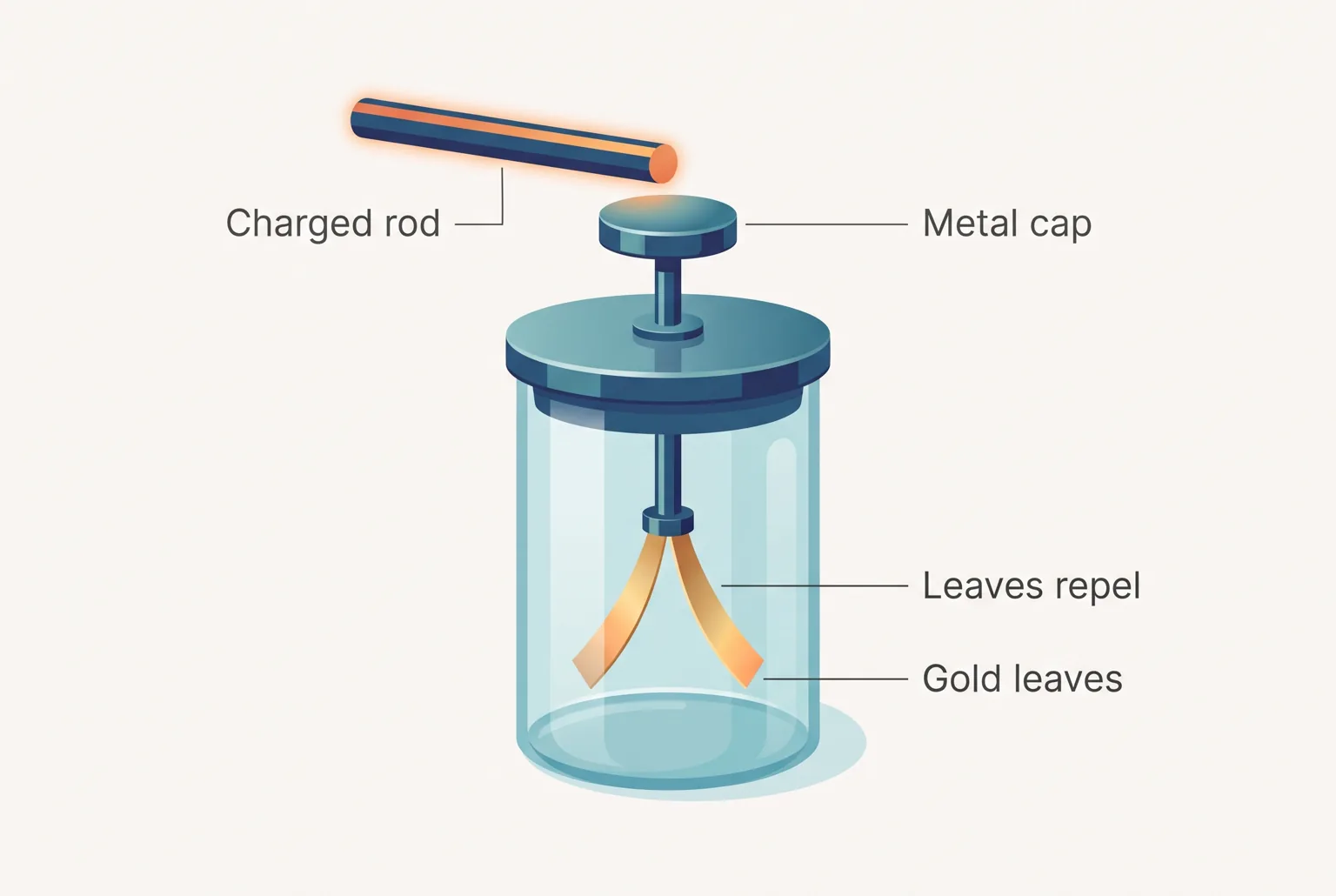
One short-answer question asks why a thin water stream bends towards a charged balloon. A strong answer builds this argument step by step. Questions on the gold-leaf electroscope rely on the fact that like charges repel.
Common mistakes in charge-transfer answers
- Moving protons. In rubbing and earthing, only electrons transfer.
- Dropping signs. Additivity is algebraic. Adding magnitudes gives a wrong total.
- Sharing unequally. Equal sharing on contact applies only to identical spheres.
- Using starting charges in later contacts. Each contact begins from the charges left by the previous one.
- Mixing up properties. "Always a multiple of " describes quantisation, not invariance.
- Calling a tiny mass change zero. A change of is unmeasurably small but not zero.
From 1-mark MCQs to 5-mark long answers: the five practice sets
The assessment holds 250 questions with worked solutions, split across five sets:
- Electric Charges: 40 questions
- Coulomb's Law and Electrostatic Field: 60 questions
- Electric Dipole: 45 questions
- Electric Flux: 55 questions
- a mixed Chapter Practice: 50 questions
Each set climbs from MCQs (1 mark), including assertion–reason items, through Very Short Answer (2 marks), Short Answer (3 marks) and Case-Based (4 marks), to Long Answer (5 marks). Question numbering restarts in each set.
The cover introduces the field idea that follows the charge topics. For an isolated point charge, , where is the distance from the charge, and the field of a positive charge points radially outward.
Work the topic sets in order before the mixed Chapter Practice. Attempt a whole subsection before opening its step-numbered solutions, then compare your reasoning step by step.
Quick self-check before the Coulomb's law set
- Can you explain why one property lets you reject a measured charge, while another lets you total several charges?
- Can you say why rubbing two neutral bodies cannot change their combined charge?
- Could you describe, in two steps, why a neutral object is pulled towards a charged one whatever the sign of the charge?
- When a charged conductor is earthed, which particles move, and which way?
Frequently asked questions
Which topics does this Electric Charges and Fields assessment cover?
It has four topic sets: electric charges, Coulomb's law and electrostatic field, electric dipole, and electric flux. A mixed Chapter Practice set follows them.
What question formats are included?
Each set includes MCQs (1 mark) with assertion–reason items, Very Short Answer (2 marks), Short Answer (3 marks), Case-Based (4 marks) and Long Answer (5 marks) questions, followed by worked solutions.
Spotted an error? Report a correction. Practise this in the app: notes, formula sheets and mind maps.













































































































































































Loading comments…