2023 CBSE Class 12 Physics Supplementary Paper with Solutions
CBSEPhysics2023 Previous Year Paper
Paper code: 55/C/3 · 2023Practise the full 2023 CBSE Class 12 Physics supplementary paper under its original three-hour limit, then use the worked explanations to check whether you chose the right principle, applied it under the right conditions and justified your answer.
This set is one of the year's papers. See every set from 2023, grouped by series.
What this year-wise paper contains
This file contains the complete English version of the 2023 CBSE Class 12 Physics supplementary examination, labelled Supplementary / Compartment and identified by paper code 55/C/3. It retains the questions, options and diagrams. The cover provides question-number links to the worked solutions, which are organised around the formula, the concept and the steps used. The explanations also cover the printed internal choices.
The paper brings together electricity, magnetism, electromagnetic induction, alternating current, optics, modern physics and semiconductors. Its value as a year-wise resource is that it tests these topics together: the section tells you what kind of response is expected, but you still have to recognise which part of Physics applies. A graph, circuit or ray diagram can be as important to that decision as the wording.

Physics Supplementary | Class 12 | Previous Year Paper | 2023 | Code 55/C/3
In the StudentCurio app
A complete 2023 CBSE Class 12 Physics supplementary examination paper with worked solutions, covering topics across the syllabus, including electricity, magnetism, optics, modern physics and semiconductors. Includes a step-by-step solution to a prism-refraction question, helping students practise the board-paper format and review solution methods.
How the 70 marks are distributed
The paper has 35 questions across five sections. Section A has 18 one-mark multiple-choice questions, including assertion–reason items. Section B has seven two-mark very short answers, Section C has five three-mark short answers and Section D has three five-mark long answers. Section E has two four-mark case-based questions.
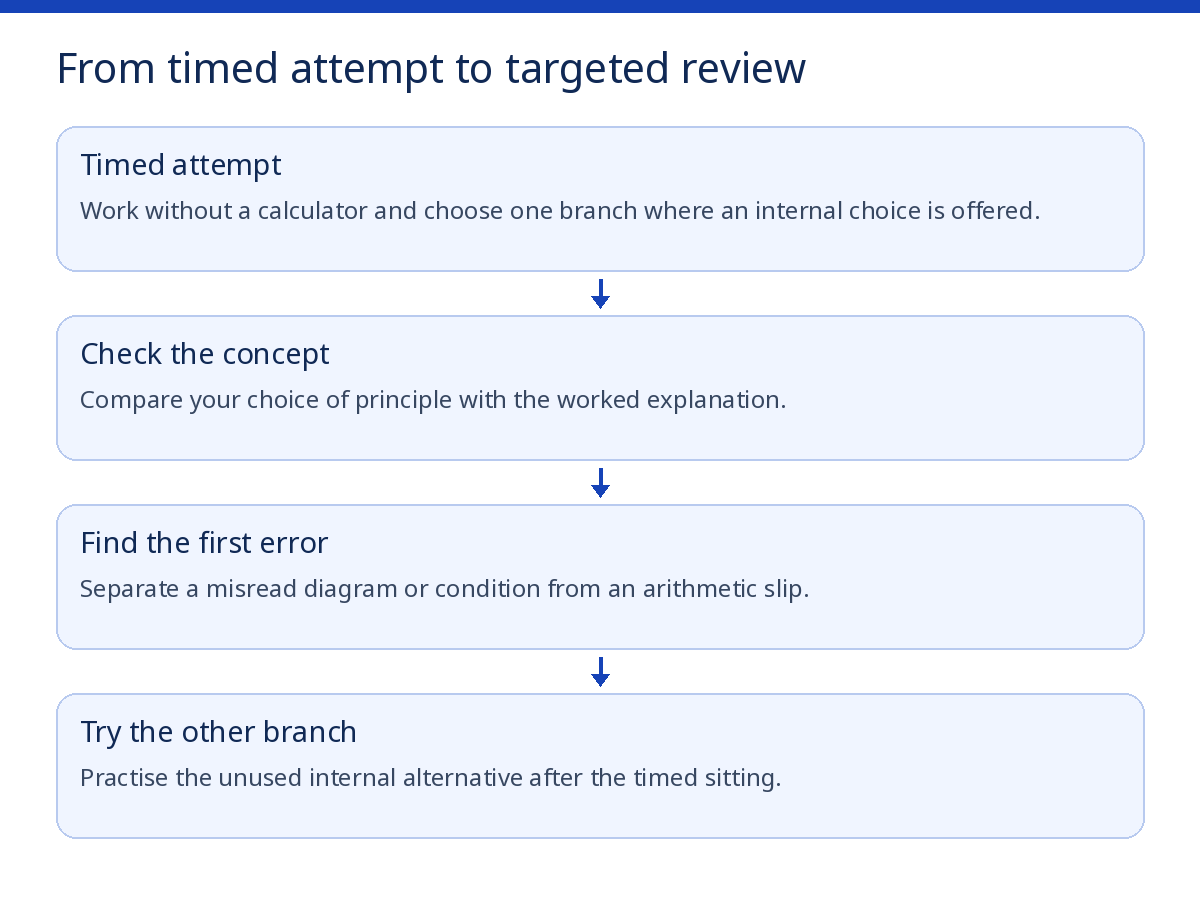
There is no overall choice: all numbered questions are compulsory, but some contain an internal alternative. In a timed attempt, treat an OR as a choice within the question, not as permission to skip the question. Save the unused alternative for a separate practice round. Calculators are not allowed, so work with the constants supplied on the paper when needed and keep unit conversions visible in your working.
Electricity and magnetism: let the setup choose the rule
The electrical questions range from flux and potential difference to resistor power, galvanometer conversion, battery internal resistance and circuit analysis. For flux through a flat surface in a uniform field, read the angle relative to the surface normal, not the plane itself. For resistor power, first establish whether the components share the same current or the same potential difference. The choice between and is useful only when you know which quantity is common to the resistors you are comparing.
The magnetism and induction questions ask you to interpret field patterns, read graphs and distinguish induced emf from induced current. A changing magnetic flux can induce an emf without driving a current through an open circuit. In a diagram-based question, identify the path available to the current before deciding what follows from the induced emf.
Common mistakes: keep optical models and quantities separate
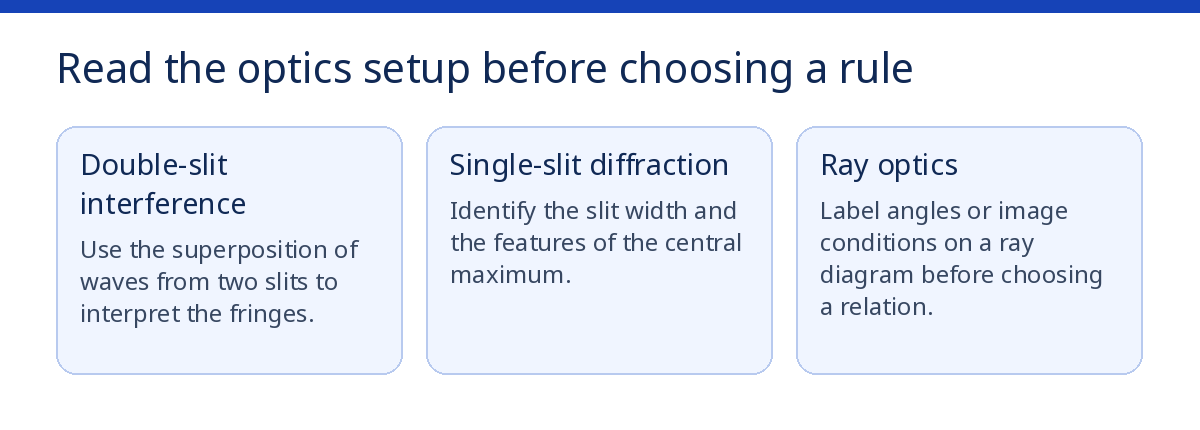
The optics questions move between wave optics and ray optics. In Young’s double-slit experiment, the pattern comes from the superposition of waves from two slits; in single-slit diffraction, the slit width is central to the pattern. Do not carry a spacing rule from one setup into the other just because both questions describe bright and dark features on a screen.
The mirror and compound-microscope questions place a different demand on the diagram: it should represent the stated object or image condition before you use an equation. For the microscope, distinguish a final image at the least distance of distinct vision from a final image at infinity. Those conditions are not interchangeable when choosing a magnification expression. In the prism case, keep the prism angle, angle of incidence and angle of deviation distinct when labelling your sketch.
Modern physics and semiconductors: track what changes
The photoelectric questions make you separate whether emission is possible from what changes once emission occurs. The first decision depends on photon energy relative to the metal’s work function. When frequency is held fixed above threshold, intensity changes the supply of incident photons, not the energy of each photon. Keep that distinction in mind before connecting the light conditions to a current or an electron energy.
The paper also moves between matter waves, atomic transitions, nuclear properties and semiconductor devices. These topics use different representations: a graph for a matter-wave relationship, energy levels for atomic transitions and energy bands for classifying solids. For the diode characteristic, check what each axis measures. Identifying the onset of appreciable forward conduction and interpreting a change in voltage over a stated current interval are different tasks.
Before calculating: mark the condition in each case study
The capacitor and prism cases both reward careful reading before calculation. In the capacitor case, underline whether the battery remains connected or has been disconnected before a dielectric is introduced. That detail determines whether the source maintains the voltage or the isolated capacitor retains its charge. In the prism case, distinguish the general passage of light through two refracting faces from the special condition of minimum deviation. Keep any small-angle approximation separate from the general treatment.
Use the original paper pages for numerical values, symbols and diagrams. This guide leaves out the extracted constants and the numerical prism alternative rather than relying on text in which some signs, units or symbols are unclear.
Use the worked steps to locate your first error
Attempt the paper before opening the explanations. When you review, begin with the concept used, not the answer line. If your result differs, locate the first point where your reasoning diverged: interpreting the diagram, selecting the relationship, identifying the condition or carrying out the calculation. Fixing that first step is more useful than copying the final expression.
For an assertion–reason item, record three judgments separately: whether the assertion is true, whether the reason is true and whether the reason actually explains the assertion. For a longer response, check that the diagram, derivation or justification requested is present in your own work. Then try the unused internal alternative to see whether you can recognise the relevant principle in a different setup.
Spotted an error? Report a correction. Practise this in the app: notes, formula sheets and mind maps.













































































































































































Loading comments…