Electrostatic Potential and Capacitance: CBSE Class 12 PYQs
CBSEPhysicsCapacitance
This guide covers the capacitor questions from Electrostatic Potential and Capacitance in a CBSE Class 12 previous year collection. It explains capacitance as a property of geometry and medium, dielectric polarisation, combinations, charge sharing, stored energy and RC charging, and suggests a practice order.
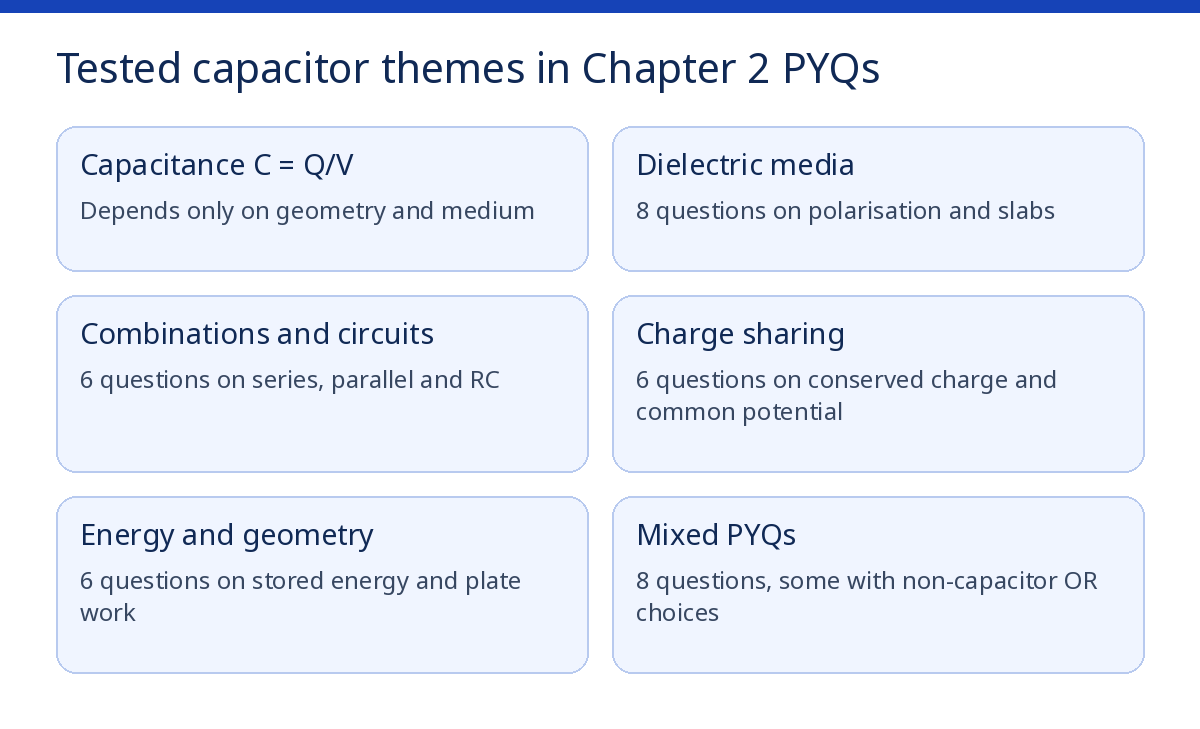
Five tested themes across the capacitor questions
The 51-page PDF collects 34 previous year questions on capacitors from Chapter 2. The cover lists exam years 2021 and 2023–2026. A topic index sorts the questions into five groups:
- Capacitance and dielectric media (8 questions)
- Capacitor combinations and circuits (6)
- Charge sharing and redistribution (6)
- Energy, force and changing geometry (6)
- Mixed capacitor PYQs (8)
The questions are split into Subjective and MCQ (Single Correct Answer). Several are case-based: a passage on combinations, dielectrics or RC circuits, followed by four sub-parts, with an internal choice marked OR in the last one. Others ask for a derivation or say "How will the following be affected? Justify your answer in each case."

Capacitance | Class 12 | Previous Year Paper
In the StudentCurio app
This 51-page PDF provides solved previous year questions for Class 12 Physics on Capacitance, including parallel-plate capacitors, dielectrics, and energy storage to help students prepare for CBSE exams.
Capacitance depends on geometry and medium, not on charge
One case-study passage gives the definition the whole chapter builds on. A capacitor is two conductors with charges and and a potential difference between them, and . This ratio is independent of or . It depends only on the shape, size and separation of the conductors and on the medium between them.
This is why so many questions change the plate gap or insert a slab. These changes alter directly. Charge, voltage, field and energy then follow from whichever quantity is held fixed.
Another passage explains why capacitors are combined. Standard capacitors come with fixed capacitances and working voltages. In series, the total capacitance falls but the voltage rating rises. In parallel, the capacitance rises and the voltage rating stays the same. One question uses this trade-off: identical capacitors whose dielectric withstands only a limited voltage must be arranged to work with a much larger supply.
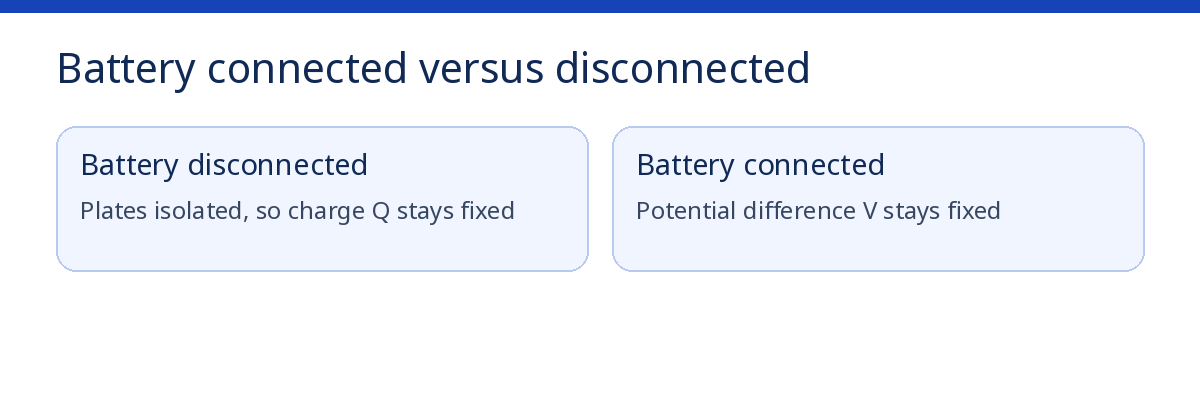
Deciding whether charge or voltage stays constant
Many dielectric and changing-geometry questions share one first step: decide what cannot change.
- If the battery is disconnected, the plates are isolated, so the charge is fixed.
- If the battery stays connected, the potential difference is fixed.
A typical stem charges a capacitor, disconnects the battery, then withdraws a dielectric slab or doubles the plate gap. It asks how capacitance, field, potential difference and energy change. The expected working is:
- State the constant quantity.
- Find the new from the change in geometry or medium.
- Obtain from .
- Find the field and the energy , or an equivalent form.
Each part says "justify", so give a reason at every step, not just a direction of change.
Common mistake: using with the old after the battery is removed. Once changes, changes too.
How a dielectric reduces the field it fills
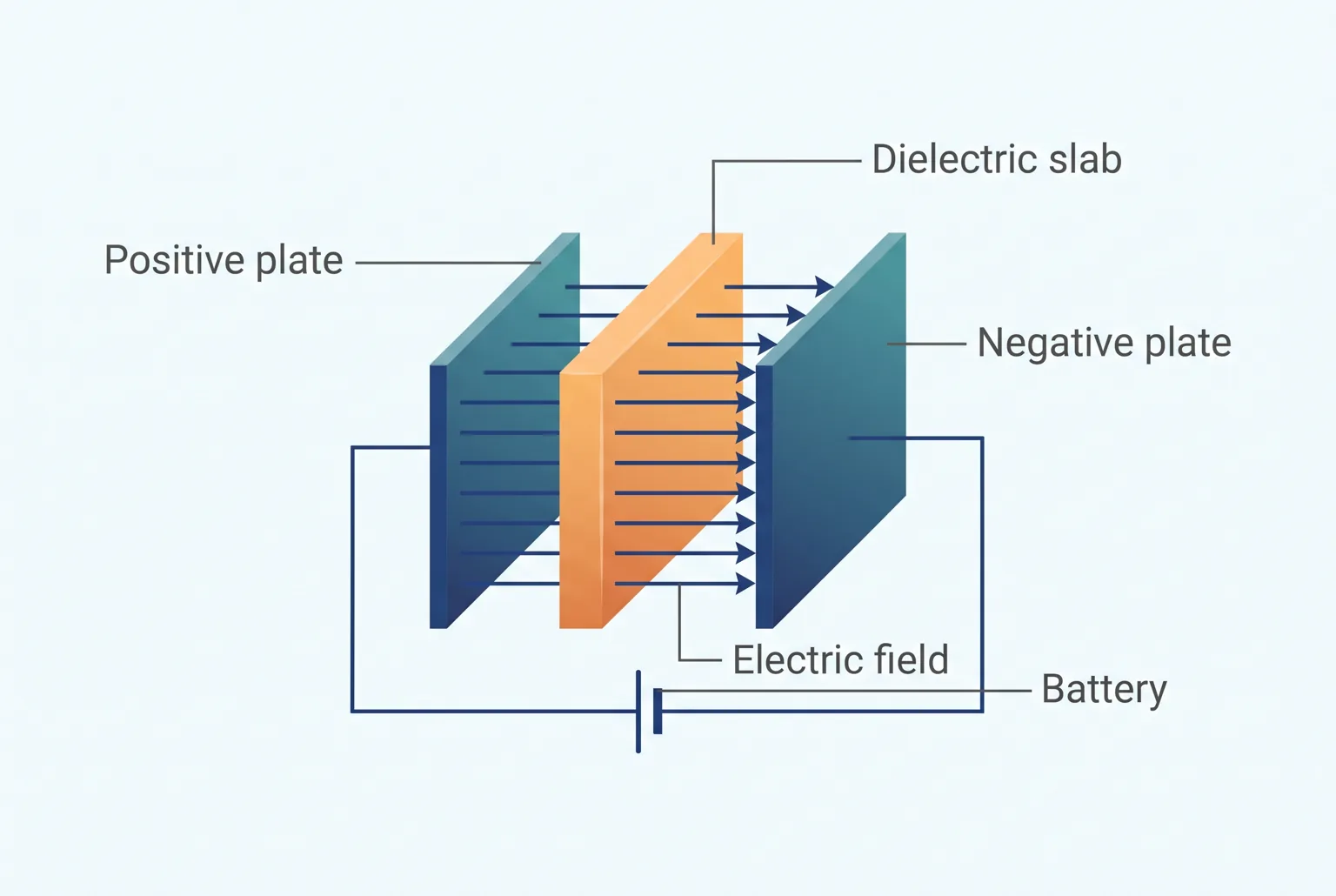
The dielectric passages describe the mechanism. In the field between charged plates (charge density ), the dielectric becomes polarised. Opposite charges of surface density appear on the slab faces next to the plates. For a linear dielectric, is proportional to the original field . These induced charges change the field, and therefore the capacitance and the stored energy.
Molecules may be polar or non-polar. A polar molecule has a dipole moment even without an external field. Expect items that ask you to identify a polar molecule or to judge statements about induced dipoles.
Partially filled capacitors are common. The slab may have thickness , , or a general , and one question fills half the space in two different ways. Identify the layout first:
- A slab parallel to the plates that covers the full area behaves like stacked layers.
- A slab covering part of the area across the full gap behaves like regions side by side.
Charge sharing between a charged and an uncharged capacitor
In the redistribution group, a charged capacitor is joined to an uncharged one. One stem charges a capacitor to 150 V and connects it to an uncharged capacitor. It asks for the final potential difference across each capacitor and the charge on each.
Two principles apply:
- Total charge is conserved, because the pair is isolated.
- When charge stops flowing, both capacitors are at a common potential.
A related question first asks why a capacitor can store only a limited amount of charge. It then compares the total energy after sharing with the initial energy. Calculate both energies rather than assuming energy is conserved.
Stored energy, plate work and RC charging
In the energy-and-force group, the plates are pulled apart while the charge stays constant. You find the new potential difference, the new field and the work done, which is linked to the change in stored energy.
The RC case study gives the charging law , with . Charging ends when equals the battery emf, which gives . The charging current follows by differentiating with respect to time. Sub-parts also test the dimensions of and the charge left once the capacitor is switched across the resistor alone.
A 2025 question links capacitors to displacement current. You must show that conduction current plus displacement current is the same throughout a circuit with an AC-charged capacitor. You must also decide whether Kirchhoff's junction rule holds at each plate.
Quick self-check before attempting the collection
Answer these in words before writing any equations:
- Why does stay the same when doubles?
- After the battery is removed, which quantity governs every later change?
- Does a slab covering the full plate area but only part of the gap act more like a series or a parallel arrangement?
- In charge sharing, what is conserved, and what must you check rather than assume?
For practice, start with Capacitance and dielectric media. Then work through Combinations and circuits, Charge sharing and Energy, force and changing geometry, and finish with the Mixed set. Some of its OR alternatives cover drift velocity, electric dipoles and Gauss's law, so revise those separately.
Subjective solutions begin on page 22 and MCQ solutions on page 46. Source review notes are on page 51. Attempt each question first, then compare the constant you stated and your justifications with the worked solution.
Frequently asked questions
How many questions and which years does this collection include?
The cover lists 34 previous year questions with exam-year coverage of 2021 and 2023–2026, and states that worked solutions have been added.
Are all questions strictly about capacitors?
Mostly. Some internal-choice alternatives in the Mixed set cover drift velocity, electric dipoles and Gauss's law instead of capacitors.
Spotted an error? Report a correction. Practise this in the app: notes, formula sheets and mind maps.













































































































































































Loading comments…