CBSE Class 12 Physics: 2025 Supplementary Paper Guide
CBSEPhysics2025 Previous Year Paper
Paper code: 55/S/3 · 2025Use the complete 2025 CBSE Class 12 Physics supplementary paper (55/S/3) for a three-hour mock, then use the worked solutions to review your choice of method, diagrams and reasoning.
This set is one of the year's papers. See every set from 2025, grouped by series.
What the 70-mark paper asks you to do
This year-wise resource contains the full English version of the 2025 supplementary paper, also labelled Supplementary / Compartment. It retains the original questions, options and diagrams. The paper has 33 questions across five sections, and calculators are not allowed.
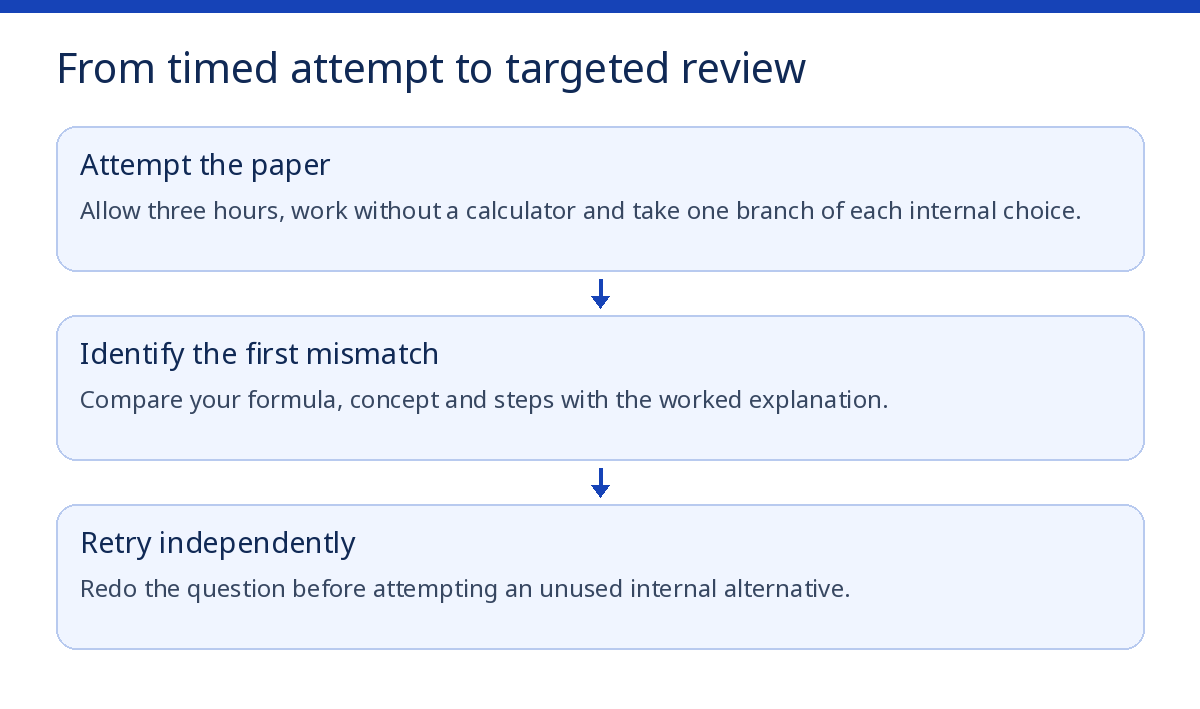
Section A has 16 one-mark multiple-choice questions, including assertion–reason items. Section B has five two-mark very short answers; Section C has seven three-mark short answers. Section D contains two four-mark case studies, and Section E has three five-mark long answers. All questions are compulsory, but some questions outside Section A offer an internal choice. For a timed attempt, answer only one branch of each printed choice. Save the other branch for a later practice session, when you can use it to test a different concept or method.

Physics Supplementary 2025 | Class 12 | Previous Year Paper | Code 55/S/3
In the StudentCurio app
A complete 2025 CBSE Class 12 Physics supplementary examination paper with worked solutions, covering questions across the syllabus. Helps students practise board-style questions and review solution methods.
Electrostatics and circuits: choose the model first
The electrostatics questions ask for different kinds of results: the magnitude and direction of a field, flux through a surface, and the effect of connecting two capacitors. First identify which quantity the question asks for. Electric field is a vector, so a magnitude alone does not describe it fully. Electric flux is a scalar, but the orientation of the surface still matters. Gauss’s law gives the net flux through a closed surface; applying it to find the flux through one face also requires a reason for how the total is shared.
The circuit questions include a resistor network supplied by a battery with internal resistance and a derivation for cells connected in parallel. Trace which terminals share a connection before simplifying the circuit. In capacitor questions, note whether the battery is still connected before deciding what the circuit constrains.
Magnetism and AC: separate direction, magnitude and phase
The magnetism questions move between the force on a moving charge, the torque on a current loop and electromagnetic induction. In the loop questions, mark the area vector normal to the plane. Flux uses a dot product between the magnetic field and area vectors, whereas torque uses a cross product between the magnetic moment and field. A diagram that shows only the plane of the loop leaves out a direction you may need.
The alternating-current questions include capacitive reactance, current in a series LCR circuit and the phase relationship for an ideal inductor. Keep peak and rms quantities distinct when moving between an AC source rating and an instantaneous expression. When reviewing a phasor diagram, check that it supports your statement about which quantity leads or lags, not just your calculation of impedance.
Optics: match the diagram to the question
The optics questions use ray diagrams, interference and wavefront reasoning. When a lens and mirror act in sequence, identify the image produced by the first element before deciding how it serves as the object for the next. Redraw the optical axis and label distances from the element you are applying a rule to; a distance measured from the lens is not automatically a distance from the mirror.
For the Young’s double-slit question, separate the effect of immersing the apparatus from the geometry of the apparatus itself. In the long-answer section, the prism option specifies minimum deviation for the requested relation. The alternative asks for refraction using Huygens’ principle, where a wavefront diagram supports the derivation. Practise the two diagrams separately rather than treating them as interchangeable sketches of refraction.
The two case studies: junctions and microscopes
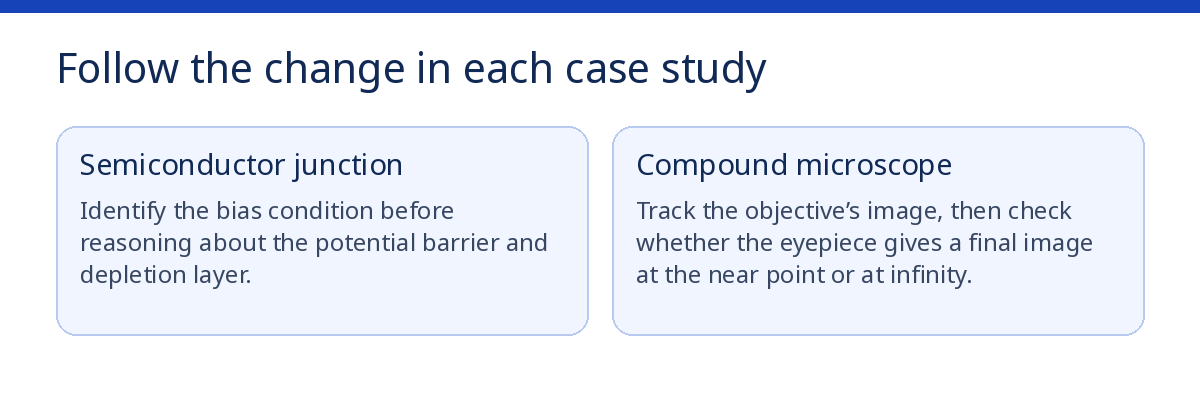
The semiconductor passage links band theory, doping and p–n junction behaviour. Read it in that order: distinguish the carriers in a pure semiconductor from the carrier distribution after doping, then track what happens at the junction. Before using a statement about the depletion layer or potential barrier, check whether the subpart describes an unbiased, forward-biased or reverse-biased junction. The paper also asks about the forward-bias characteristic elsewhere, so you can connect the junction model to a circuit diagram and a graph.
The compound microscope passage separates the roles of the objective and eyepiece. Follow the intermediate image from one lens to the other, and mark whether the final image is at the near point or at infinity. The passage explicitly distinguishes these viewing conditions because they affect the eyepiece’s contribution to magnification.
Quick self-check: identify the assumption
Before opening a solution, point to the words or diagram features that justify your method. In an assertion–reason item, judge each statement separately before deciding whether the reason explains the assertion; two true statements need not have that relationship. In a graph question, read the axis labels and units before interpreting the slope. A numerical slope is tied to the units of both plotted quantities.
For a derivation or diagram, ask whether your conditions are visible to someone reading your work. A sign convention, an interface normal or a labelled reference direction can show why a step is valid more clearly than a formula written on its own.
Use the worked solutions after a closed-paper attempt
Use the question-number links after the mock rather than during it. The explanations separate the formula used, the concept used and the steps, and the file states that it covers the printed internal alternatives. Compare your response at those same three levels. You might choose the right principle but misread a unit, or reach a numerical result without providing the requested sketch or justification.
For a second pass, redo one question from each category you struggled with before trying an unused internal alternative. Use the printed PDF when checking symbols and units: text extraction can misread prefixes, Greek letters and vector notation. This guide leaves aside the opening work question’s answer and the photoelectric graph’s worked answer; the latter depends on axis units not established in the excerpt.
Spotted an error? Report a correction. Practise this in the app: notes, formula sheets and mind maps.













































































































































































Loading comments…